XRP vs Bitcoin (BTC): Which Is Better in 2026?
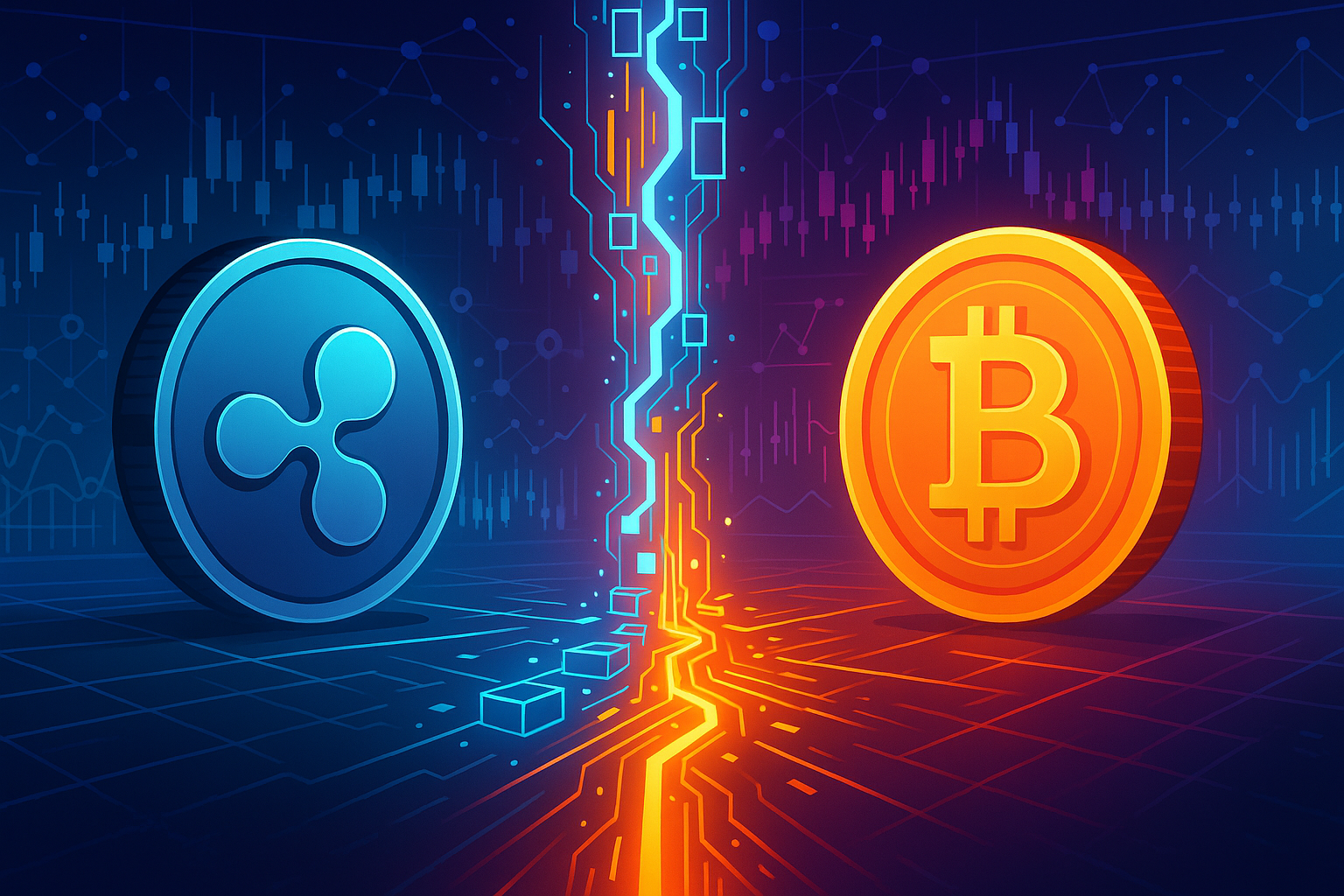
In 2026, the key difference in the XRP vs Bitcoin debate is purpose: Bitcoin is still the dominant store-of-value asset, while XRP is optimized for fast, low-cost cross-border payments. Bitcoin remains far larger by market cap and adoption, but XRP offers much faster and cheaper transactions. Many investors use BTC as a long-term hedge and treat XRP as a high-speed liquidity and payments play. If you want to rebalance between the two, you can swap XRP to BTC instantly and privately without giving up custody.
| Feature | XRP (XRP) | Bitcoin (BTC) (BTC) |
|---|---|---|
| Current Price (2026-03-05) | $1.43 | $72,482.00 |
| Market Cap | $87.32B (Rank #5) | $1,452.37B (Rank #1) |
| Purpose / Use Case | High-speed cross-border payments, liquidity bridge asset | Decentralized digital money and store of value |
| Consensus Mechanism | Ripple Protocol Consensus Algorithm (validator-based) | Proof of Work (Bitcoin mining) |
| Transaction Speed | ~3–5 seconds | ~10 minutes per block, longer for finality |
| Fees | Very low (fractions of a cent) | Variable, can be several dollars or more in congestion |
Quick Overview: XRP vs Bitcoin (BTC)
Bitcoin and XRP solve different problems inside the crypto ecosystem.
Bitcoin (BTC) is the original cryptocurrency. It is designed to be decentralized, censorship-resistant money with a hard-capped supply of 21 million BTC. Today it is widely treated as “digital gold” and a macro asset held by institutions, companies, and retail users.
XRP powers the XRP Ledger, which focuses on fast, low-cost global value transfers. It aims to act as a neutral bridge currency for banks, payment providers, and on/off-ramps moving money across borders. XRP transactions settle in a few seconds with minimal fees.
From an investment perspective, BTC offers the largest network effects, deepest liquidity, and the clearest store-of-value narrative. XRP, by contrast, offers exposure to the evolving world of cross-border payments and on-chain liquidity, with more centralized governance but higher throughput.
What Is XRP?
XRP is the native digital asset of the XRP Ledger (XRPL), a public blockchain optimized for fast and inexpensive payments. Launched in 2012 by developers who later formed Ripple Labs, the network uses a unique consensus algorithm instead of energy-intensive mining. Transactions typically settle within 3 to 5 seconds, with fees that are often a fraction of a cent.
The primary vision behind XRP is to serve as a bridge asset for cross-border payments. Financial institutions, remittance providers, and fintechs can use XRP to move value between currencies without pre-funding accounts in each corridor. This makes the XRPL attractive for on-demand liquidity, remittances, and forex-style transfers.
Supply-wise, XRP has a max cap of 100 billion tokens, with 61.09 billion in circulation as of March 2026. A large portion of supply was initially held by Ripple and placed into escrow, released over time. This token distribution and the role of Ripple have led to debates around decentralization and regulatory status, but XRP remains a top-5 crypto asset by market capitalization and is widely traded on major exchanges.
What Is Bitcoin (BTC)?
Bitcoin is the first and largest cryptocurrency, created in 2009 by the pseudonymous Satoshi Nakamoto. It introduced a peer-to-peer electronic cash system secured by Proof of Work, where miners compete to add new blocks to the blockchain in exchange for newly issued BTC and transaction fees. This design has proven highly resilient, operating without central control for more than a decade.
Over time, Bitcoin’s role shifted from everyday payments toward being a store of value. Its strictly limited supply of 21 million BTC, predictable issuance schedule, and decentralized network of nodes support the “digital gold” thesis. Many investors now hold BTC as a long-term hedge against inflation, monetary debasement, and geopolitical uncertainty.
Bitcoin’s ecosystem has also expanded beyond simple transfers. Layer-2 solutions like the Lightning Network aim to enable faster and cheaper BTC payments, while new protocols on Bitcoin’s base layer have introduced digital collectibles and additional financial uses. Despite competition from thousands of altcoins, BTC still dominates by market cap, liquidity, and brand recognition in 2026.
XRP vs Bitcoin (BTC): Technology
Consensus mechanisms and decentralization
Bitcoin relies on Proof of Work (PoW). Miners use computational power to solve cryptographic puzzles, secure the network, and validate transactions. This design is highly decentralized: anyone with hardware and energy can participate, and no single organization controls Bitcoin. The tradeoff is substantial energy consumption and relatively low throughput.
XRP uses the Ripple Protocol Consensus Algorithm (RPCA). Instead of mining, a set of validators agree on which transactions are valid through a voting process. This makes consensus extremely fast and efficient, but critics argue it is more centralized, because trusted validator lists and Ripple’s influence over the ecosystem matter in practice. Supporters counter that anyone can run an XRPL validator and the network has diversified over time.
Transaction speed and scalability
On raw speed, XRP is clearly ahead. The XRP Ledger can handle around 1,500 transactions per second at the protocol level, with confirmation finality in a few seconds. This is suitable for high-volume payments and remittances.
Bitcoin processes roughly 7 on-chain transactions per second, with new blocks every ~10 minutes. For high-value transfers, users often wait for multiple confirmations, which can take 30–60 minutes for strong settlement assurance. Layer-2 networks such as Lightning aim to increase throughput significantly, but they add complexity and are still maturing.
Fees and energy usage
Bitcoin transaction fees fluctuate with demand. In periods of high activity, sending BTC can cost several dollars or more per transaction, although it is often cheaper during quiet periods. Mining is energy-intensive, drawing global attention to Bitcoin’s environmental footprint, although a growing share of mining uses renewable or stranded energy.
XRP transactions are extremely cheap, typically costing tiny fractions of a cent. The fee also acts as an anti-spam mechanism by burning a small amount of XRP per transaction, slightly reducing total supply over time. XRPL’s consensus is much less energy-intensive than PoW, which makes it appealing for institutions concerned about ESG metrics.
Smart contracts and programmability
Bitcoin’s scripting language is intentionally limited for security and simplicity. More complex functionality is often pushed to second layers or sidechains. This conservative approach helps maintain Bitcoin’s robustness, but it limits on-chain programmability.
The XRP Ledger supports more advanced features for payments, escrow, and decentralized exchange (DEX) functions natively. Additional smart contract capabilities are being built via sidechains and related projects, not on the base XRPL itself, to preserve its speed and efficiency. For general-purpose DeFi and NFTs, other chains are still more popular, but XRPL continues to evolve.
XRP vs Bitcoin (BTC): Use Cases
Bitcoin: Store of value and macro asset
Bitcoin’s primary use case today is as a long-term store of value. Investors buy BTC to:
- Diversify portfolios with a non-sovereign, scarce digital asset
- Hedge against inflation and currency devaluation
- Participate in the broader crypto economy as a base asset
It is also used for large cross-border value transfers, especially where traditional banking rails are slow or heavily controlled. Bitcoin’s liquidity and brand make it a preferred collateral asset in parts of the crypto lending and derivatives markets.
XRP: Cross-border payments and liquidity bridge
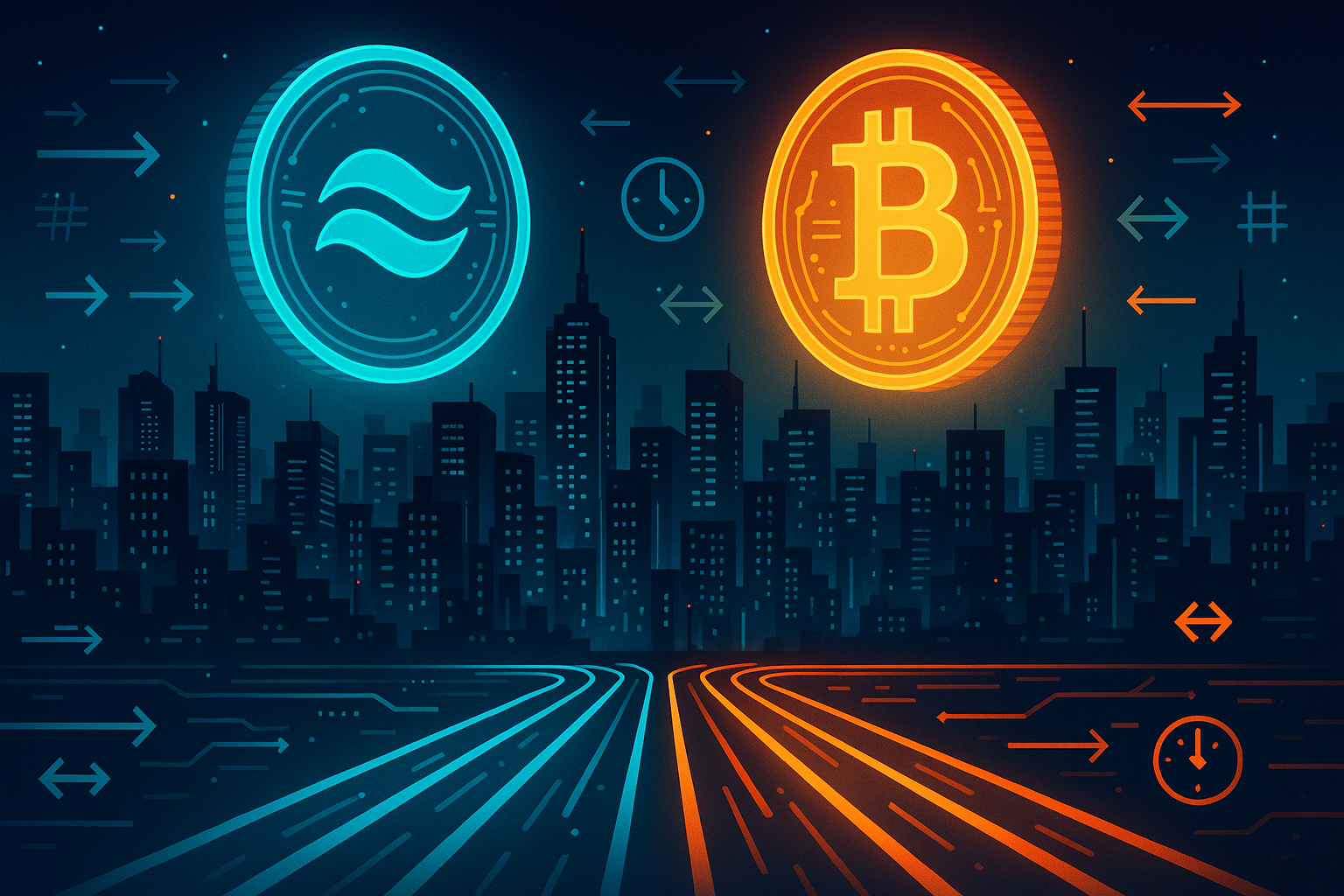
XRP is primarily positioned as an infrastructure asset for moving value between currencies and jurisdictions. Typical use cases include:
- Instant cross-border remittances between financial institutions
- On-demand liquidity for payment providers and exchanges
- Fast movement of funds between crypto venues and fiat gateways
Instead of holding pre-funded nostro/vostro accounts in each country, a payment provider can convert local currency to XRP, send it across the XRPL, and convert to the destination currency within seconds. This capital efficiency is central to XRP’s value proposition.
Retail and everyday payments
Both BTC and XRP can be used for everyday payments, but they play different roles.
Bitcoin payment adoption is growing slowly via the Lightning Network and merchant integrations. However, price volatility and relatively complex UX still limit its mainstream use as daily money.
XRP’s low fees and fast settlement are more aligned with day-to-day payments, but real-world adoption depends on wallets, payment processors, and regulatory clarity in each jurisdiction. As of 2026, both assets are far more commonly held as speculative or strategic investments than used as routine spending currencies.
Institutional adoption
Institutions predominantly use Bitcoin as a treasury and investment asset. Public companies, funds, and even some sovereign entities hold BTC on their balance sheets, viewing it similarly to gold.
XRP’s institutional story is more about infrastructure than reserves. Banks, fintechs, and remittance firms explore using XRPL for settlement and liquidity improvement, often abstracting the underlying XRP exposure via partners. This means institutions might use XRP “under the hood” without advertising it to end customers.
You can swap XRP for BTC, ETH, USDT and 1,500+ other coins on GhostSwap without KYC.
XRP vs Bitcoin (BTC): Price Performance
Current market data (March 2026)
Based on the latest data (2026-03-05):
- XRP price: $1.43
Market cap: $87.32B (Rank #5)
24h volume: $3.73B - Bitcoin price: $72,482.00
Market cap: $1,452.37B (Rank #1)
24h volume: $70.56B
This highlights a major difference in scale. Bitcoin’s market cap is over 16 times larger than XRP’s, reinforcing BTC’s role as the dominant crypto asset.
Recent performance and volatility
Short- and medium-term performance as of March 2026:
- XRP 24h: +2.01%
7d: -0.95%
30d: -11.13%
1y: -42.47% - BTC 24h: +1.41%
7d: +6.32%
30d: -7.37%
1y: -19.78%
Over the last year, both assets are down from their peaks, but XRP has underperformed Bitcoin, falling more than 40% compared with BTC’s ~20% decline. This pattern is typical of altcoins: they often move more sharply both up and down relative to Bitcoin.
All-time highs and lows
Historical extremes provide useful context:
- XRP all-time high: $3.65 on 2025-07-18
- XRP all-time low: $0.002686 on 2014-05-22
- BTC all-time high: $126,080.00 on 2025-10-06
- BTC all-time low: $67.81 on 2013-07-06
From their all-time highs, both XRP and BTC are significantly lower as of March 2026, reflecting the cyclical nature of crypto markets. Historically, Bitcoin has led market cycles, with altcoins like XRP often following but with higher beta.
Risk/return considerations
Bitcoin is generally viewed as lower risk than XRP within the crypto asset class, due to:
- Larger market cap and deeper liquidity
- Stronger regulatory clarity in many jurisdictions
- Longer track record and more decentralized architecture
XRP offers potential upside linked to payments adoption and regulatory developments, but it also carries:
- Concentration risk tied to Ripple and large token holdings
- Ongoing or potential regulatory scrutiny in certain markets
- Higher historical volatility than Bitcoin
For many investors, this leads to using BTC as a core holding and XRP as a smaller, more speculative position. Rebalancing between the two is straightforward using a non-custodial swap like GhostSwap’s XRP/BTC pair.
XRP vs Bitcoin (BTC): Future Potential
Bitcoin’s outlook
Bitcoin’s long-term thesis rests on:
- Continued institutional adoption and integration into financial products
- Its halving cycles gradually reducing new supply issuance
- Growing recognition as “digital gold” alongside traditional safe-haven assets
Key developments to watch include regulatory frameworks for spot ETFs and custody, macroeconomic conditions affecting risk assets, and the evolution of Bitcoin scaling solutions. While upside may be less explosive than small-cap altcoins, the network effect and brand around BTC are extremely strong.
XRP’s outlook
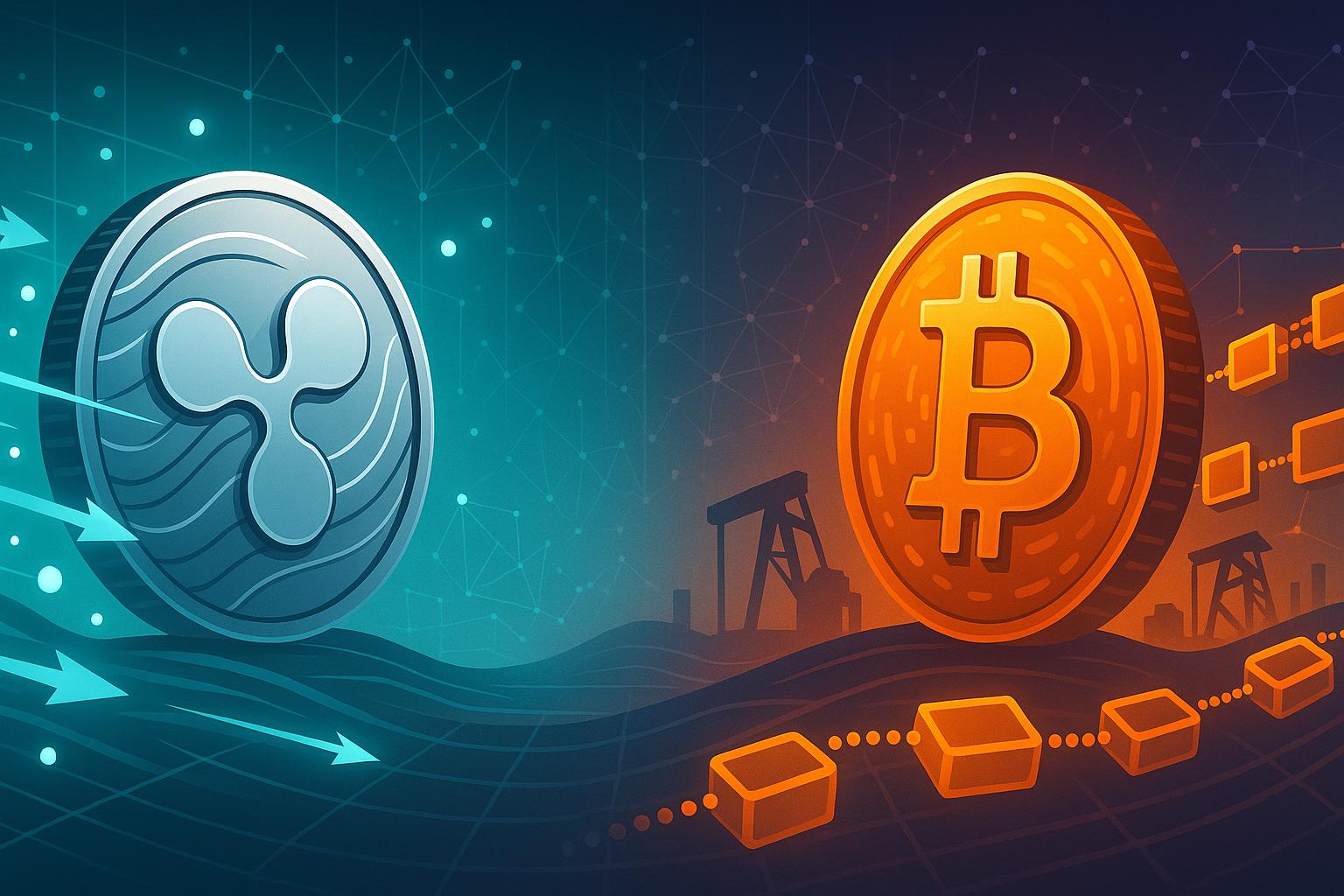
XRP’s potential is more tied to execution and regulation in the payments sector. Factors that could influence its trajectory:
- Adoption of XRPL-based solutions by banks, remittance firms, and fintechs
- Regulatory clarity around XRP’s status in major markets
- Technical upgrades improving interoperability, programmability, and on-chain liquidity
If cross-border payments infrastructure continues to modernize and XRPL captures meaningful volume, XRP could benefit. However, it competes not only with other cryptos but also with central bank digital currencies (CBDCs), stablecoins, and proprietary bank networks.
Regulation and competitive landscape
Regulation will shape both assets’ futures. Bitcoin has generally been classified as a commodity in key jurisdictions, which gives it a relatively straightforward path for institutional products. XRP has had more complex regulatory history, making future decisions and enforcement actions a significant driver of sentiment.
Competition is also fierce. Bitcoin primarily competes with gold, other macro assets, and occasionally other store-of-value narratives. XRP competes with other high-speed payment networks, stablecoins like USDT/USDC, and potential CBDC corridors. How each asset adapts to this landscape will influence long-term value.
Which Should You Invest In?
Investment profile and time horizon
Choosing between XRP vs Bitcoin depends on your risk tolerance, investment horizon, and thesis:
- Bitcoin (BTC) may fit investors seeking a long-term, relatively lower-risk core crypto exposure focused on digital scarcity and macro adoption.
- XRP may appeal to those who believe in the modernization of cross-border payments and are comfortable with higher regulatory and execution risk.
Short-term traders might rotate between XRP and BTC based on momentum, news, and relative valuations, while long-term holders often choose a diversified allocation.
Diversification vs concentration
Many crypto investors hold both BTC and XRP. A common approach is:
- Use BTC as a base position that represents conviction in the overall crypto asset class
- Allocate a smaller percentage to XRP as a targeted bet on payments infrastructure
Rebalancing between the two over time can help manage risk and capture relative performance. For example, if XRP rallies strongly vs BTC, some investors may rotate part of their gains back into Bitcoin, or vice versa.
Practical considerations
Before investing, consider:
- Your local tax rules on crypto trading and holding
- Secure storage (hardware wallets, self-custody best practices)
- Exit strategy and what would make you change your thesis
For research, rely on reputable sources such as official project sites like Bitcoin.org and XRPL.org, and neutral data aggregators such as CoinGecko or CoinMarketCap.
How to Swap XRP for Bitcoin (BTC)
Why use a non-custodial swap?
Non-custodial swaps let you trade directly from your wallet without depositing funds on a centralized exchange. You stay in control of your private keys, reduce counterparty risk, and often avoid lengthy signup processes. This approach aligns well with the original ethos of cryptocurrencies.
Swapping XRP to BTC on GhostSwap
On GhostSwap, you can swap XRP to BTC instantly without KYC, keeping your funds under your control from start to finish. The process is simple:
- Visit the XRP to BTC swap page.
- Enter the amount of XRP you want to exchange and check the quoted BTC amount.
- Provide your BTC receiving address and double-check it.
- Send the required XRP to the deposit address provided by GhostSwap.
- Wait for network confirmations, after which you receive BTC directly in your wallet.
Because GhostSwap is non-custodial, you never create an account or hand over custody. You simply initiate a one-off swap from your XRP wallet to your BTC wallet with no centralized balance sitting in between. Ready to trade? You can swap BTC to XRP instantly on a non-custodial exchange with no registration.
Ready to Trade XRP or BTC?
If you hold XRP and want to rotate into Bitcoin, or vice versa, you do not need a traditional exchange account. GhostSwap lets you swap crypto instantly with a private, non-custodial exchange flow, supporting XRP, BTC, and 1,500+ other pairs with no KYC and straightforward UX.
Frequently Asked Questions
Is XRP better than Bitcoin (BTC)?
Neither asset is universally “better”; they serve different roles. Bitcoin is generally stronger as a long-term store of value, with higher decentralization, larger market cap, and broader recognition. XRP is better optimized for speed and low-cost cross-border payments, making it more suitable as a payments rail and liquidity bridge.
Your choice depends on what you want from crypto. For digital gold and macro exposure, many prioritize BTC. For a targeted bet on payments infrastructure and fast transfers, some add XRP to their portfolio alongside Bitcoin.
Can XRP overtake Bitcoin (BTC)?
In terms of market capitalization and global influence, Bitcoin currently has a massive lead over XRP. While crypto markets are unpredictable, overtaking BTC would require extraordinary XRP adoption and/or a major decline in Bitcoin’s role. Most analysts consider BTC’s first-mover advantage and network effects very hard to displace.
XRP does not necessarily need to “flip” Bitcoin to be successful. It can still appreciate and find strong product-market fit in payments without becoming the top asset by market cap.
Should I hold both XRP and BTC?
Many investors choose to hold both as part of a diversified crypto strategy. BTC often acts as the core holding, while XRP offers additional upside tied to a different use case and risk profile. Holding both exposes you to two distinct narratives: digital store of value (BTC) and high-speed cross-border settlement (XRP).
The exact allocation should reflect your risk tolerance, conviction in each project, and time horizon. Regular portfolio reviews and rebalancing can help keep your exposure aligned with your goals.
Where can I swap XRP to BTC?
You can swap XRP to BTC on non-custodial platforms like GhostSwap directly from your wallet. With GhostSwap, you do not need to open an account or pass KYC; you just specify the amount of XRP, provide a BTC address, and complete the transfer. This keeps the process fast, private, and self-custodial.
To try it, go to the dedicated XRP vs Bitcoin swap page, follow the on-screen steps, and receive BTC into your own wallet once the transaction is confirmed.
Ready to Swap?
Convert your crypto instantly on GhostSwap, a no-KYC crypto exchange — no sign-up required.
Popular swaps: BTC to XMR | BTC to ETH | XMR to BTC | ETH to XMR | BTC to SOL