Layer 2 crypto refers to technologies built on top of a base blockchain (like Ethereum or Bitcoin) that process transactions off the main chain, then settle the results back to it. This design boosts speed, cuts fees, and increases scalability while still relying on the security of the underlying Layer 1 network.
If you use Ethereum, Polygon, Arbitrum, or Lightning Network and then instantly swap those assets on a non-custodial platform like GhostSwap, you are already benefiting from Layer 2 crypto solutions.
What Is Layer 2 Crypto Explained Simply
Blockchains like Bitcoin and Ethereum are secure, but they get crowded and slow when many people use them at once. Fees can spike, and transactions may take minutes to confirm.
Layer 2 crypto is a set of tools and networks that help move some of this activity “off” the main chain. Instead of forcing every tiny payment or trade to be recorded directly on Ethereum or Bitcoin, Layer 2 systems batch or compress many actions together, then send a single summary back to the base chain.
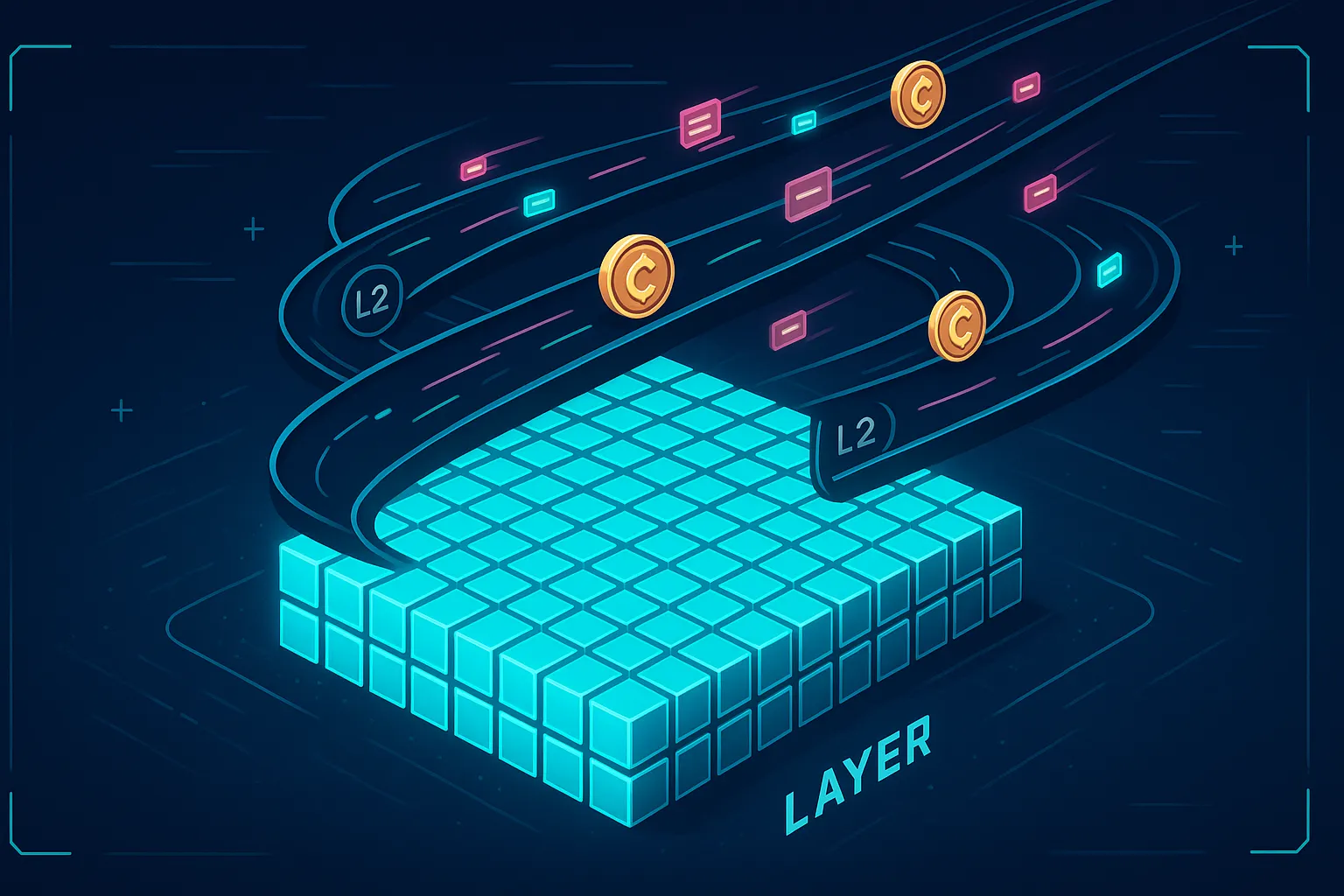
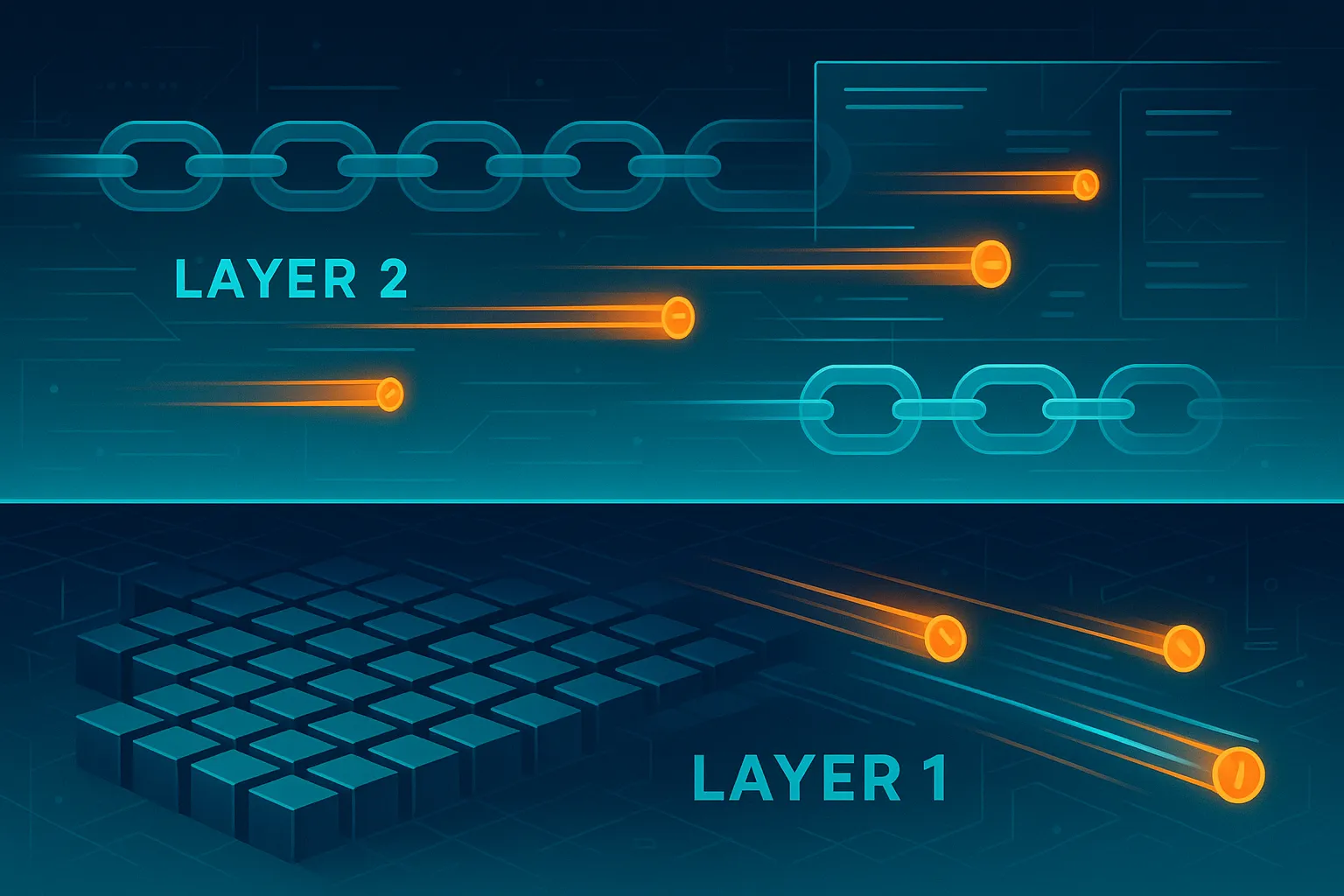
Think of it like a busy highway. The Layer 1 blockchain is the main road. Layer 2 is the express lane above it. Cars (transactions) use the express lane for speed, and only important checkpoints get recorded on the main road.
You still trust the main road for safety, but you use the express lane for speed and lower costs. In the same way, Layer 2 aims to keep the security of big blockchains while making everyday usage faster and cheaper.
How Does Layer 2 Crypto Work?
To understand how Layer 2 works, it helps to separate the roles:
- Layer 1 (L1): The base blockchain like Bitcoin, Ethereum, or another main network.
- Layer 2 (L2): A protocol or network built on top that handles transactions off-chain or semi-off-chain, then periodically interacts with L1.
Rollups: Bundling Transactions for Ethereum
On Ethereum, the most popular Layer 2 approaches are called rollups. These systems collect hundreds or thousands of transactions off-chain, then publish compressed data to Ethereum.
Two main types of rollups are common:
- Optimistic rollups (e.g., Arbitrum, Optimism): Assume transactions are valid by default, but allow a window for fraud proofs. If someone detects a bad transaction, they can challenge it on Ethereum.
- Zero-knowledge (ZK) rollups (e.g., zkSync Era, StarkNet): Use cryptographic proofs (ZK-proofs) that mathematically guarantee transactions are valid before being posted to Ethereum.
In both cases, the heavy lifting happens off-chain, while Ethereum acts as the final court of appeal. This dramatically reduces gas fees and increases throughput, but users still benefit from Ethereum’s security model.
State Channels and Payment Channels
State channels let two or more participants lock funds in a smart contract, then transact privately and rapidly between themselves. Only the opening and closing balances are written on-chain.
Bitcoin’s Lightning Network is the leading example of a payment channel system. Users open a channel on Bitcoin, make many instant, nearly free transactions with one another, and then settle the final result back to Bitcoin.
This approach works well for frequent repeat payments, such as tipping, microtransactions, or recurring transfers between known parties.
Sidechains and Validiums
Sidechains are separate blockchains that run in parallel to a main chain and are connected via bridges. They often have their own validators and security assumptions.
Example: Polygon PoS is commonly called a sidechain to Ethereum. It is EVM-compatible and bridges assets between Ethereum and its own network. Users get faster and cheaper transactions, but security partly depends on Polygon’s validator set rather than Ethereum alone.
Validium solutions store transaction data off-chain but still use validity proofs for correctness. They offer high scalability for specific use cases (like gaming or NFTs) while keeping a cryptographic link to Layer 1 security.
Bridges: Moving Assets Between Layers
To use a Layer 2, users often move assets from the base chain to the L2 via a bridge. This usually involves locking tokens on Layer 1 and minting equivalent tokens on Layer 2, or vice versa.
Because bridges are critical infrastructure and have been exploited in the past, they are a major focus of security research. Users should always double-check official bridge URLs from project documentation.
You can swap BTC, ETH, USDT and 1,600+ other coins across major L1 and L2 networks on GhostSwap without KYC, which makes it easy to move between ecosystems after you bridge your assets.
Why Does Layer 2 Crypto Matter?
The importance of Layer 2 crypto is straightforward: scalability. Base chains like Ethereum are limited in how many transactions they can handle per second. Without scaling, global adoption would mean sky-high fees and poor user experience.
Layer 2 solutions aim to deliver:
- Lower transaction fees: L2s can be many times cheaper than transacting directly on L1.
- Higher throughput: More transactions per second, enabling DeFi, gaming, and social apps.
- Better UX: Faster finality and smoother interactions for everyday users.
For developers, L2s unlock new application types that would be impractical on slow, expensive mainnets. High-frequency trading, micro-payments, on-chain games, and complex DeFi strategies become more realistic.
For traders and investors, Layer 2 offers a way to stay within the crypto ecosystem while avoiding mainnet congestion costs. Being able to move assets cheaply across L2s and then swap crypto instantly on non-custodial platforms gives more flexibility and control.
Layer 2 Crypto Examples and Use Cases
1. Ethereum Rollups: Arbitrum, Optimism, zkSync, StarkNet
Ethereum has become the most active ecosystem for Layer 2. Popular L2 networks include:
- Arbitrum One and Optimism (optimistic rollups)
- zkSync Era and StarkNet (ZK-rollups)
These networks aim to reduce gas costs while maintaining an EVM-compatible environment for smart contracts. Top DeFi apps like Uniswap and Aave have deployed versions on multiple L2s.
For live network data, you can check each project’s official site or aggregators like CoinGecko’s Layer 2 category.
2. Bitcoin Lightning Network
The Lightning Network is Bitcoin’s main Layer 2 payment system. By routing payments across a network of channels, Lightning enables instant, low-fee BTC transfers that can support microtransactions and global remittances.
This is especially useful for merchants, tipping systems, and applications where on-chain Bitcoin fees would be too high for small payments. Lightning remains anchored to Bitcoin’s security model, as channels ultimately settle back on-chain.
3. Polygon Ecosystem
Polygon started as a PoS sidechain, but has expanded into a family of scaling solutions, including Polygon zkEVM (a ZK-rollup) and Polygon Miden. It focuses on fast, cheap transactions with Ethereum compatibility.
NFT marketplaces, gaming projects, and DeFi protocols use Polygon to deliver near-instant interactions. For more details on specific networks and tokens, platforms like CoinMarketCap educational articles provide up-to-date overviews.
4. Gaming and NFT Scaling (Immutable, Ronin, etc.)
Gaming and NFT platforms often adopt specialized Layer 2 or sidechain solutions to manage large volumes of low-value actions. Examples include Immutable’s zk-rollup stacks and game-focused chains like Ronin.
These networks let players trade in-game assets and NFTs with minimal fees, while still using crypto wallets and blockchain-based ownership.
5. DeFi and High-Frequency Trading
DeFi protocols on L2 can offer lower slippage, cheaper swaps, and more frequent rebalancing. Strategies that would be unprofitable after Layer 1 gas fees can become viable on L2.
Traders frequently move tokens between L1 and L2 to chase yields, arbitrage opportunities, or cheaper swaps, then consolidate positions using a non-custodial exchange such as GhostSwap.io.
Pros and Cons of Layer 2 Crypto
Advantages of Layer 2
- Lower fees: Transaction costs are typically much cheaper than mainnet equivalents, making DeFi and NFTs more accessible.
- Higher speed: Faster confirmations and higher throughput improve user experience across wallets and dApps.
- Better scalability: Layer 2 extends the capacity of existing blockchains without sacrificing their decentralization goals.
- Security inheritance: Many L2 solutions inherit security from the underlying L1, especially rollups anchored to Ethereum.
- Innovation space: Developers can experiment with new designs without modifying the base chain.
Limitations and Trade-offs
- Bridge and smart contract risk: Bridges, L2 contracts, and sequencers introduce new attack surfaces compared to simple L1 holds.
- User complexity: Managing multiple networks, RPCs, and bridges can be confusing, especially for newcomers.
- Withdrawal delays: Some optimistic rollups require waiting periods for withdrawals back to L1, impacting liquidity.
- Centralization concerns: Early-stage L2s often rely on centralized sequencers or upgrade keys, which may improve over time but are still a consideration.
- Fragmented liquidity: Assets and liquidity spread across many L2s and sidechains, which can fragment markets.
How Layer 2 Crypto Relates to Trading on GhostSwap
Layer 2 has a direct impact on how you trade and move assets.
On mainnets, high gas fees can eat into profits from small or mid-size trades. By using assets issued on Layer 2 networks, you can often move coins faster and cheaper, then execute a swap on a non-custodial platform like GhostSwap with more flexibility.
GhostSwap focuses on being a simple, instant, non-custodial swap platform. You stay in control of your funds, trade across 1,600+ pairs, and you do not need to complete KYC. This is especially useful when managing portfolios that span multiple L1 and L2 ecosystems.
Typical flow for a Layer 2 user might look like:
- Bridge assets from Ethereum L1 to an L2 such as Arbitrum.
- Use DeFi or apps on that L2 with lower fees.
- When ready, send tokens to your wallet on the desired chain.
- Swap those tokens for BTC, ETH, stablecoins, or other assets on GhostSwap.
This gives you the scalability benefits of L2 plus the privacy and simplicity of a non-custodial swap platform.
Ready to Trade Layer 2 Assets?
If you already hold tokens on Ethereum, Bitcoin, or Layer 2 networks, you can quickly rebalance your portfolio without giving up custody. Visit GhostSwap to exchange across 1,600+ pairs in a few clicks, with no sign-up and no KYC.
Frequently Asked Questions
Is Layer 2 a separate blockchain?
It depends on the design. Some Layer 2 solutions, like optimistic and ZK-rollups, are tightly integrated with the base chain and rely on it for security. They post transaction data and proofs directly to Layer 1.
Other scaling solutions, such as sidechains, operate more like separate blockchains that are connected via bridges. They can still be called “Layer 2” in broad conversation, but they may not inherit security from the base chain in the same way as rollups.
Is Layer 2 crypto safe?
Layer 2 can be safe, but it introduces different risks than holding funds directly on Layer 1. Smart contract bugs, bridge vulnerabilities, centralized sequencers, and misconfigurations are all potential hazards.
To reduce risk, it is wise to:
- Use well-audited, widely used Layer 2 networks.
- Confirm official URLs through project documentation.
- Avoid keeping more funds than necessary in experimental or unaudited protocols.
Regardless of the network, non-custodial swaps ensure you keep control of your keys during trades.
What is the difference between Layer 1 and Layer 2?
Layer 1 is the base blockchain, such as Bitcoin or Ethereum. It defines consensus, security, and the core protocol rules.
Layer 2 is built on top of Layer 1 to improve scalability, speed, and cost. L2 systems process transactions off-chain or partially off-chain, then periodically submit results back to L1. Users benefit from improved performance while still leveraging the base chain’s security assumptions.
Do I need Layer 2 to use DeFi and NFTs?
You do not need Layer 2, but it often makes DeFi and NFT usage much more affordable and convenient. On busy days, Ethereum or other L1s can become expensive, which prices out smaller users.
Using an L2 network can lower your gas costs, enabling more frequent trades, staking, or NFT interactions. Once you are done, you can bridge assets back to L1 or send them to a wallet you control and rebalance with a private exchange service such as GhostSwap.
How do I move my coins from Layer 2 back to Layer 1?
To move coins from Layer 2 to Layer 1, you typically use a bridge. Most major L2 networks provide an official bridge interface that lets you withdraw tokens back to the base chain.
Be aware of:
- Withdrawal times: Some optimistic rollups have waiting periods.
- Fees: Both L2 and L1 gas fees may apply.
- Correct network configuration: Ensure your wallet is set to the right network before initiating transfers.
After your funds are back on L1 (or on another network you choose), you can use a non-custodial platform like GhostSwap to convert them into whichever assets you prefer.