Know Your Customer (KYC) in crypto is the identity verification process that exchanges and crypto platforms use to collect personal documents and data from users to comply with anti-money laundering (AML) and financial regulations. It typically involves submitting an ID, selfie, and proof of address before you can trade, deposit, or withdraw.
If you prefer to trade without sharing sensitive personal data, you may look for non-custodial swap services that do not require KYC for normal usage.
What Is KYC in Crypto Explained Simply
Basic idea in plain English
KYC in crypto is like showing your ID when you open a bank account, but online.
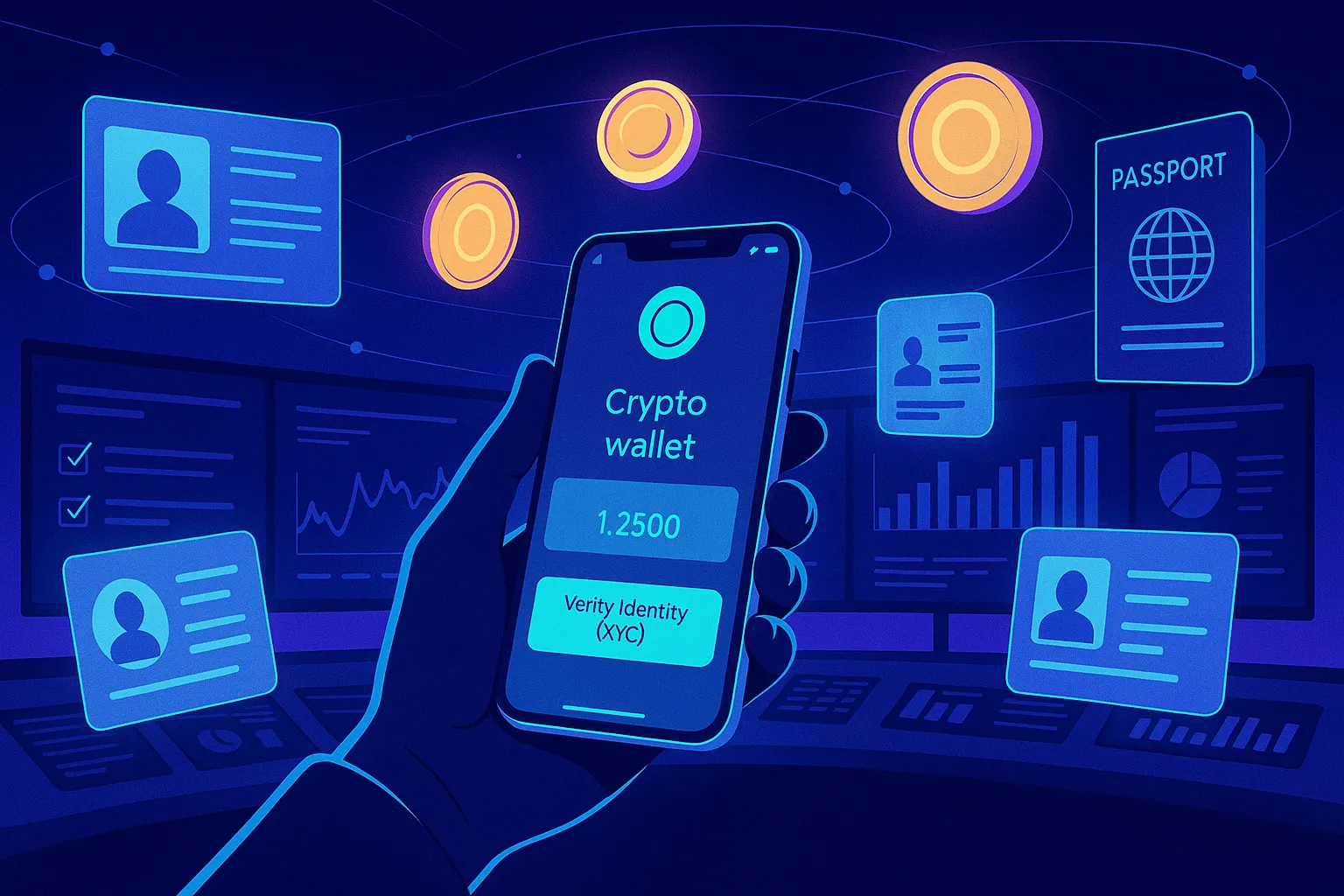
Instead of walking into a branch, you upload photos of your passport or ID card, maybe a selfie, and sometimes a proof of address. The crypto platform checks these documents to confirm you are a real person and not on any sanctions or fraud lists.
Why crypto platforms ask for KYC
Most centralized exchanges and some wallet providers are legally required to know who is using their services.
Regulators want to prevent money laundering, terrorist financing, and other financial crimes. To do that, they push platforms to verify user identities and monitor suspicious activity. KYC is the method they use to do this.
What you usually have to provide
Although every platform is slightly different, the KYC process typically asks for:
- Full legal name and date of birth
- Government-issued ID (passport, national ID, or driver’s license)
- A selfie or video to match your face to the ID
- Proof of address such as a utility bill or bank statement
- Sometimes information about your income or source of funds
Once approved, your account is usually allowed to deposit, withdraw, and trade within certain limits.
How Does KYC in Crypto Work?
The step-by-step KYC workflow
Behind the scenes, KYC in crypto is a structured, multi-step compliance workflow:
- Data collection: The platform gathers your personal information and document images through a secure web or app form.
- Document validation: Automated tools and human reviewers check if your ID is genuine, unaltered, and not expired.
- Biometric check: A selfie or video match confirms the person submitting the ID is the same as the person in the document.
- Sanctions & watchlist screening: Your name and sometimes address are checked against global databases such as OFAC, UN, and local watchlists.
- Risk scoring: The platform may use internal rules to rate the risk level of your account based on country, transaction patterns, or past flags.
- Ongoing monitoring: Even after approval, transactions are monitored for unusual behavior that could trigger enhanced review.
The role of AML and regulation
KYC is one part of a broader anti-money laundering (AML) and counter-terrorist financing (CTF) framework.
Regulations such as the FATF “Travel Rule,” the EU’s AML directives, and rules from local regulators push crypto companies to collect and store user identity data. In many jurisdictions, large withdrawals, high trading volume, or using fiat on-ramps automatically trigger KYC requirements.
Regulation is evolving rapidly, and more jurisdictions are classifying many crypto businesses as “virtual asset service providers” (VASPs) that must implement KYC processes similar to banks.
Tools and providers behind KYC
Most crypto exchanges rely on third-party KYC/AML vendors to manage identity checks.
These vendors provide:
- Optical character recognition (OCR) for reading IDs
- Fraud detection for forged or altered documents
- Biometric liveness tests to prevent deepfakes or photos of screens
- Access to sanctions, politically exposed person (PEP), and adverse media databases
While this adds security, it also means your personal data may be processed by multiple companies, not just the exchange itself.
Why Does KYC in Crypto Matter?
Impact on user privacy and security
Handing over detailed personal information creates privacy and security trade-offs.
KYC data breaches have occurred in the broader financial sector, and leaked ID documents can be used for identity theft or fraud. Crypto users who value anonymity or pseudonymity often see KYC as going against the original ethos of decentralized, permissionless currencies like Bitcoin.
Access to services and higher limits
On the other hand, completing KYC usually unlocks higher deposit and withdrawal limits, margin trading, and fiat on-ramps.
Without KYC, many platforms either block certain features or cap how much you can move. For some users, especially institutional and professional traders, the benefits of higher limits outweigh the privacy concerns.
Regulatory compliance and legitimacy
For governments and regulators, KYC is a key tool to integrate crypto into the mainstream financial system.
Platforms that comply with KYC and AML rules may find it easier to maintain banking relationships, list new tokens, or operate in multiple countries. This, in turn, can increase liquidity and make it easier for users to move between crypto and traditional finance.
Risk management for platforms
KYC helps exchanges and custodial platforms understand where funds come from and reduce exposure to sanctioned entities or high-risk activity.
When suspicious transactions are detected, platforms can freeze accounts or file suspicious activity reports (SARs), which is often a legal obligation. From the platform’s perspective, strong KYC is part of staying operational and avoiding regulatory penalties.
You can swap BTC, ETH, USDT and 1,600+ other coins on GhostSwap without KYC.
KYC in Crypto: Examples and Common Use Cases
1. Centralized exchanges (CEXs)
Most large centralized exchanges require KYC, especially when dealing with fiat currencies like USD or EUR.
Typically, you can create an account with only an email, but to deposit or withdraw above a small threshold, you must complete KYC. Some platforms also require higher “levels” of KYC for margin trading, futures, or large-volume activity.
2. Fiat on-ramps and off-ramps
Services that allow you to buy crypto with credit cards or bank transfers almost always enforce KYC.
Banks and card issuers insist that their partners identify end users. This is why buying Bitcoin directly with your bank account usually involves an identity check, even if pure crypto-to-crypto trading sometimes does not.
3. Crypto lending, yield, and DeFi gateways
Centralized lending platforms or “CeFi” yield services often require KYC to manage credit risk and comply with securities or lending regulations.
Pure on-chain DeFi protocols usually do not have KYC because they are smart-contract based and non-custodial. However, many front-end interfaces, aggregators, and fiat gateways that connect users to DeFi have started introducing KYC checks, especially for larger accounts or institutional users.
4. Institutional and OTC trading
Over-the-counter (OTC) desks and institutional trading platforms rely heavily on KYC and enhanced due diligence (EDD).
When handling very large trades, these providers must verify who their counterparties are to avoid sanctions breaches or reputation risk. KYC allows them to demonstrate to regulators that they know their clients and where funds originate.
5. Non-custodial, no-KYC alternatives
Some services that provide instant non-custodial swaps focus strictly on crypto-to-crypto conversions and avoid holding user funds.
Because they do not custody assets or connect to traditional banking rails, they can often operate without mandatory KYC for standard-sized swaps, while still using blockchain analytics to monitor for obviously risky flows. This model preserves user privacy while helping reduce custodial risk.
Pros and Cons of KYC in Crypto
Main advantages of KYC
- Regulatory compliance: Helps platforms operate legally in more jurisdictions and reduces risk of shutdowns.
- Higher account limits: Verified users usually get higher withdrawal and trading limits.
- Better fiat integration: KYC makes it easier to wire money in and out of exchanges and use cards or bank transfers.
- Reduced fraud on platforms: Identity verification can deter some types of fraud and account abuse.
- Stronger relationships with institutions: Banks, payment processors, and institutional investors often require robust KYC controls.
Main disadvantages of KYC
- Loss of privacy: Users must reveal sensitive identity data, which some consider incompatible with crypto’s original ideals.
- Data breach risk: Centralized storage of IDs and personal data can be a target for hackers.
- Exclusion and discrimination: People without traditional IDs or from high-risk regions may be denied access.
- Centralization of power: Platforms gain the ability to freeze accounts or block withdrawals based on compliance decisions.
- Friction and delay: Verification can take hours or days, especially during high-demand periods.
Finding a balance: privacy vs compliance
There is an ongoing debate in the crypto community about how to balance user privacy with regulatory expectations.
Some believe more privacy-preserving technologies, like zero-knowledge proofs and self-sovereign identity, will eventually make KYC less intrusive. Others argue that fully anonymous financial systems will face increasing political and regulatory pressure.
How KYC Relates to Trading on GhostSwap
Non-custodial design and user control
GhostSwap is a non-custodial instant swap platform, which means it does not hold your funds in centralized accounts.
Instead, you connect your own wallet and swap from one coin to another, with assets moving directly between addresses. This architecture greatly reduces custodial risk, because there is no pooled user deposit account that can be frozen or hacked in the same way as a centralized exchange.

No mandatory KYC for normal swaps
Because GhostSwap focuses on crypto-to-crypto swaps and does not provide fiat deposits or withdrawals, it is able to offer trading without traditional KYC for regular users.
This makes it useful for privacy-conscious traders who still want fast access to liquidity across 1,600+ pairs. You keep control of your keys and avoid uploading ID documents to a central server when performing normal-sized swaps.
Compliance and risk controls without identity uploads
Even non-custodial platforms must think about risk management.
Services like GhostSwap can use transaction monitoring, liquidity routing, and smart order execution across decentralized venues to provide a safer environment without tying activity directly to personal identity. For many users, this strikes a better balance between regulatory realities and the desire to keep trading information separate from real-world identity.
Ready to Start Trading?
If you want to swap crypto instantly without going through lengthy verification queues, you can use GhostSwap’s private exchange interface to convert between BTC, ETH, stablecoins, and hundreds of other assets while keeping control of your own wallet.
Ready to Trade Crypto?
Visit GhostSwap.io to swap crypto instantly, access 1,600+ trading pairs, and trade non-custodially without standard KYC requirements.
Frequently Asked Questions
Is KYC mandatory for all crypto exchanges?
No. KYC is mandatory for many centralized exchanges, especially those that offer fiat on-ramps, derivatives, or operate in tightly regulated countries.
However, some non-custodial platforms, decentralized exchanges (DEXs), and swap services focus purely on crypto-to-crypto and can often operate without traditional KYC for typical use, depending on their jurisdiction and business model.
Can I buy crypto without KYC?
Yes, but options are more limited and usually crypto-only.
You can use non-custodial swap services, certain DEXs, or peer-to-peer trading platforms where you control your wallet. To buy crypto directly with a bank account or card, most regulated services require KYC because they interact with traditional financial institutions.
Is KYC safe and what are the risks?
KYC processes are usually handled with encryption and strict security policies, but no centralized database is completely risk-free.
The main risks are data breaches, identity theft, and your personal information being shared with third parties such as analytics firms or law enforcement. Always enable strong account security like two-factor authentication (2FA) and only submit KYC to reputable platforms.
What is the difference between KYC and AML?
KYC (Know Your Customer) is about identifying and verifying the user, while AML (Anti-Money Laundering) is the broader set of rules and processes to detect and prevent illicit financial activity.
KYC is one component of AML. Other components include transaction monitoring, suspicious activity reporting, sanctions screening, and internal compliance audits.
Can my KYC data be deleted?
In many jurisdictions, financial regulations require platforms to store KYC data for several years, even after an account is closed.
Some regions, such as the EU, provide data protection rights like access, correction, and in limited cases erasure under frameworks similar to GDPR. You should check each platform’s privacy policy to see how long they keep data and what rights you have.
Does DeFi require KYC?
Pure on-chain DeFi protocols that run as smart contracts usually do not include KYC, because they do not custody funds or directly control users.
However, interfaces, aggregators, and bridges that connect traditional finance to DeFi increasingly add KYC at the access layer, especially for large or institutional users, to meet regulatory expectations.
For more details on current markets and listed assets, you can reference data providers like CoinGecko or CoinMarketCap while planning your trading strategy.