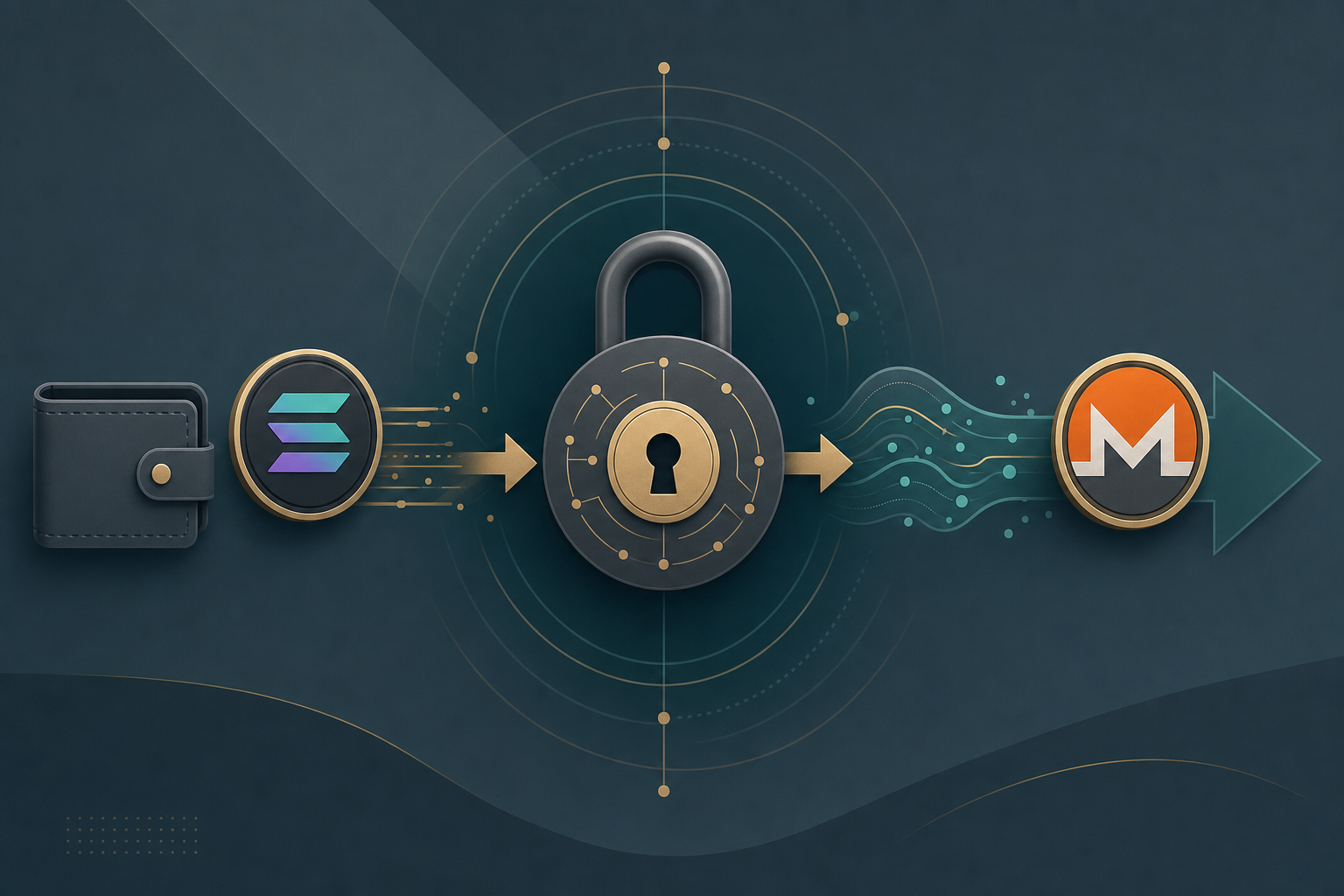
Swapping Solana (SOL) into a privacy coin means moving SOL out of the Solana network and into a chain like Monero (XMR) or Zcash (ZEC), where transaction details are shielded by design. Phantom is a non-custodial Solana wallet, so it holds the keys but does not run cross-chain privacy-coin swaps itself. To convert SOL into XMR or ZEC, you send SOL out of Phantom to a swap service that supports the route. On GhostSwap this happens without an account, without an email, and without identity verification: you paste your Monero or Zcash receiving address, send SOL from Phantom, and the swap routes through a non-custodial engine.
TL;DR: Paste your XMR or ZEC address into GhostSwap, send SOL from Phantom, receive your privacy coin. No account, no KYC. Median completion is about 8 minutes.
What you need before you start
A SOL-to-privacy-coin swap needs three things: SOL in Phantom, a receiving address on the privacy chain, and a swap service that supports the pair. Phantom is non-custodial, which means you control the private keys and GhostSwap never touches your Phantom balance — you push SOL out yourself. GhostSwap supports 1,600+ pairs across roughly 200 assets, including SOL to XMR and SOL to ZEC.
Here is the checklist:
- SOL in your Phantom wallet — enough to cover the amount plus a small Solana network fee. Check the minimum swap amount on the pair page before you start; very small amounts can fall below the threshold.
- A receiving address on the privacy chain — a Monero address for XMR, or a Zcash address for ZEC. Use a dedicated privacy-coin wallet such as Cake Wallet, Feather, or Monerujo for Monero. Copy the address carefully; privacy-chain addresses are long and unforgiving.
- A SOL refund address (recommended) — if the swap cannot complete, GhostSwap returns your SOL here. Without it you would contact support to arrange a manual refund.
No sign-up, no email, and no identity verification are required to swap. You supply the receiving address; GhostSwap handles the conversion.
Step-by-step: send SOL from Phantom and receive XMR or ZEC
The flow is the same whether you receive Monero or Zcash. You enter the pair, paste your address, send SOL, and wait for the privacy coin to land. Median completion runs about 8 minutes, with a 95th-percentile time near 30 minutes depending on network congestion. Here are the five steps:
- Pick the pair. Open the SOL to XMR pair page for Monero, or the SOL to ZEC pair page for Zcash. Enter how much SOL you want to swap. GhostSwap shows a live estimate of the privacy coin you will receive.
- Paste your receiving address. Enter your Monero or Zcash address — this is where the privacy coin lands. Add a SOL refund address if prompted.
- Send SOL from Phantom. GhostSwap generates a Solana deposit address. Open Phantom, choose Send, paste that deposit address, and confirm. Phantom signs the transaction with your keys; GhostSwap never holds your SOL before you send it.
- Wait for the swap to route. Once Solana confirms your deposit, GhostSwap converts SOL into your chosen privacy coin using floating-rate pricing from aggregated liquidity. The amount is locked when your deposit is detected on-chain, not when you click.
- Receive your privacy coin. XMR or ZEC arrives at the address you entered. You can verify it landed in your privacy-coin wallet.
Funds pass through non-custodially — GhostSwap never holds them. The whole route is account-free.
Which privacy coins can you swap SOL into?
GhostSwap supports SOL into several privacy chains, plus 1,600+ other pairs across roughly 200 assets. The three most common privacy destinations:
| Privacy coin | Ticker | What it shields | Common wallets |
|---|---|---|---|
| Monero | XMR | Sender, receiver, and amount by default | Cake Wallet, Feather, Monerujo |
| Zcash | ZEC | Amount and addresses in shielded (z-addr) transactions | Zashi, Ywallet |
| Pirate Chain | ARRR | Amounts and addresses via mandatory shielding | Verus, Treasure Chest |
Monero shields every transaction by default, which is why SOL to XMR is the most direct privacy route. Zcash gives you a choice between transparent and shielded transactions, so use a shielded (z) address if privacy is the goal. If you swap to ZEC and send to a transparent address, the privacy benefit is lost.
GhostSwap vs custodial exchanges for Phantom users
The core difference is custody and accounts. A custodial exchange takes possession of your coins and requires an account with identity verification before you can trade. A non-custodial swap routes funds through without holding them and needs no account. Here is the comparison:
| Feature | GhostSwap | Custodial exchange |
|---|---|---|
| Account / KYC | None required | Account + identity verification required |
| Custody | Non-custodial pass-through | Exchange holds your funds |
| SOL to XMR / ZEC | Supported | Often delisted or unsupported |
| Pricing | Floating-rate from aggregated liquidity | Order book or internal rate |
| Pairs | 1,600+ across ~200 assets | Varies |
| Median completion | ~8 minutes | Varies by withdrawal queue |
If you want a named no-KYC alternative to compare against, the approved lineup worth checking includes Exolix, FixedFloat, SimpleSwap, StealthEX, and Trocador. Rates and supported pairs differ between services, so compare the live SOL-to-XMR quote on each before you commit. Quotes move with the market, so check them close to when you plan to swap.
Common issues and how to avoid them
Most failed swaps trace back to address errors or amounts below the minimum. A few checks prevent the common ones:
- Address format. Phantom sends SOL using a Solana address; your privacy coin lands at a Monero or Zcash address. Don't paste a Solana address into the receiving field — paste the privacy-chain address. Mismatched address types are the most common error.
- Minimum SOL amount. Each pair has a minimum. If your SOL amount is too small, the swap won't start. Check the figure on the pair page and round up if needed.
- Confirming the swap. After you send SOL from Phantom, wait for Solana to confirm the transaction before expecting the privacy coin. Solana confirms quickly, but the full route still depends on the conversion step.
- Refund address. Set a SOL refund address so funds return automatically if the swap can't complete.
FAQ
Q: Can Phantom swap SOL directly into Monero?
A: No. Phantom is a non-custodial Solana wallet and does not run cross-chain swaps into privacy chains like Monero. You send SOL out of Phantom to a swap service that supports the SOL-to-XMR route, then receive XMR at your Monero address.
Q: Do I need an account or ID to swap SOL to a privacy coin on GhostSwap?
A: No. There is no account, no email, and no identity verification required to swap. You supply a Monero or Zcash receiving address, send SOL from Phantom, and the funds pass through non-custodially.
Q: How long does a SOL to XMR swap take?
A: Median completion is about 8 minutes, with a 95th-percentile time near 30 minutes. Timing depends on Solana confirmation speed and network congestion on the privacy chain.
Q: Is the rate fixed when I click swap?
A: No. GhostSwap uses floating-rate pricing from aggregated liquidity. The amount you receive is locked when your SOL deposit is detected on-chain, not at the moment you click. If the market moves while your deposit confirms, the output reflects that.
Q: Which privacy coin should I swap SOL into?
A: Monero (XMR) shields every transaction by default, making it the most direct privacy route. Zcash (ZEC) offers shielded transactions if you use a z-address. Choose based on which privacy chain your wallet supports.
Ready to swap?
Open the SOL to XMR pair page or the SOL to ZEC pair page, paste your privacy-coin address, and send SOL from Phantom. No account, no KYC. If you also hold Bitcoin, the BTC to XMR route works the same way.