How to Swap USDT to BTC in 2026: Fast, Private & No-KYC Guide
The quickest way to swap USDT to BTC in 2026 is to use a non-custodial instant swap service like GhostSwap. You connect your wallet, choose USDT and BTC, paste your BTC address, send USDT, and receive Bitcoin directly in your wallet, usually within minutes and without submitting any ID.
Swap USDT to BTC instantly and privately here.
- Get a Bitcoin wallet and make sure you control the private keys.
- Go to a non-custodial swap platform and select USDT to BTC.
- Enter the BTC address where you want to receive your coins.
- Send your USDT to the deposit address and wait for BTC to arrive.
What You Need Before You Start
1. A USDT Wallet With Available Balance
You need a wallet that currently holds your Tether (USDT). USDT exists on several networks, including Ethereum (ERC‑20), Tron (TRC‑20), and others like BNB Smart Chain and Solana.
Most instant swap platforms, including GhostSwap, will ask you to select the specific network. Always match the USDT network from your wallet to the network you select when you swap USDT to BTC, or funds can be lost.
2. A Bitcoin Wallet You Control
Next, you need a Bitcoin (BTC) address where you will receive your coins. This can be a hardware wallet, a mobile non-custodial wallet app, or a desktop wallet.
For higher security, consider hardware wallets like Ledger or Trezor, or well-reviewed software wallets such as Sparrow, BlueWallet, or Electrum. Always back up your seed phrase offline.
3. Minimum Amounts & Fees
Each platform sets a minimum amount for converting USDT to BTC to cover network fees and service costs. This can vary depending on network congestion, but it is commonly in the $20–$50 equivalent range for small swaps.
You also pay blockchain network fees: USDT network fees when sending Tether, and BTC mining fees when you receive Bitcoin. Instant swap services typically bundle their fee into the exchange rate you see on screen.
4. Time Needed
On-chain crypto swaps usually complete in 5–30 minutes, depending on the networks involved and the fee levels. Tron USDT (TRC‑20) tends to confirm faster and more cheaply than Ethereum USDT (ERC‑20).
If you use a centralized exchange, the total time can stretch to hours or days due to KYC, internal review, withdrawal queues, and withdrawal limits.
Method 1: Using GhostSwap (No KYC — Recommended)
GhostSwap is a non-custodial, instant crypto swap platform that lets you convert USDT to Bitcoin directly between your own wallets. You never create an account and never upload identity documents.
Step 1: Go to GhostSwap.io
Open your browser and navigate to GhostSwap.io. For extra safety, bookmark the website and always use the bookmark in the future to avoid phishing or fake clones.
Check the URL carefully and consider enabling a browser extension that warns about suspicious crypto sites.
Step 2: Select USDT in the Exchange Widget
On the main page, you will see an exchange widget. In the “You send” field, select Tether (USDT). Make sure you pick the correct network variant, such as USDT (ERC‑20) or USDT (TRC‑20), matching the network holding your tokens.
In the “You get” field, select Bitcoin (BTC). Enter the amount of USDT you want to swap. The widget will calculate how much BTC you will receive, including all service and network costs already reflected in the rate.
Step 3: Enter Your Bitcoin Wallet Address
Open your Bitcoin wallet and copy your BTC receiving address. Double-check that it is a valid Bitcoin address and that it is on the correct network (standard Bitcoin mainnet, not Lightning unless the platform explicitly supports it).
Paste this BTC address into the “Recipient address” or “Destination address” field in the GhostSwap widget. Carefully review every character of the pasted address and the first and last few characters to ensure it matches your wallet.
Step 4: Send Your Crypto and Receive BTC
GhostSwap will generate a unique deposit address for your USDT. This is where you send your Tether from your wallet or the platform that currently holds your USDT.
In your wallet, initiate a transfer of the exact USDT amount you entered, to the deposit address shown. Once the transaction is broadcast and receives the required confirmations on the USDT network, GhostSwap automatically performs the conversion and sends BTC to your specified Bitcoin address.
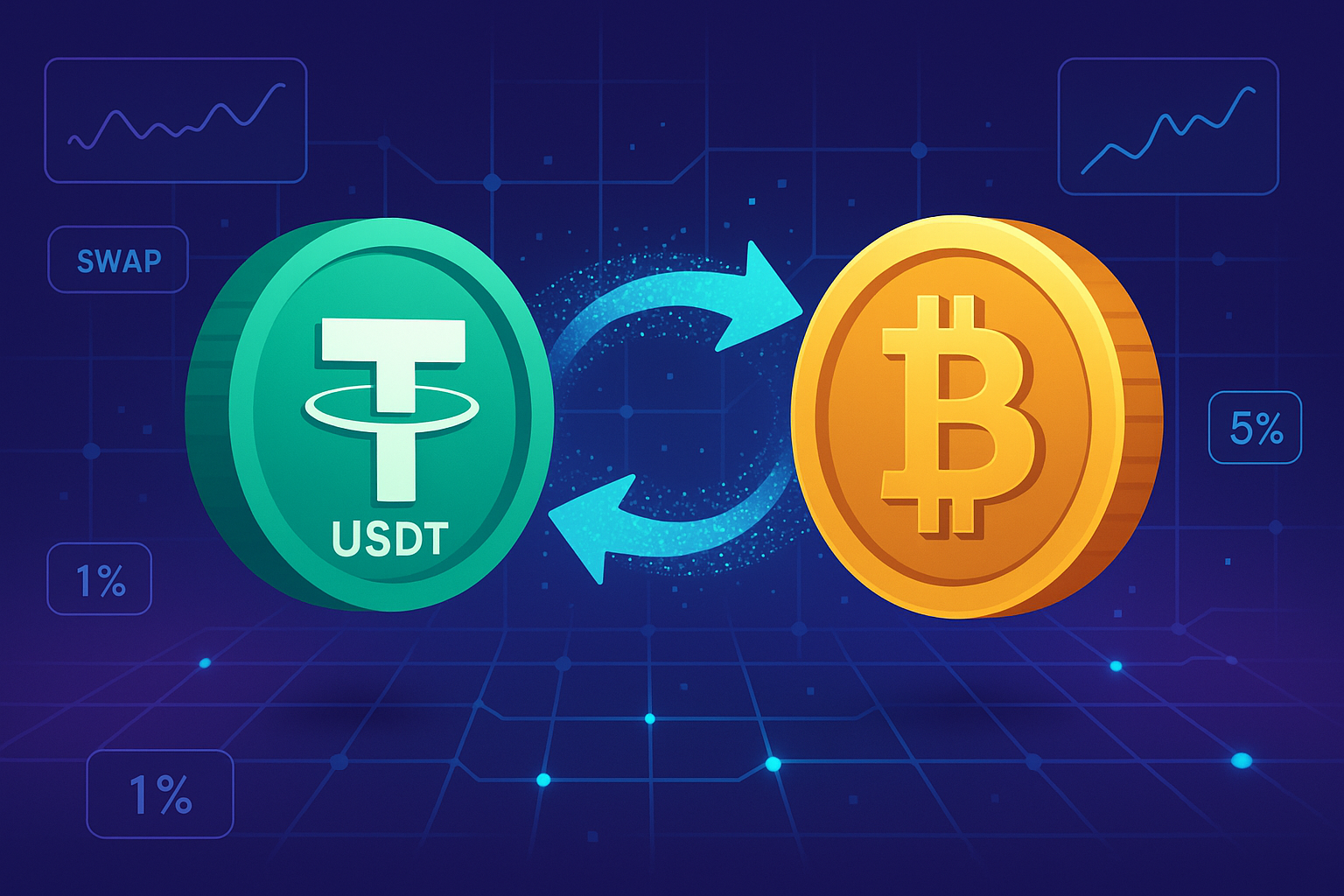
You can monitor the status on the transaction page. In most cases, your BTC will arrive within minutes after the USDT transaction is confirmed.
Pros of Swapping USDT to BTC on GhostSwap
- No KYC or account creation required, preserving your privacy.
- Non-custodial: you always keep control of your wallets and private keys.
- Fast settlement: typical swaps finish in 5–30 minutes.
- Wide choice: 1,500+ crypto pairs available, not just USDT/BTC.
- Simple interface suitable for both beginners and experienced traders.
Cons of Swapping USDT to BTC on GhostSwap
- Crypto-to-crypto only: you need to already have USDT to use it.
- You cannot deposit or withdraw traditional currencies unless you use a separate “buy crypto” on-ramp.
You can swap USDT for BTC, ETH, USDC and 1,500+ other coins on GhostSwap without KYC.
Method 2: Using a Centralized Exchange
Another way to swap USDT to BTC is via a centralized exchange (CEX). This involves depositing your USDT into an exchange account, placing a trade on the USDT/BTC spot market, then withdrawing your BTC to your personal wallet.
How It Works
First, you must sign up and complete the exchange’s account verification process. This typically requires KYC documentation like a passport or ID card, proof of address, and sometimes a selfie or video verification.
Once verified, you obtain a deposit address for USDT (again, be sure to match the network), send your USDT there, wait for confirmations, then use the trading interface to buy BTC with your Tether balance.
Pros of Using a Centralized Exchange
- Advanced order types such as limit, market, and stop orders.
- High liquidity on major pairs like USDT/BTC, potentially tighter spreads.
- Additional services like margin, derivatives, and savings products.
Cons: KYC, Delays, and Custodial Risk
- Mandatory KYC and ID verification that can take hours or days.
- Your assets are held in a custodial wallet controlled by the exchange.
- Possible withdrawal limits, delays, or freezes during peak periods.
- Higher attack surface: exchanges are frequent targets of hacks.
If your primary goal is simply to convert USDT to BTC quickly and maintain privacy, a centralized exchange is usually less convenient than a no-KYC swap service.
Method 3: Using DEXs, P2P, or Bitcoin ATMs
Beyond instant swap platforms and centralized exchanges, there are three other broad paths to move from USDT into Bitcoin: decentralized exchanges (DEXs), peer-to-peer trading, and Bitcoin ATMs.
Swapping USDT to BTC on a DEX
A decentralized exchange lets you trade directly from your wallet via smart contracts. On chains with synthetic BTC (like WBTC on Ethereum), you could first swap USDT to a wrapped Bitcoin token, then bridge or convert to native BTC.
This route is more complex and may involve multiple steps: USDT to WBTC, WBTC to BTC via a bridge, and possibly higher gas fees, especially on Ethereum. It is better suited to advanced DeFi users.
Peer-to-Peer (P2P) USDT to BTC Trades
In P2P markets, you trade directly with another person. You send USDT to their wallet, and they send BTC to yours, often coordinated through a P2P marketplace with escrow.
Advantages include customizable payment methods and sometimes better rates, but risks include counterparty fraud, platform disputes, and the need for extra vigilance in choosing reputable counterparties.
Using Bitcoin ATMs
Some Bitcoin ATMs allow you to insert cash or sometimes even send stablecoins, receiving BTC in return. This is highly location dependent, and fees at ATMs are usually much higher than online methods.
Many modern ATMs also enforce KYC thresholds above certain amounts, so privacy is not guaranteed. Check the machine’s terms before transacting.
Tips for Staying Safe When You Swap USDT to BTC
Verify Contract Addresses and Networks
USDT exists on multiple blockchains. Always confirm that your wallet, the platform you are using, and any address you interact with are on the same network (for example, TRC‑20 to TRC‑20).
You can verify the official USDT contracts on the Tether website at tether.to to avoid interacting with fake tokens.
Use Trusted Wallets and Keep Backups
Only use well-reviewed, reputable wallets that let you control your seed phrase. Store your seed phrase offline, written on paper or a metal backup, never in screenshots or cloud notes.
For larger BTC holdings after your swap, consider hardware wallets for maximum security and reduced attack surface.
Double-Check Every Address and Amount
Copy-paste errors or clipboard malware can redirect your funds to an attacker. Always verify at least the first and last several characters of any crypto address you paste.
Before sending large amounts, do a small test transaction. Once confirmed, send the remaining balance.
Beware of Phishing and Fake Platforms
Attackers create fake websites that imitate popular crypto services. Type URLs manually or use bookmarks, and look for HTTPS and correct spelling of site names like GhostSwap.io.
Never follow random links from emails, social media, or messaging apps that ask you to connect your wallet or “claim rewards.”
Monitor Market Conditions and Fees
Crypto prices can change rapidly. If you are swapping a large amount of USDT to BTC, monitor price volatility on aggregators like CoinGecko or CoinMarketCap so you are comfortable with the rate.
Network fees on both USDT chains and Bitcoin can spike during busy periods. If timing is flexible, waiting for lower congestion can save you money on fees.
Ready to Get Started?
If you are looking for the simplest private path from stablecoins into BTC, using a non-custodial swap is normally the most direct route. You avoid accounts, order books, and complicated trading screens, and the BTC arrives directly in your own wallet.
To swap crypto instantly from USDT to BTC, you only need your USDT wallet, a Bitcoin address, and a few minutes of your time.
Ready to Trade Tether (USDT)?
You can start a private exchange from USDT to BTC in a few clicks using GhostSwap’s non-custodial swap interface. Visit the USDT to BTC swap page on GhostSwap, enter your amount, paste your BTC address, and send your Tether to receive Bitcoin directly in your wallet, without KYC.
Frequently Asked Questions
Can I do this without ID?
Yes. If you use a non-custodial instant swap platform, you can typically convert USDT to BTC without creating an account or uploading identification documents. You only interact with smart routing and liquidity providers while staying in control of your own wallets.
Centralized exchanges, on the other hand, almost always require KYC for deposits, trading, and certainly for withdrawals above very small limits. If your priority is privacy, prefer no-KYC services where you remain non-custodial.
What is the best method to swap USDT to BTC?
The best method depends on your priorities. If you want speed, privacy, and simplicity, a non-custodial instant swap like GhostSwap is usually the optimal choice because you do not leave funds on an exchange and can complete the process in minutes.
If you are an active trader who needs advanced tools, order types, and high-frequency trading, a centralized exchange may be more suitable, but you will trade off privacy and assume custodial risk. For a fast, private option, you can convert to XMR via BTC on a non-custodial platform with no account required.
How long does it take to convert USDT to Bitcoin?
For on-chain instant swaps, most USDT to BTC swaps complete in 5–30 minutes. The timing largely depends on the confirmation speed of the network holding your USDT and the current congestion on the Bitcoin blockchain.
Centralized exchanges can introduce additional waiting time: account verification, internal risk checks, batching of withdrawals, and security reviews may extend the process to several hours or even days in some cases.
Is it safe to use GhostSwap?
GhostSwap is designed as a non-custodial swap service, meaning it does not hold your long-term balances and does not require an account. You send only the amount you want to swap, and the BTC is returned directly to an address you control.
No platform can eliminate all risk, but you can significantly enhance safety by verifying the correct URL, double-checking addresses, using secure wallets, and keeping your device free from malware. Combined with these best practices, a non-custodial swap model minimizes exposure compared with storing funds on custodial exchanges.
Ready to Swap?
Convert your crypto instantly on GhostSwap — no KYC, no sign-up required.
Popular swaps: BTC to XMR | BTC to ETH | XMR to BTC | ETH to XMR | BTC to SOL