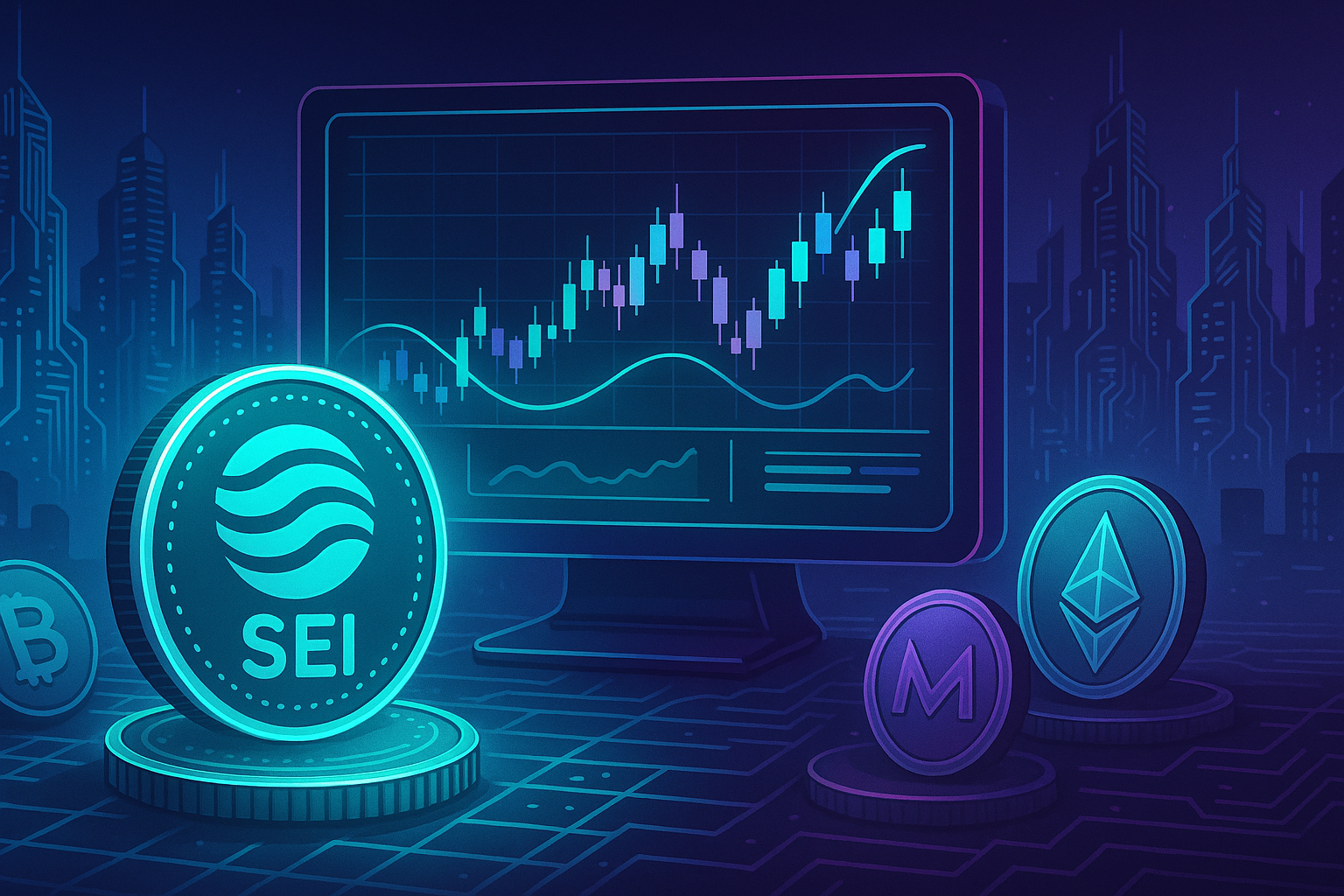
SEI Price Prediction 2026-2030: Can Sei Turn Modular DeFi Into Long-Term Gains?
| Year | Low | Average | High |
|---|---|---|---|
| 2026 | $0.18 | $0.32 | $0.55 |
| 2027 | $0.25 | $0.46 | $0.85 |
| 2028 | $0.32 | $0.60 | $1.10 |
| 2029 | $0.40 | $0.78 | $1.40 |
| 2030 | $0.52 | $1.05 | $1.90 |
SEI could trade in a broad range between roughly $0.18 and $1.90 over 2026-2030 in our scenario-based outlook, with the average case seeing a slow grind higher if the Sei ecosystem keeps growing. These projections assume continued crypto adoption, no catastrophic regulatory shock, and gradual delivery on the project roadmap. If you want to position ahead of potential volatility without using a custodial exchange, you can swap SEI for BTC and other coins privately in a few minutes using GhostSwap.
This is not financial advice. Cryptocurrency markets are volatile. Always do your own research before investing.
SEI Price Overview
Sei (SEI) is the native token of the Sei Network, a high-performance layer-1 blockchain focused on trading, DeFi, and orderbook-based applications. Built originally on the Cosmos SDK and now evolving toward a more modular architecture, Sei aims to provide ultra-fast finality and a parallelized execution environment tailored to on-chain trading experiences.
At the time of writing in mid-2026, SEI trades well below its all-time high and is considered a mid-cap altcoin by market size. For live statistics such as current price, circulating supply, 24-hour volume, and market capitalization, you should always reference trusted data aggregators like CoinGecko or CoinMarketCap, as these figures change constantly.
Historically, SEI reached an all-time high (ATH) of around the low-dollar range shortly after launch, before retracing significantly with the broader altcoin market. Its all-time low (ATL) was set during a later period of risk-off sentiment when liquidity rotated into Bitcoin and large caps.
The SEI token currently has several core functions:
- Gas fees for transactions and smart contract execution on Sei Network.
- Staking to secure the network and participate in delegated proof-of-stake governance.
- Collateral and utility within DeFi protocols, orderbooks, and liquidity venues built on Sei.
Because SEI sits at the intersection of DeFi, modular blockchains, and the Cosmos / IBC ecosystem, its price is sensitive to adoption by on-chain exchanges and traders. This makes non-custodial swap options particularly useful for investors actively rotating between SEI, BTC, and stablecoins.
SEI Price History
To build a realistic SEI price prediction, it helps to understand how the token has traded so far. While exact price levels move daily, the structural phases of SEI’s history are clearer.
Launch and Initial Hype Phase
SEI launched during a period of strong interest in high-throughput, trading-focused blockchains. Backed by reputable venture capital and a clear narrative around orderbook-optimized infrastructure, the token quickly attracted speculative flows.
The early weeks after listing saw:
- A sharp post-listing rally as centralized exchanges opened spot markets and liquidity mining incentives came online.
- High volatility due to relatively low float and concentrated early holders.
- Strong social media attention around performance metrics and testnet benchmarks.
This was when SEI set its all-time high, driven more by narrative and momentum than by mature on-chain fundamentals.
Consolidation and Retracement
As initial hype faded and token unlock schedules progressed, SEI experienced a substantial retracement. This phase was shaped by:
- Vesting and unlocks from private rounds, which increased circulating supply.
- A shift in macro conditions as interest rates stayed elevated and risk assets became less attractive.
- Rotation from speculative L1s into Ethereum, Bitcoin, and large-cap DeFi tokens.
Like many newer layer-1 tokens, SEI’s drawdown from its peak was steep in percentage terms. This locked in a wide ATH-to-ATL range that will matter for future resistance levels in our SEI price prediction analysis.
Infrastructure Build-out and Ecosystem Growth
After the speculative peak, the project’s focus turned more toward:
- Launching core DeFi protocols such as DEXs, perps, and lending markets on Sei.
- Expanding IBC interoperability and bridges to Ethereum and other ecosystems.
- Rolling out optimizations and upgrades tied to Sei’s modular and parallelized execution roadmap.
Price action during this era has been more range-bound, with periodic pumps around announcements or broader market rallies. Each new integration or protocol launch has helped build the case that SEI could evolve from a speculative L1 token into a core settlement and trading hub.
SEI Technical Analysis
Technical analysis can offer a framework for SEI price forecasts, even though it cannot predict the future with certainty. Here, we look at common tools like support and resistance, moving averages, and momentum indicators to form directional biases.
Support and Resistance Levels
Key support and resistance for SEI typically align with:
- The prior all-time low region, which often acts as a long-term demand zone if tested again.
- Round-number psychological levels around fractions of a dollar.
- Previous local highs set during relief rallies after the main bear-market drop.
- Volume profile nodes where large amounts of SEI have historically traded.
On most timeframes, the zone around the prior ATL and nearby consolidation clusters forms major support. Breakdown below that area would be structurally bearish and could invalidate many optimistic SEI price prediction scenarios.
Moving Averages
Traders often watch the 50-day, 100-day, and 200-day moving averages (MAs) for SEI:
- When SEI trades above the 200-day MA with that line sloping upward, the asset is generally considered in a macro uptrend.
- Golden crosses (50-day MA crossing above the 200-day) are seen as bullish confirmation after a bottoming phase.
- Death crosses (50-day crossing below 200-day) tend to confirm deeper corrective structures.
In mid-2026, SEI has spent extended periods moving sideways around these key MAs, reflecting an undecided market where fundamental progress is balancing out token unlock overhang and macro uncertainty.
RSI and Momentum
The Relative Strength Index (RSI) can highlight overbought or oversold conditions:
- RSI readings over 70 often mark short-term overextension, especially on 4H and daily charts.
- RSI under 30 can indicate selling exhaustion and potential bounce areas, especially if diverging from price.
- Bullish divergence occurs when RSI trends up while price makes equal or lower lows.
SEI’s RSI history shows several strong oversold readings after large unlock-related selloffs, followed by mean-reverting rallies. For long-term investors, these momentum washes may present better risk-reward entries than chasing parabolic breakouts.
Patterns and Market Structure
Common patterns observed on SEI charts include:
- Accumulation ranges with tightening volatility as early buyers and sellers reach equilibrium.
- Breakouts from horizontal resistance zones on ecosystem news or broader market strength.
- Descending channels during macro risk-off phases, which can sometimes resolve higher if fundamentals improve.
Technical structure should always be layered with fundamentals, tokenomics, and macro drivers when forming a SEI price prediction across multiple years.
SEI Price Prediction 2026
Our SEI price prediction for 2026 centers on whether the next crypto cycle continues and whether Sei can secure a real niche as a trading-optimized layer-1.
Base Case: Gradual Adoption
In a neutral scenario where the crypto market is generally bullish but not euphoric, and Sei continues to ship upgrades and attract DEX/perps TVL, SEI could average around $0.32 in 2026. This would represent moderate appreciation from depressed bear-market levels, without reclaiming its earliest speculative peaks.
Key assumptions for this base case include:
- Bitcoin maintains a higher post-halving range, supporting altcoin interest.
- Sei’s modular architecture and parallel execution demonstrably improve on-chain trading UX.
- Token unlocks are absorbed gradually, with staking and real yield helping offset selling pressure.
In this environment, liquidity would likely improve across both centralized and decentralized exchanges, while non-custodial platforms let users rotate efficiently. You can swap SEI for BTC, ETH, USDT and 1,500+ other coins on GhostSwap without KYC.
Bull Case: Breakout on Ecosystem Growth
In a bullish scenario, SEI price in 2026 could reach up to $0.55. This would likely require:
- At least one flagship on-chain orderbook or perps exchange on Sei capturing meaningful market share.
- Robust cross-chain connectivity, with Sei becoming a preferred settlement layer for certain trading verticals.
- Favorable regulatory conditions for DeFi and derivatives trading in key jurisdictions.
Under these circumstances, a narrative could emerge that Sei is a core infrastructure play for the next wave of on-chain trading, driving speculative and fundamental flows alike.
Bear Case: Macro or Execution Risks
In a bearish 2026, SEI might revisit or slightly undercut prior lows, trading down to around $0.18. Such an outcome would likely stem from:
- Stronger-than-expected regulatory clampdowns on DeFi or exchange tokens.
- Underwhelming ecosystem traction relative to competitors like Solana, Ethereum L2s, or other app-specific chains.
- Prolonged risk-off macro conditions where investors flee smaller caps.
Even in this case, SEI might still hold some value as a speculative bet on future rebound, but the risk-reward would be skewed by opportunity cost and illiquidity.
SEI Price Prediction 2027
By 2027, SEI’s valuation will likely depend on how sticky its ecosystem has become, and whether its performance edge versus general-purpose chains is still meaningful.
Base Case: Ecosystem Maturity
In a steady development trajectory, our SEI price prediction for 2027 puts the average price around $0.46, with the token trading mostly within a wide band as market cycles unfold. By then, Sei should have:
- A set of core DeFi protocols with established user bases and liquidity.
- More mature governance processes and clearer monetary policy around inflation and staking rewards.
- Integration into multi-chain wallets, aggregators, and institutional-facing infrastructure.
Assuming altcoins overall remain relevant and on-chain activity continues growing, SEI could benefit from rising volumes and increased staking demand.
Bull Case: Structural Winner in On-Chain Trading
In a strong bull case for 2027, SEI could spike up to around $0.85. This would likely require:
- Sei establishing itself as a go-to chain for high-frequency, low-latency trading strategies.
- Significant TVL in derivatives, structured products, and novel DeFi primitives that can only run efficiently on Sei-like infrastructure.
- Strong partnerships with liquidity providers, market makers, and institutional participants.
In such a scenario, SEI might start being treated as a “picks-and-shovels” play on on-chain exchange volume, attracting more long-term capital rather than just speculative retail flows.
Bear Case: Competitive Squeeze
On the downside, SEI in 2027 could lag the market and trade around $0.25 if:
- Major competitors (e.g., Ethereum L2s, Solana, other L1s) neutralize Sei’s latency and throughput advantages.
- Developers and liquidity providers favor ecosystems with larger existing user bases.
- Tokenomics, such as inflation, reduce the appeal of holding SEI versus alternatives.
In this environment, SEI might remain a niche chain, and upside would depend on a future pivot or breakthrough product.
SEI Price Prediction 2028
By 2028, the digital asset landscape could be very different, with real-world assets, compliant DeFi, and modular blockchains either entrenched or replaced by new paradigms. SEI’s price will reflect how well it adapts.
Base Case: Slow but Steady Growth
Our base SEI price prediction for 2028 places the average price near $0.60, with the token continuing a gradual uptrend from prior years. This would assume:
- Sustained on-chain volume on Sei’s main applications.
- Healthy staking participation, which reduces effective circulating float.
- Ongoing network upgrades that keep Sei competitive in performance and developer tooling.
By now, fundamental valuation metrics such as fee revenue, MEV capture, and staking yield could matter more for SEI than pure narrative.
Bull Case: Multi-Cycle Compounder
In a very bullish 2028 scenario, SEI could reach up to $1.10. This would likely correlate with:
- Sei expanding beyond its original niche into a broader modular ecosystem with app-chains or rollups anchored to it.
- Significant integration with institutional flows, possibly through permissioned DeFi rails or compliant trading venues.
- Clear revenue-sharing or value-accrual mechanisms from protocol fees to SEI stakers or holders.
If these conditions hold, SEI might be viewed as a core infra asset similar to how some investors approached Ethereum or leading L2 tokens in earlier cycles.
Bear Case: Stagnation and Dilution
On the bearish side, SEI in 2028 might stagnate near $0.32 if:
- Ecosystem growth plateaus and volume migrates to more dominant chains.
- Token incentives are no longer compelling, and inflation dilutes holders without corresponding growth.
- Regulatory frameworks limit the types of trading activity that can legally occur on permissionless chains.
In this case, SEI could still have periodic speculative rallies but fail to make sustainable new highs, making long-term compounding difficult.
SEI Price Prediction 2029-2030
Longer-term SEI price predictions involve a wide margin of error. Still, constructing scenarios helps investors think through what must be true for SEI to succeed or fail by the end of the decade.
Macro and Industry Context
By 2029-2030, several structural factors could shape SEI’s path:
- The maturity of modular blockchain architectures, where execution, data availability, and settlement are decoupled.
- The share of global trading volume that has migrated on-chain, including derivatives and tokenized real-world assets.
- Regulatory clarity around self-custody, DeFi participation, and cross-border access to trading protocols.
If on-chain trading becomes a substantial proportion of global markets, a chain optimized for this use case could capture significant value. If it remains a niche, upside might be limited.
Base Case 2029-2030: Sustainable Infrastructure Play
In a reasonable base case where Sei remains relevant and continues to evolve, we project:
- 2029 average price: around $0.78, within a $0.40 to $1.40 range.
- 2030 average price: around $1.05, within a $0.52 to $1.90 range.
This path assumes SEI outperforms traditional markets but behaves roughly in line with a basket of successful alt-L1 and L2 tokens that survive multiple cycles.
Bull Case 2029-2030: Category Leader
In an aggressive bull case for late-decade SEI valuation:
- Sei could be a central backbone for specialized on-chain exchanges, both retail and institutional.
- Protocol revenues and sequencer or validator economics could drive strong real yield to SEI stakers.
- SEI might trade with valuations more akin to high-growth tech infra companies than speculative tokens.
Under such conditions, the upper bound of our projected ranges, near $1.90, becomes plausible, with intracycle spikes possibly overshooting even that during mania phases. However, forecasting beyond this is speculative and should be treated cautiously.
Bear Case 2029-2030: Obsolescence or Displacement
On the downside, SEI might underperform if:
- Newer architectures or regulatory-compliant platforms make existing public L1s less attractive for serious trading.
- Network security or uptime issues erode trust in Sei as a core settlement layer.
- The token loses clear value-accrual pathways, becoming a pure governance or gas token with limited upside.
In such a pessimistic scenario, SEI could struggle to sustain prices even at the lower end of our projected ranges, and long-term holders would be heavily reliant on speculative rotation rather than fundamentals.
Is SEI a Good Investment?
Whether SEI is a good investment depends on your risk tolerance, time horizon, and conviction in Sei Network’s technical edge and ecosystem potential.
Investment Thesis: Pros
- Clear niche focus: Sei targets on-chain trading and orderbook-based applications, giving it a coherent narrative compared with generic L1s.
- High-performance architecture: Fast finality and parallel execution can be tangible advantages for latency-sensitive trading use cases.
- Staking and yield: Delegated proof-of-stake allows holders to stake SEI, potentially earning rewards and aligning with network security.
- Interoperability: Roots in the Cosmos/IBC ecosystem allow cross-chain connectivity, boosting potential liquidity inflows.
Key Risks and Cons
- Fierce competition: SEI competes with Ethereum L2s, Solana, app-chains, and other optimized L1s, all chasing DeFi and trading volume.
- Tokenomics risk: Unlock schedules, inflation, and incentive design can exert sustained sell pressure if not matched by adoption.
- Regulatory uncertainty: DeFi, derivatives, and exchange infrastructure are in regulators’ crosshairs, which could affect Sei’s core use cases.
- Execution risk: Delivering on a modular, high-throughput roadmap while keeping security and decentralization robust is non-trivial.
Who Might Consider SEI?
SEI may be suitable for:
- Investors comfortable with mid- to high-risk altcoin exposure.
- Those who understand DeFi and on-chain trading and can evaluate ecosystem traction.
- Stakers seeking exposure to potential real yield from protocol usage over the long term.
It may be less suitable for conservative investors, short-term traders who cannot monitor volatility closely, or anyone overexposed to high-beta crypto already.
What Experts Say About SEI
While long-term predictions are uncertain, industry analysts and research platforms have offered perspectives on Sei and SEI’s potential.
Research and Analytics Platforms
Crypto research outlets and data providers have highlighted Sei’s positioning among high-performance chains. For example, analytical commentary often notes that:
- Sei’s design is tailored to a specific use case (trading), which can be a competitive advantage if it captures a significant share of that vertical.
- Real activity metrics such as daily active addresses, on-chain volume, and DEX usage will be key indicators for SEI’s sustainable valuation, beyond speculative narratives.
You can track such metrics through dashboards on analytics platforms and cross-reference them with market data from CoinGecko or CoinMarketCap to inform your own SEI price prediction views.
VC and Institutional Commentary
Early venture backers and institutional participants in the Sei ecosystem have generally emphasized:
- The potential for app-specific, optimized chains to coexist with general-purpose blockchains.
- The importance of attracting serious market makers and liquidity providers to any trading-focused chain.
Public statements from these groups tend to be optimistic, but they should be read with awareness of their vested interests.
Independent Analysts and Traders
Independent crypto analysts and technical traders often treat SEI as a high-beta altcoin that can outperform in strong markets but underperform in drawdowns. Some see it as:
- A cyclical trading vehicle around key support and resistance zones.
- A tactical allocation if on-chain trading narratives regain momentum.
When considering expert opinions, focus on those who clearly lay out assumptions, tokenomics, and risk factors rather than pure price calls.
Factors That Could Affect SEI Price
Several structural, fundamental, and market factors will influence SEI’s trajectory between now and 2030.
1. Network Adoption and On-Chain Volume
The single most important driver for SEI is likely to be actual usage of Sei Network:
- DEX and perps volume, open interest, and fee revenue.
- Number of active protocols and developers building on Sei.
- Liquidity depth across SEI pairs and major stablecoin markets.
Stronger adoption improves the fundamental case for SEI and can justify higher valuations, especially if there are robust value-accrual mechanisms.
2. Tokenomics and Staking Dynamics
SEI’s supply schedule and staking parameters are critical:
- High inflation without corresponding growth can suppress price.
- Well-managed emissions and incentives can bootstrap liquidity while protecting long-term holders.
- Staking yields that come from real economic activity (fees, MEV, protocol revenues) are more sustainable than purely inflationary rewards.
Monitoring governance proposals and tokenomics changes is essential for anyone building a SEI price prediction or investment thesis.
3. Regulatory Landscape
Because Sei focuses on trading infrastructure, regulations around:
- Decentralized exchanges and derivatives.
- KYC/AML requirements for on-chain trading interfaces.
- Classification of tokens as securities in various jurisdictions.
could materially impact SEI’s upside or downside. Friendly regulation could unlock institutional adoption, while restrictive rules might push activity to more permissioned systems.
4. Competition from Other Chains
SEI competes with:
- Ethereum rollups and modular stacks aimed at low-latency trading.
- Fast monolithic chains with strong ecosystems.
- Emerging app-specific infrastructures offering specialized trading environments.
If competitors close Sei’s performance gap or offer more attractive incentives, SEI might struggle to capture mindshare and liquidity.
5. Macro and Crypto Market Cycles
Finally, broader market cycles exert large influence:
- Bitcoin halving cycles and global liquidity conditions typically drive capital flows into or out of altcoins.
- Risk-on periods can see SEI multiples expand, while risk-off phases may compress valuations sharply.
Even the strongest fundamentals cannot fully shield SEI from macro drawdowns, so cycle awareness matters for entry and exit timing.
Ready to Trade SEI?
Swap SEI instantly on GhostSwap without KYC, registration, or custody risk. Choose from over 1,500 cryptocurrency pairs and move between SEI, BTC, ETH, stablecoins and more in a few clicks.
Try the SEI to BTC private exchange route on GhostSwap if you want fast, non-custodial swaps instead of leaving funds on centralized platforms.
Frequently Asked Questions
Will SEI reach $1?
Based on the scenario ranges in this SEI price prediction, it is plausible that SEI could revisit or exceed $1 by 2028-2030 in a bullish or strong base-case environment. Our upper projections put SEI’s potential high around $1.10 in 2028 and up to $1.90 in 2030 under favorable conditions.
However, this outcome depends on robust network adoption, competitive positioning, and a supportive macro environment. There is no guarantee SEI will reach or hold $1, and investors should always consider downside scenarios.
Is SEI a good long-term investment?
SEI can be a compelling long-term investment for those who believe in:
- The growth of on-chain trading and DeFi as a structural trend.
- The need for specialized high-performance chains for certain financial applications.
- Sei’s ability to attract developers, liquidity, and institutional partners.
At the same time, SEI is a higher-risk altcoin subject to intense competition, regulatory uncertainty, and macro volatility. It should generally be treated as a speculative component of a diversified portfolio rather than a core holding for conservative investors.
What will SEI be worth in 2030?
Our SEI price prediction for 2030 outlines a broad range:
- Low: around $0.52, assuming modest adoption or a challenging macro/regulatory backdrop.
- Average: around $1.05, in a steady growth scenario where Sei remains a relevant trading-focused chain.
- High: up to $1.90, in a bullish outcome where Sei becomes a category leader in on-chain trading infrastructure.
These numbers are estimates, not guarantees. They should be used as a framework for thinking about risk and reward, not as price targets.
Where can I buy/swap SEI?
You can acquire SEI on major centralized exchanges that list the token, as well as on decentralized exchanges within supported ecosystems. If you prefer a non-custodial, privacy-focused route, you can use GhostSwap to swap crypto instantly between SEI and BTC, ETH, USDT, and over 1,500 other assets without creating an account or passing KYC.
Always double-check contract addresses and URLs to avoid phishing sites, and consider using hardware wallets for long-term storage.
Is SEI better than other layer-1 competitors?
Whether SEI is “better” than another chain depends on what metrics you prioritize:
- Performance: Sei is designed for fast, parallelized execution, which can outperform some general-purpose chains for trading workloads.
- Ecosystem: Larger chains may currently have more applications, users, and liquidity, which is a key competitive factor.
- Risk profile: Mature ecosystems could be seen as lower risk, while younger chains like Sei might offer higher upside with higher uncertainty.
Investors often diversify across multiple L1 and L2 ecosystems rather than betting on a single winner. Comparing developer activity, TVL, and real usage data from sources like CoinGecko and block explorers can help you make an informed judgment.
Finally, remember that you do not have to commit permanently to one ecosystem. Non-custodial platforms like GhostSwap make it easy to adjust your allocation over time as new information emerges and narratives evolve.