How to Swap ETH to BTC in 2026: Fast, No‑KYC Guide for All Skill Levels
If you want to swap ETH to BTC as quickly as possible in 2026, the fastest method is to use a non-custodial instant swap service with no KYC. Just connect your wallet, choose Ethereum to Bitcoin, enter your BTC address, send ETH, and receive BTC in minutes.
- Open a non-custodial swap platform and select ETH → BTC.
- Enter the amount of ETH and your Bitcoin receiving address.
- Send the exact ETH amount to the deposit address shown.
- Wait for confirmations, then receive BTC directly in your wallet.
For example, you can swap ETH to BTC on GhostSwap in one flow, without creating an account or uploading ID.
What You Need Before You Start
Swapping Ethereum for Bitcoin is straightforward, but having the right setup avoids delays and mistakes.
1. A Non‑Custodial Wallet for ETH
You need a wallet that holds your ETH and lets you send transactions. Popular non-custodial wallets include:
- MetaMask (browser & mobile)
- Trust Wallet (mobile)
- Ledger or Trezor hardware wallets (connected via their apps)
Make sure:
- You control the seed phrase or private keys.
- You can send ETH on the main Ethereum network (not a testnet or L2 unless the service explicitly supports it).
2. A Bitcoin Wallet Address
You also need a BTC receiving address, which you can generate from:
- Non‑custodial wallets like BlueWallet, Sparrow, or hardware wallets.
- Custodial wallets on centralized exchanges (if you accept holding BTC on an exchange).
Always double‑check you are using a Bitcoin address format:
- Legacy:
1... - P2SH:
3... - Bech32 (SegWit):
bc1...
3. Minimum Amounts and Gas Fees
Instant swap platforms have minimum trade sizes, depending on liquidity and network fees.
Before starting your swap:
- Check the platform’s minimum ETH amount for ETH → BTC.
- Have a bit more ETH than you plan to swap to cover network gas.
Ethereum gas fees fluctuate, so verify the current fee environment on a block explorer or fee tracker like Etherscan Gas Tracker.
4. Time Needed
The total time to swap ETH to BTC depends on:
- Ethereum confirmation time for your deposit.
- Bitcoin confirmation time for your outgoing swap.
- Platform processing time between the two.
In practice, an instant non‑custodial swap usually completes in 5–30 minutes, while a centralized exchange route can take anywhere from 30 minutes to several days if KYC review is needed.
Method 1: Using GhostSwap (No KYC — Recommended)
GhostSwap is a non‑custodial instant swap platform that lets you swap ETH to BTC without creating an account or submitting ID. It supports 1,500+ trading pairs and sends crypto directly to your wallet.
Step 1: Go to GhostSwap.io
Open your browser and go to GhostSwap.io.
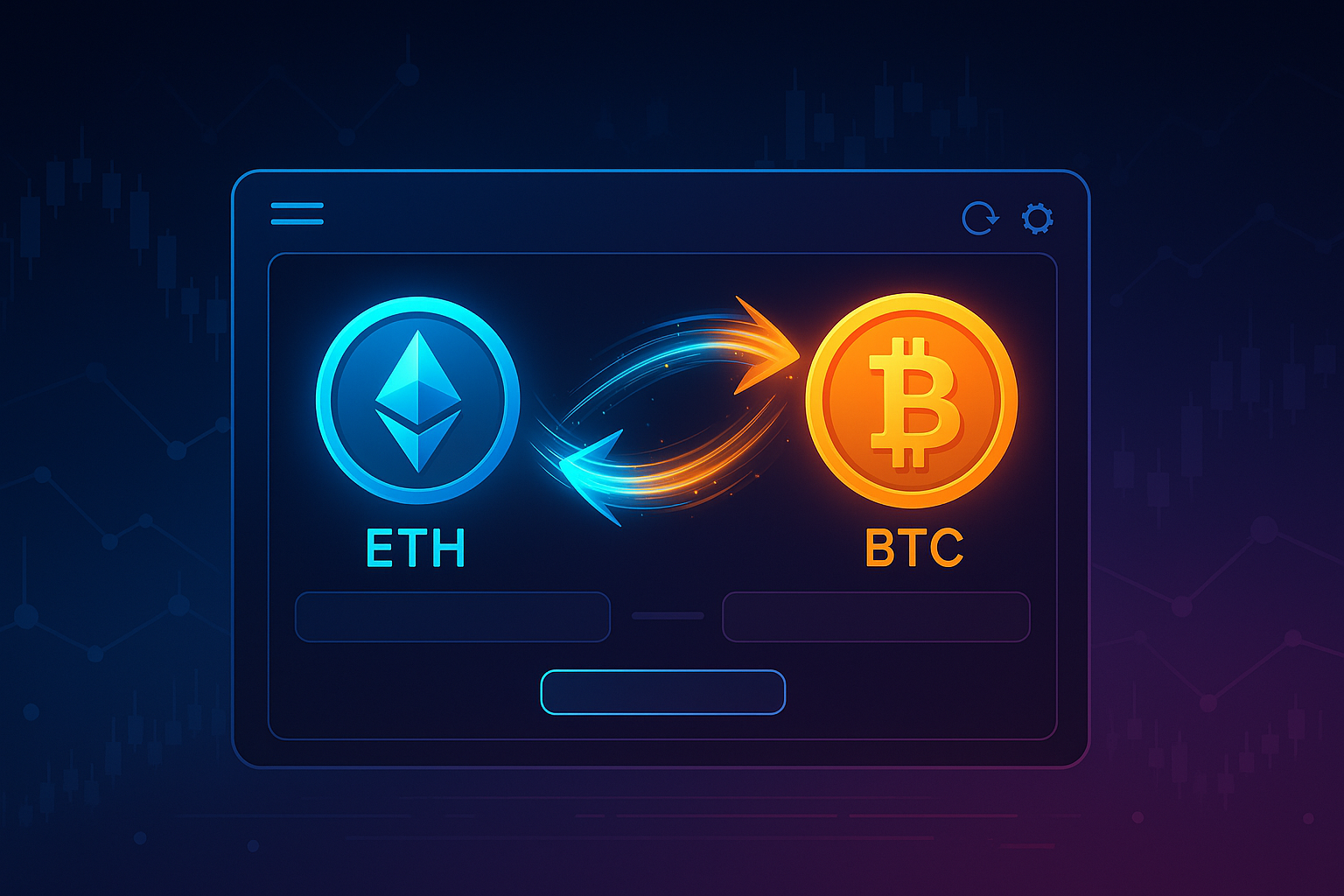
On the homepage, you will see a simple swap widget where you can choose your input and output currencies.
Step 2: Select ETH in the Exchange Widget
In the “You send” field, select ETH (Ethereum) as the coin you are swapping from.
In the “You receive” field, select BTC (Bitcoin) as the coin you want to receive. Or go directly to the ETH → BTC page at this non-custodial swap link.
Now:
- Enter the amount of ETH you want to swap.
- Review the estimated BTC amount you will receive, including displayed fees and rate.
Step 3: Enter Your Wallet Address
In the receiver / destination field, paste your Bitcoin address.
Double‑check it carefully:

- Compare first and last 4–6 characters with your wallet UI.
- Confirm you are not pasting an Ethereum address by mistake.
Once the BTC address is correct, proceed to the next screen to see the ETH deposit details.
Step 4: Send Your Crypto and Receive BTC
GhostSwap will show you:
- A unique ETH deposit address.
- The exact amount of ETH to send.
- A time window during which the rate is valid or the swap is guaranteed to execute.
Now, from your ETH wallet:
- Copy the deposit address from GhostSwap.
- Open your wallet and start a new transaction.
- Paste the deposit address and enter the exact ETH amount shown.
- Set an appropriate gas fee and confirm the transaction.
After the required Ethereum confirmations, GhostSwap automatically executes the trade and sends BTC to your specified address. You can track the progress on a status page and on-chain via explorers like Etherscan for ETH and a Bitcoin explorer (e.g., mempool.space) for BTC.
Pros and Cons of Using GhostSwap
Pros
- No KYC: Swap ETH to BTC without uploading ID or selfies.
- Non‑custodial: Funds go directly from your wallet to your BTC address.
- Speed: Most swaps complete within minutes after confirmations.
- 1,500+ pairs: Trade many altcoins alongside ETH → BTC.
- Simplicity: No order books, just one clear flow.
Cons
- Crypto‑to‑crypto only: You cannot deposit fiat here directly, though you can use a separate “buy crypto” feature that routes through on‑ramps.
- Network dependence: Final speed depends on Ethereum and Bitcoin network congestion.
You can swap ETH for BTC, USDT and 1,500+ other coins on GhostSwap without KYC.
Method 2: Using a Centralized Exchange
Another way to swap ETH to BTC is to go through a centralized exchange (CEX) like Binance, Coinbase, or Kraken. This involves registering an account, passing KYC, and trading on an internal order book.
How It Works
- Create an account: Sign up on a CEX with your email and password.
- Verify identity (KYC): Upload government ID, selfies, and possibly proof of address.
- Deposit ETH: Generate an ETH deposit address and send ETH from your wallet or from another exchange.
- Trade ETH → BTC: In the exchange interface, place a market or limit order on the ETH/BTC pair.
- Withdraw BTC: Send the BTC you bought to your personal Bitcoin wallet.
Pros of Using a CEX
- Deep liquidity: Large order books can offer tight spreads for big trades.
- Extra features: Staking, margin, futures, etc., if you need them.
- Fiat on‑ramp: Easier to move in and out of bank accounts.
Cons of Using a CEX
- KYC and ID: You must submit personal documents, which may take hours or days to review.
- Custodial risk: You do not control your keys while funds sit on the exchange.
- Longer timelines: Between registration, KYC, and withdrawals, the total process can be slow.
- Privacy trade‑off: Your trades are linked to your verified identity.
For users who prioritize privacy and speed, non‑custodial swaps like private exchange routes for ETH → BTC are often more attractive than CEX accounts.
Method 3: Using a DEX, P2P Marketplace, or Bitcoin ATM
Beyond instant swap services and centralized exchanges, there are other paths to convert ETH to BTC in 2026. They vary in complexity, fees, and privacy.
Option A: Decentralized Exchanges (DEXs)
Pure DEXs like Uniswap, Sushi, or Curve specialize in Ethereum and EVM‑based tokens. They typically do not natively support BTC on the Bitcoin network, only wrapped versions like WBTC or renBTC.
To get real BTC, you would:
- Swap ETH to a stablecoin or WBTC on a DEX.
- Bridge or send that asset to a service that can redeem/buy BTC on the Bitcoin chain.
This multi‑step flow:
- Increases smart contract and bridge risk.
- Adds extra gas fees and time.
Because of that, most users who want native BTC prefer direct non‑custodial swaps instead of complex bridging flows.
Option B: P2P Marketplaces
Peer‑to‑peer platforms connect you directly with buyers and sellers who want to trade ETH and BTC. Examples include bulletin‑board style marketplaces or escrow‑based platforms.
Typical steps:
- Create an account on the P2P marketplace (some require KYC, others do not).
- Search for offers where someone wants to buy ETH with BTC or sell BTC for ETH.
- Agree on a rate and initiate the trade, often with an escrow system.
- Send ETH and wait for the counterparty to send BTC to your address.
Pros:
- Potentially good rates if you negotiate.
- Can sometimes avoid full KYC, depending on the platform.
Cons:
- Counterparty risk if escrow or dispute resolution is weak.
- Trades can be slow, depending on the other person.
- Interface is more complex than a simple swap widget.
Option C: Bitcoin ATMs and Local Cash Deals
Some Bitcoin ATMs and local crypto dealers may accept ETH and give you BTC in return, but this is far less common than fiat ↔ BTC operations.
Realistically, for ETH → BTC in 2026, ATMs usually involve an extra step:
- Sell BTC or buy BTC with cash; you still need a way to convert ETH to cash or another asset first.
Because of the limited infrastructure and high fees, ATMs are rarely the best choice for directly swapping ETH to BTC compared with online non‑custodial services.
Tips for Staying Safe
Crypto transfers are irreversible. A few careful checks dramatically reduce your risks when you swap ETH to BTC.
1. Use Reputable Wallets and Keep Backups
- Stick to well‑known wallets with open‑source code or strong audits.
- Store your seed phrase offline, written on paper or a metal backup.
- Never share your seed phrase or private keys with any website or “support” agent.
2. Verify URLs and Bookmark Services
- Type
ghostswap.ioyourself or use a trusted bookmark instead of clicking random ads. - Check for the correct domain spelling and HTTPS lock icon.
3. Double‑Check Addresses and Amounts
- Copy‑paste wallet addresses, then verify the first and last few characters manually.
- Watch out for clipboard‑hijacking malware that swaps in an attacker’s address.
- When trying a new service, start with a small test amount.
4. Monitor Network Fees and Confirmations
- Check ETH gas fees before sending; congested periods can make swaps more expensive.
- Follow your transaction on a block explorer to ensure it is confirmed.
- Remember that Bitcoin confirmations might take longer than Ethereum, especially in congested periods.
5. Keep Your Device Secure
- Update your OS, browser, and wallet apps regularly.
- Use hardware wallets for larger balances whenever possible.
- Enable 2FA on any exchange accounts you use.
For additional reference on ETH and BTC market data, check reliable aggregators like CoinGecko (Ethereum) or CoinMarketCap (Bitcoin).
Ready to Trade Ethereum?
If you are ready to convert ETH to BTC privately, you can use GhostSwap’s swap crypto instantly interface. Choose ETH → BTC, paste your Bitcoin address, send ETH, and receive BTC straight to your wallet without KYC.
Frequently Asked Questions
Can I do this without ID?
Yes. You can swap ETH to BTC without ID by using non‑custodial, no‑KYC swap services like GhostSwap.
These platforms do not require an account or identity verification for standard crypto‑to‑crypto swaps. You just provide a receiving BTC address and send ETH from your wallet.
Centralized exchanges, by contrast, almost always require KYC if you want to trade or withdraw beyond very small limits.
What is the best method?
The “best” way to swap ETH to BTC depends on your priorities:
- Privacy & simplicity: Non‑custodial instant swaps like GhostSwap are typically best.
- Deep liquidity & advanced features: Centralized exchanges can be useful if you are comfortable with KYC and custodial risk.
- Custom arrangements: P2P marketplaces are an option but require more effort and trust management.
For most everyday users who simply want ETH → BTC directly to their own wallet without ID, an instant non-custodial swap is usually the most efficient route.
How long does it take?
On a non‑custodial instant swap service:
- Ethereum confirmations: typically a few minutes, depending on gas fees.
- Swap processing: usually a couple of minutes after confirmations.
- Bitcoin confirmations: first confirmation often within 10–30 minutes, though it can be faster or slower based on network congestion.
In total, most ETH → BTC swaps complete in 5–30 minutes. Centralized exchanges can take longer because of KYC approval, internal processing, and withdrawal delays.
Is it safe to use GhostSwap?
GhostSwap is built as a non‑custodial swap tool. It does not hold your long‑term balances, and you keep control of your own wallets.
Safety still depends on your own practices:
- Always verify the official GhostSwap URL before using it.
- Start with small swaps if you are a first‑time user.
- Use secure wallets and protect your seed phrase.
No service can eliminate blockchain or market risks entirely, but non‑custodial swaps significantly reduce custodial exchange risks by sending assets directly between wallets you control.
When you are ready, you can use GhostSwap’s non-custodial swap flow to turn ETH into BTC quickly and privately.