What Is DeFi? A Complete 2026 Guide to Decentralized Finance
DeFi, short for decentralized finance, is a system of financial apps built on public blockchains that lets anyone lend, borrow, trade, save, and earn yield without banks or brokers. Instead of relying on companies, DeFi uses smart contracts, open-source code, and crypto assets to deliver financial services directly to users.
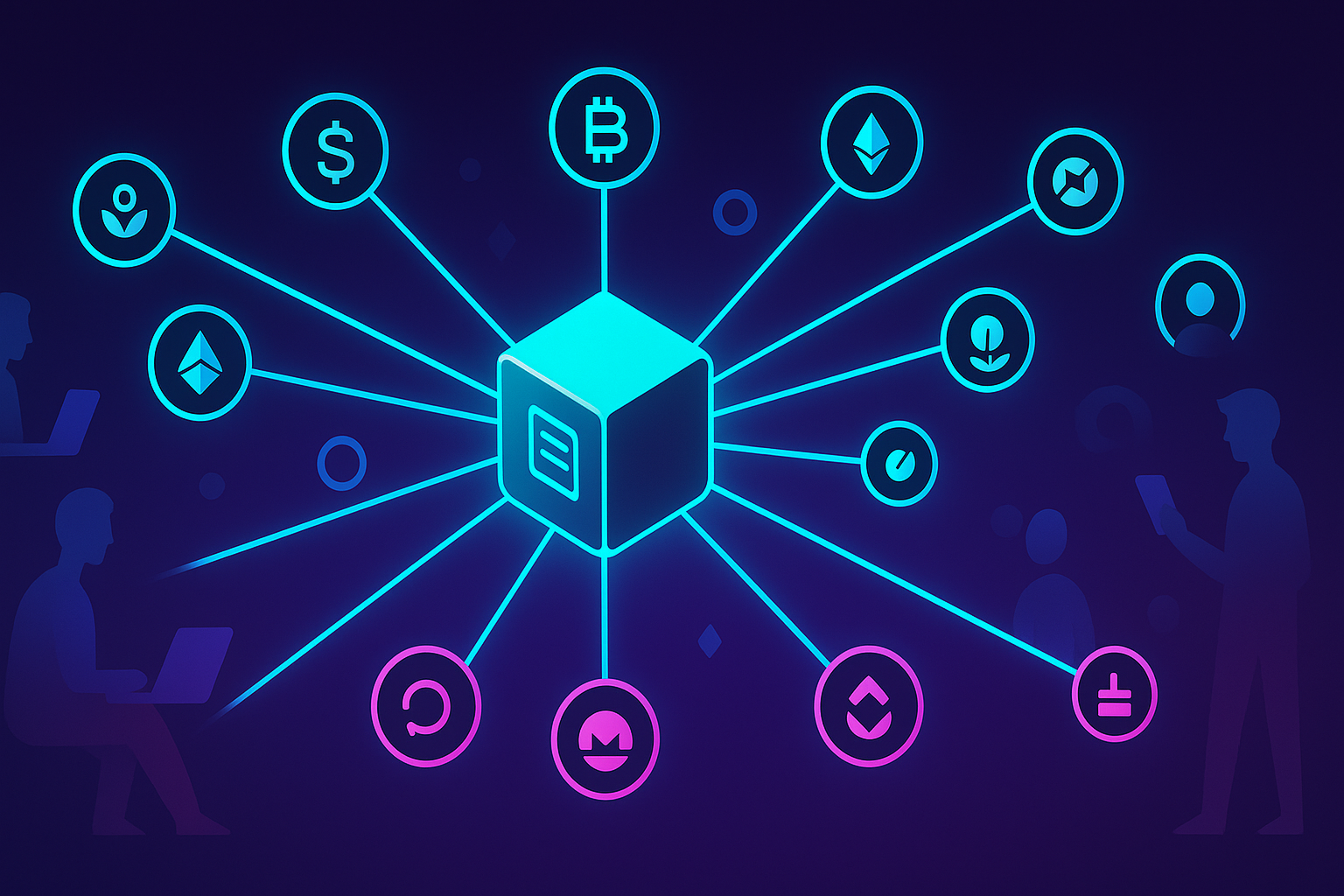
At its core, DeFi tries to rebuild key parts of traditional finance using transparent code and distributed networks. You keep control of your funds in your own wallet, and you interact with protocols rather than signing paperwork with a bank or broker. Platforms like GhostSwap make it easy to plug into this ecosystem by swapping one crypto for another instantly and non-custodially.
What Is DeFi? Explained Simply
To understand what DeFi is, start by thinking about how traditional finance works.
When you use a bank, stock broker, or payment app, your money sits in their accounts. They maintain databases, decide who gets access, set the rules, and can freeze or block transactions. You trust them to hold your funds and follow laws and regulations.
DeFi flips this model.
Instead of companies holding your money, you hold your own crypto in a wallet that you control with your private keys. Instead of banks and brokers, you interact with programs called smart contracts running on blockchains like Ethereum, Polygon, BNB Chain, and others.
These smart contracts are like vending machines for financial services. Deposit one asset, get another out, according to rules that anyone can inspect in the code. No account manager, no branch office, no paperwork.
In simple terms:
- DeFi is finance run by code instead of by banks.
- It is open to anyone with an internet connection, usually without KYC or credit checks at the protocol level.
- You keep custody of your funds in your own wallet instead of depositing into a company’s account.
That is why DeFi is often described as “open, programmable money” or “banking without banks.”
How Does DeFi Work?
Even though DeFi feels simple to use once you try it, there is a lot going on under the hood. Here is how decentralized finance works at a technical but accessible level.
Smart contracts on public blockchains
Most DeFi apps are built on smart contract platforms such as Ethereum, which pioneered programmable money, and compatible networks like Arbitrum, Optimism, Polygon, and BNB Chain.
A smart contract is self-executing code stored on the blockchain. It holds funds, enforces rules, and updates balances automatically based on inputs. No one can arbitrarily change it once deployed, unless an upgrade or governance path is built in.
Examples of DeFi smart contracts:
- Automated market makers (AMMs) that let users swap tokens algorithmically
- Lending pools that match borrowers and lenders via collateral and interest rates
- Staking contracts that distribute token rewards to participants
Tokens as programmable assets
DeFi runs on crypto tokens. The most common standard is ERC‑20 on Ethereum and equivalent standards on other chains.
Tokens can represent:
- Native assets like ETH or MATIC
- Stablecoins pegged to fiat currencies, such as USDT, USDC, or DAI
- Governance tokens that give voting rights over a protocol
- Yield-bearing tokens that track deposits in lending or staking protocols
Because these tokens follow standard interfaces, different DeFi applications can plug into each other. This composability is why people call DeFi “money Legos.”
Non-custodial wallets and keys
DeFi is typically accessed via a non-custodial wallet like MetaMask, Rabby, Trust Wallet, or hardware wallets such as Ledger and Trezor.
With a non-custodial wallet:
- You hold your own private keys.
- The wallet signs transactions that interact with smart contracts.
- Apps never actually take ownership of your funds; they just receive permission to use them under specific rules.
This is different from leaving coins on a centralized exchange account, where the company holds the keys.
Automated market makers (AMMs) and DEXs
Trading is one of the core DeFi use cases. Instead of centralized order books run by exchanges, DeFi often uses AMMs to power decentralized exchanges (DEXs).
In an AMM:
- Liquidity providers deposit pairs of tokens into a pool.
- The pool uses a pricing formula (like x*y=k in Uniswap v2) to quote prices.
- Traders swap tokens directly against the pool, paying a fee.
- Fees are shared proportionally among liquidity providers.
This model means markets can exist for long-tail tokens without depending on traditional market makers or centralized matching engines.
Oracles and external data
Some DeFi protocols need off-chain data, such as asset prices. They use oracles like Chainlink, Pyth, or Uniswap TWAP oracles to feed reliable data into smart contracts.
Robust oracles are particularly critical for:
- Lending and borrowing protocols that risk liquidations
- Derivatives and perpetual futures
- Synthetic assets that track external prices
Governance and DAOs
Many DeFi projects are governed by DAOs (Decentralized Autonomous Organizations). Token holders vote on proposals such as fee structures, new features, or treasury spending.
Governance tokens do not guarantee ownership in a legal sense, but they often control a protocol’s parameters and revenue flows. This governance layer is what keeps DeFi evolving over time rather than being frozen at launch.
You can swap BTC, ETH, USDT and 1,500+ other coins or tokens to access the wider DeFi ecosystem using non-custodial tools like GhostSwap without any KYC.
Why Does DeFi Matter?
Understanding what DeFi is is only half the story. The bigger question is why it matters at all.
Open access to financial services
Traditional banks and brokers often gate access based on geography, ID documents, credit scores, and minimum balances. Billions of people are underbanked or excluded entirely.
DeFi protocols are generally:
- Permissionless Anyone with an internet connection and a wallet can use them.
- Borderless There is no concept of domestic vs international users on a public blockchain.
- 24/7 Markets and protocols run continuously, not on business hours.
This can expand access to savings, credit, and investment tools for people in emerging markets or those shut out of legacy systems.
Self-custody and reduced counterparty risk
High-profile exchange failures in past cycles highlighted risks of centralized custodians. When you leave funds on a custodial platform, you are exposed to their operational, regulatory, and fraud risks.
In DeFi, you typically:
- Keep funds in your own wallet.
- Interact with audited smart contracts instead of opaque internal ledgers.
- Rely on open-source code and on-chain proofs rather than company statements.
There are still smart contract and market risks, but the risk profile is different and more transparent.
Programmable money and innovation
Because DeFi is built in software, it is highly programmable. Developers can:
- Compose protocols together to create new financial products.
- Automate complex strategies that run 24/7.
- Launch global applications without securing bank partnerships.
This accelerates innovation compared to traditional finance, where new products often require regulatory approvals, bank integrations, and manual processes.
Transparency and verifiability
Activity in DeFi is recorded on public blockchains. Anyone can inspect:
- Smart contract code and audits
- Reserves backing stablecoins or lending pools
- Historical trades, liquidations, and governance votes
This level of transparency is rare in traditional finance, where many processes and risks are hidden in internal systems.
Potential for new economic models
DeFi introduces native digital assets, token incentives, and on-chain governance. This enables experiments in:
- Community-owned protocols
- Revenue-sharing tokens
- Decentralized credit scoring and identity
It is still early, but these tools could reshape how people coordinate capital and ownership online.
DeFi Examples and Real-World Use Cases
To make “what is DeFi” concrete, here are several common categories and how people actually use them.
1. Decentralized exchanges (DEXs)
DEXs like Uniswap and Curve allow users to trade tokens directly from their wallets through AMM pools. There is no account signup, and trades settle on-chain.
People use DEXs to:
- Swap between major assets like ETH and stablecoins
- Access long-tail tokens that may not be listed on centralized platforms
- Provide liquidity and earn a share of trading fees
Non-custodial swap platforms such as GhostSwap’s instant crypto swap service complement these tools by aggregating routes and simplifying the user experience.
2. Lending and borrowing
Protocols like Aave and Compound let you supply tokens to earn interest or borrow against your crypto collateral.
Typical uses include:
- Putting idle stablecoins to work for yield
- Borrowing without selling long-term holdings
- Leveraged strategies for advanced users
Interest rates adjust algorithmically based on supply and demand, and all loans are typically overcollateralized, reducing default risk at the protocol level.
3. Stablecoins and on-chain savings
Stablecoins such as USDT, USDC, and DAI aim to track the value of fiat currencies like the US dollar. They are a cornerstone of DeFi liquidity.
Use cases include:
- Storing value in crypto without volatility
- Sending low-cost global payments
- Depositing into yield-bearing protocols for on-chain savings
Data from aggregators like CoinGecko’s stablecoin rankings show that stablecoins are among the most traded crypto assets by volume.
4. Yield farming and liquidity mining
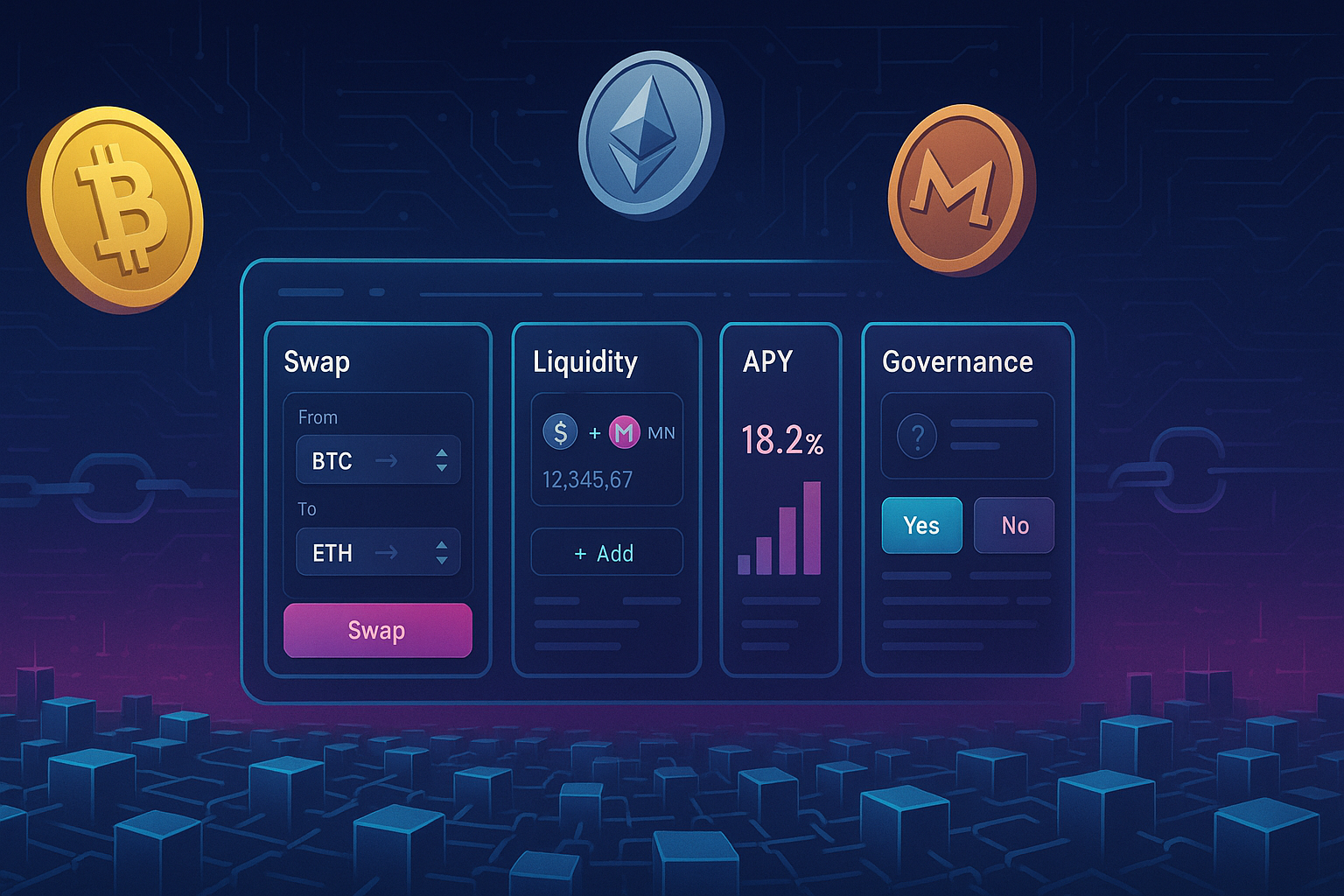
Yield farming involves providing liquidity or capital to DeFi protocols in exchange for rewards, often in the form of governance tokens.
Common strategies include:
- Staking LP tokens from DEXs in reward contracts
- Depositing assets into yield aggregators that auto-compound returns
- Participating in early liquidity mining programs for new projects
These strategies can be complex and risky, especially regarding impermanent loss and smart contract exploits, so they are best approached cautiously.
5. Derivatives, perpetuals, and synthetics
More advanced DeFi users trade derivatives such as perpetual futures, options, and synthetic assets that track stocks, commodities, or indexes.
On-chain derivatives allow:
- Leverage and hedging without centralized brokers
- Access to non-crypto price exposure via tokenized synthetics
- Automated liquidation and collateral management via smart contracts
These markets are still growing and carry substantial risk but showcase the breadth of what programmable finance can do.
Pros and Cons of DeFi
DeFi is powerful, but it is not a magic solution to every financial problem. Understanding its advantages and trade-offs is critical.
Benefits of DeFi
- Permissionless access Most protocols do not require KYC, credit checks, or bank accounts.
- Self-custody You control your keys and funds rather than trusting a centralized custodian.
- Transparency Code, balances, and transaction histories are visible on-chain.
- Global and 24/7 DeFi markets do not sleep and are not tied to any country.
- Composability Apps can build on each other like Lego bricks, accelerating innovation.
- Programmability Complex strategies can be automated without intermediaries.
Risks and limitations of DeFi
- Smart contract risk Bugs or vulnerabilities can lead to lost funds.
- Market and liquidation risk Volatility can trigger liquidations in lending and derivatives protocols.
- Regulatory uncertainty Rules for DeFi are evolving and vary by jurisdiction.
- User error Losing private keys, signing malicious transactions, or interacting with fake sites can be costly.
- Scams and rug pulls Some projects are malicious or unsustainable; due diligence is essential.
- Network fees and congestion Popular chains can become expensive or slow during peak periods.
Being aware of both pros and cons helps you approach DeFi with realistic expectations and appropriate caution.
How DeFi Relates to Trading on GhostSwap
Trading and swapping tokens is a foundational DeFi activity. Before you can lend, stake, or farm, you usually need to move into the right assets on the right chains.
GhostSwap fits into the DeFi stack as a non-custodial instant swap platform. Rather than functioning as a traditional order-book exchange, it acts as a bridge between you and liquidity across multiple networks.
Here is how using a tool like GhostSwap aligns with DeFi principles:
- Self-custody You never deposit funds into GhostSwap accounts. Swaps move directly between your wallets and the destination.
- Privacy-friendly You can swap crypto instantly on a private exchange interface, typically without KYC for reasonable amounts.
- Broad asset support With 1,500+ pairs, you can quickly obtain DeFi-native tokens (like governance or LP tokens) required by various protocols.
- Cross-chain flexibility Moving assets between different DeFi ecosystems becomes much simpler.
For example, you might:
- Swap BTC or another major coin into a stablecoin or ETH using GhostSwap.
- Send the tokens to your non-custodial wallet.
- Connect that wallet to DeFi apps to lend, trade, or farm yield.
In practice, a user-friendly instant swap is often the first step from holding crypto to actively using DeFi.
Ready to Start Trading?
If you want to move from learning about DeFi to actually using it, your first step is usually acquiring the right tokens in a self-custodial setup.
With GhostSwap, you can:
- Trade between BTC, ETH, USDT and 1,500+ other assets
- Avoid account registrations and lengthy KYC checks for typical amounts
- Maintain full control over your funds while swapping
Visit GhostSwap’s non-custodial swap platform to position your portfolio for DeFi opportunities in minutes.
Frequently Asked Questions
Is DeFi safe?
DeFi can be used safely, but it is not risk-free. Smart contract bugs, hacks, market volatility, and scams are real concerns.
To reduce risk:
- Stick to well-known protocols with audits and significant total value locked (TVL), as tracked by sites like DeFiLlama.
- Use hardware wallets for substantial amounts.
- Beware of offers promising extremely high yields with little explanation.
Never invest more than you can afford to lose, and always do your own research.
Do I need KYC to use DeFi?
Most DeFi protocols themselves are permissionless and do not require KYC because you interact via wallets, not personal accounts. However, on- and off-ramps, such as centralized exchanges or fiat gateways, may require KYC to comply with regulations.
Non-custodial services like GhostSwap focus on crypto-to-crypto swaps, allowing users to maintain more privacy than typical custodial platforms, though you are still responsible for complying with local laws.
How do I start using DeFi as a beginner?
A simple starter path looks like this:
- Set up a reputable non-custodial wallet and securely back up your seed phrase.
- Acquire a base asset (such as ETH or a major stablecoin) through your preferred channels.
- Use a non-custodial swap service to get the specific tokens you need for a protocol you have researched.
- Start with small amounts to learn how transactions, gas fees, and confirmations work.
Focus on blue-chip DeFi apps with clear documentation and strong communities while you build experience.
What is the difference between DeFi and CeFi?
CeFi (centralized finance) refers to traditional banks and also centralized crypto platforms that custody user funds and manage internal order books. You rely on the company’s solvency, security, and compliance.
DeFi removes the central operator layer. Funds stay in user-controlled wallets, and transactions are mediated by smart contracts on public blockchains. The trade-off is that you gain control and transparency but must manage your own security and deal directly with protocol risks.
Can I earn passive income with DeFi?
Yes, many people use DeFi for yield-focused strategies, including:
- Supplying assets to lending markets to earn interest
- Providing liquidity to DEXs for a cut of trading fees
- Staking tokens to secure networks or participate in governance rewards
However, “passive” does not mean “risk-free.” Yields can fluctuate, token prices can fall, and smart contracts can fail. Always weigh potential returns against the risks and complexity involved.