Updated 1 Oct 2026
Quick answer: to buy Bitcoin anonymously with no KYC, swap crypto you already hold (USDT, ETH, XMR, LTC and others) to BTC on a no-account swap service such as GhostSwap, or buy from a person on a peer-to-peer market such as Bisq, RoboSats or Hodl Hodl. Bitcoin ATMs work for small cash amounts, but many ask for ID above low limits. Card and bank purchases almost always involve an ID check by the payment provider.
Buy Bitcoin with no account in 4 steps
- Get a Bitcoin wallet you control (for example Sparrow, Electrum or a hardware wallet; see the best anonymous crypto wallets) and copy a receiving address.
- Pick the coin you send in the box below and BTC as the coin you receive.
- Paste your BTC address. The quote shows the rate, the network fee and the minimum and maximum before you commit.
- Send the deposit to the one-time address. The BTC is paid to your wallet, and you can follow the swap on its status page.


By clicking Confirm exchange, you agree to the Privacy Policy & Terms of Service.
Ways to buy Bitcoin without KYC, compared
| Method | ID / KYC | Pay with | Speed | Watch out for |
|---|---|---|---|---|
| No-account swap (GhostSwap) | None | USDT, ETH, XMR, LTC, SOL and 1,600+ other coins | Minutes after your deposit confirms | You need some crypto to start |
| P2P market (Bisq, RoboSats, Hodl Hodl) | None on the platform | Bank transfer, cash, payment apps (varies) | 30 minutes to a day | Counterparty risk, security deposits, slower trades |
| Bitcoin ATM | Often required above low limits | Cash | About 30–60 minutes, plus travel | High fees, often 10% or more |
| Gift cards and vouchers | Varies | Gift cards, prepaid vouchers | Varies | Poor rates and scams |
| Card or bank purchase | Yes, by the payment provider | Debit or credit card, bank transfer | 15–60 minutes | Not anonymous |
If you already hold any crypto, a no-account swap is the quickest way to get BTC with no ID at any step. Popular routes: USDT (TRC20) to BTC, ETH to BTC, XMR to BTC and LTC to BTC.
What Does “Buy Bitcoin Without KYC” Actually Mean?
“Buying Bitcoin without KYC” simply means purchasing BTC without going through invasive identity verification such as:
- Uploading a photo or scan of your ID or passport
- Providing a selfie or video verification
- Submitting detailed personal information like address, occupation, or income source
This does not mean the transaction is completely anonymous in every sense. Blockchain transactions are still public, and depending on the method you use, payment providers or counterparties may still see some data (for example, your bank or card details).
The key idea is to avoid tying your real‑world identity directly to your Bitcoin wallet through centralized KYC databases operated by large exchanges.
Why Buying Bitcoin Without KYC Matters
1. Financial Privacy
KYC exchanges store sensitive personal and financial data in centralized databases that can be hacked, leaked, or abused. High‑profile data breaches in traditional finance and crypto show that any centralized repository of identity documents is a long‑term risk.
For many users, buying Bitcoin without KYC is about:
- Reducing exposure to identity theft
- Limiting who can see their net worth and trading habits
- Avoiding the creation of a permanent, linked profile of all their crypto activity
2. Censorship Resistance
KYC requirements give platforms the power to freeze funds, close accounts, or block specific users, sometimes without clear explanation. Non‑KYC options are appealing to people in regions where:
- Crypto usage is restricted or heavily monitored
- Banks are hostile to exchanges and frequently close related accounts
- Sanctions or capital controls limit access to financial services
Bitcoin was designed to be censorship‑resistant. Using platforms that do not enforce strict KYC can be a way to align more closely with that original vision.
3. Reduced Friction and Faster Access
KYC verification on major exchanges can take hours or days, especially at peak times. Document rejections are common if photos are slightly blurry, expired, or not in the “right format.”
With non‑KYC options, users often can:
- Skip lengthy verification processes
- Buy smaller amounts quickly
- Avoid waiting for manual approval from support teams
Key Benefits of Buying Bitcoin Without KYC
1. Stronger Data Minimization
The fewer entities that hold your personal data, the smaller your attack surface. When you buy without KYC:
- No scanned IDs sit in centralized exchange databases
- There is less data for regulators or third parties to link to your on‑chain behavior
- You retain more control over how and where your personal information is stored
2. Better Alignment with Self‑Custody
Non‑KYC methods often encourage users to:
- Use their own wallets instead of leaving coins on an exchange
- Learn the basics of seed phrases and backups
- Adopt better security practices like hardware wallets
This mindset aligns with the core crypto principle: “Not your keys, not your coins.”
3. Access for the Underbanked
Some users cannot easily pass KYC even if they want to, for example:
- People without standard government IDs
- Migrants or refugees facing documentation challenges
- Individuals in countries with unstable or poorly functioning bureaucracies
Non‑KYC markets and on‑chain swaps can provide an alternative entry point to Bitcoin for those people.
Risks and Drawbacks of Non‑KYC Bitcoin Purchases
While the privacy and convenience benefits are real, there are also important trade‑offs to understand.
1. Higher Scams and Counterparty Risk
Peer‑to‑peer (P2P) trades without a trusted intermediary can expose you to:
- Fake payment confirmations
- Chargeback fraud when using reversible methods like PayPal or credit cards
- Counterparties disappearing after receiving your funds
Using reputable platforms and escrow features can reduce, but not fully remove, these risks.
2. Less Recourse if Something Goes Wrong
With major regulated exchanges, there is usually:
- Customer support
- Some internal controls and auditing
- Clear Terms of Service and dispute procedures
With smaller or non‑KYC platforms, you typically have less formal protection. If funds are lost due to a hack, bug, or scam, there may be no way to recover them.
3. Regulatory and Tax Considerations
Avoiding KYC does not make you exempt from local laws. In many jurisdictions:
- Gains on Bitcoin are still taxable
- Reporting obligations may still apply
- Certain payment methods may flag suspicious activity
Users are responsible for understanding and complying with the rules in their country, regardless of whether they use KYC or non‑KYC platforms.
4. Lower Buy Limits or Higher Fees
Many non‑KYC services:
- Limit how much you can buy per transaction or per day
- Charge higher spreads or fees for the convenience and privacy
- Price in the additional risk they take by not identifying users
This can make non‑KYC purchasing less attractive for very large amounts.
Main Ways to Buy Bitcoin Without KYC
There is no single “best” way; the right method depends on your location, risk tolerance, and payment preferences. Here are some of the most common approaches.
1. Non‑Custodial Swap Services
Non‑custodial swap services let you trade one cryptocurrency for another directly to your own wallet address. Typically:
- You do not create an account
- No or minimal personal data is collected
- Funds are not held on the platform; they pass through during the swap
A typical flow is:
- You provide a Bitcoin address you control
- You send another coin (for example USDT, ETH, or another crypto) to a generated deposit address
- The service sends BTC to your provided address after confirming the deposit
If you already have crypto and just need to convert it into BTC privately, a non‑custodial XMR to BTC swap can be one of the simplest non‑KYC options.
2. P2P Marketplaces and Local Traders
P2P platforms connect buyers and sellers directly. Features often include:
- Multiple payment methods (bank transfer, cash, online wallets, gift cards)
- Escrow, which holds BTC until both sides confirm payment
- User ratings and trade histories
Some P2P markets require KYC above certain limits or for specific payment methods. Others allow limited trading without verification. With in‑person cash trades, you can exchange fiat for Bitcoin directly using your own wallet.
3. Bitcoin ATMs (BTMs)
Bitcoin ATMs exist in many major cities. Many of them:
- Allow purchases with cash or debit cards
- Send BTC directly to your wallet via QR code
- Have variable KYC requirements based on amount and local law
In some regions, you can buy small amounts without ID, while larger purchases trigger phone verification or ID scanning. Always check the machine’s limits and fees in advance, as ATM fees can be significantly higher than online options.
4. Gift Cards and Vouchers
Some services and communities facilitate buying Bitcoin indirectly with gift cards or vouchers. Common patterns include:
- Trading gift cards with P2P traders who send you BTC
- Using regional crypto voucher codes redeemable on certain platforms
This method can be convenient but is also a common target for fraud, so skeptically verify any counterparty and platform.
Step‑by‑Step Guide: How to Buy Bitcoin Without KYC
Below is a general, practical workflow for someone starting from zero and wanting to end up with BTC in their own wallet without going through centralized exchange KYC. Adapt the steps based on your region and which tools are available to you.
Step 1: Set Up a Secure Bitcoin Wallet
Before buying any Bitcoin, prepare a wallet that you fully control.
- Choose a wallet type
- Hardware wallet for larger amounts and long‑term storage
- Mobile or desktop non‑custodial wallet for smaller sums and daily spending
- Write down your seed phrase on paper and store it securely offline
- Enable extra security based on wallet options:
- PIN or password
- Biometric lock on mobile
- Passphrase feature on hardware devices if supported
Never share your seed phrase or private keys with anyone, including support staff or “helpful” strangers online.
Step 2: Decide on Your Non‑KYC Method
Ask yourself:
- Do you already own other crypto?
If yes, a non‑custodial swap service may be fastest. - Do you prefer cash?
Look into local Bitcoin ATMs or trusted in‑person traders. - Do you want to use bank transfer or online payment methods?
Explore P2P marketplaces that offer escrow and optional KYC‑free tiers.
In practice, many users combine methods over time depending on fees, availability, and the amounts they want to buy.
Step 3: If You Already Have Crypto, Use a Non‑Custodial Swap
For someone who already holds USDT, ETH, or other cryptocurrencies, a non‑custodial swap is straightforward:
- Visit a reputable non‑custodial swap platform that does not require account registration.
- Select the pair (for example “USDT to BTC” or “ETH to BTC”).
- Enter the Bitcoin address from your personal wallet as the destination.
- Confirm the quoted rate and fees.
- Send the specified amount of input crypto to the deposit address provided.
- Wait for on‑chain confirmations. The service will send BTC to your wallet automatically.
A USDT to BTC swap with no account can be particularly useful if you want to avoid both account creation and KYC, while still converting one asset into another.
Step 4: If You Start From Fiat, Use P2P or ATMs
If you only have cash or bank funds, consider:
Option A: P2P Marketplace
- Choose a known P2P platform active in your region.
- Filter offers by:
- Payment method you can use
- Non‑KYC availability or low verification thresholds
- Seller rating and number of completed trades
- Read the seller’s terms carefully before initiating a trade.
- Initiate the trade and follow instructions precisely:
- Send the agreed fiat payment
- Provide your Bitcoin address in the chat or through the platform’s form
- Wait for the seller to confirm payment and release BTC from escrow.
- Verify the BTC has reached your wallet and only then mark the trade as complete.
Option B: Bitcoin ATM
- Locate a Bitcoin ATM using an aggregator site or local map.
- Check:
- Buy limits and any ID requirements
- Fees (usually expressed as a percentage above market)
- Supported payment types (cash, debit, etc.)
- On arrival, select “Buy Bitcoin” on the machine.
- Scan your wallet’s QR code or generate a new one in your app.
- Insert cash or use your card as instructed.
- Confirm the transaction and keep the receipt or on‑screen record.
- Wait for BTC to arrive in your wallet; this may take several minutes.
Step 5: Secure and Verify Your Bitcoin
After the purchase:
- Verify that the BTC balance appears in your wallet.
- Check the transaction on a blockchain explorer using your wallet’s transaction ID.
- For larger amounts, move coins from a “hot” wallet to a hardware wallet for long‑term storage.
- Back up your seed phrase in multiple secure locations, avoiding digital copies when possible.
Practical Tips for Buying Bitcoin Without KYC Safely
1. Start with Small Test Amounts
When using a new platform or method:
- Begin with an amount you can afford to lose.
- Confirm that the process works as expected.
- Scale up slowly once you are comfortable.
2. Vet Platforms and Traders Carefully
- Search for independent reviews and community feedback.
- On P2P markets, prioritize traders with high completion rates and positive reputations.
- Be skeptical of offers that seem “too good to be true,” especially with unusually favorable rates.
3. Protect Your Network and Devices
- Use updated antivirus and a secure operating system.
- Consider a VPN to reduce IP‑based profiling and tracking.
- Avoid public Wi‑Fi for transactions involving larger sums.
4. Use Payment Methods Thoughtfully
- Bank transfers and cards can be reversed, increasing fraud risk in P2P trades.
- Cash and some vouchers are harder to reverse but may involve more friction or higher fees.
- Always comply with your local legal and tax obligations regardless of method.
5. Do Not Overshare Information
Even on non‑KYC platforms, be mindful:
- Avoid sending ID images, selfies, or sensitive personal data in chats.
- Never share your wallet seed phrase or private keys.
- Use separate email addresses or aliases where appropriate and permitted.
Conclusion: Balancing Privacy, Security, and Responsibility
It is possible to buy Bitcoin without KYC by using a combination of non‑custodial swap services, P2P marketplaces, Bitcoin ATMs, and other privacy‑respecting tools. These methods can help you preserve financial privacy, reduce your exposure to centralized data breaches, and align more closely with Bitcoin’s self‑custodial ethos.
At the same time, non‑KYC does not mean risk‑free or law‑free. You still need to:
- Understand local regulations and tax rules
- Evaluate counterparty and platform risk
- Practice strong operational security
For users who already hold other cryptocurrencies and want to convert into BTC without creating new exchange accounts or handing over identification documents, a privacy‑focused, non‑custodial swap service can be a practical part of a broader strategy.
By choosing reputable tools, starting small, and staying informed, you can buy Bitcoin without KYC in a way that respects both your privacy and your long‑term security.
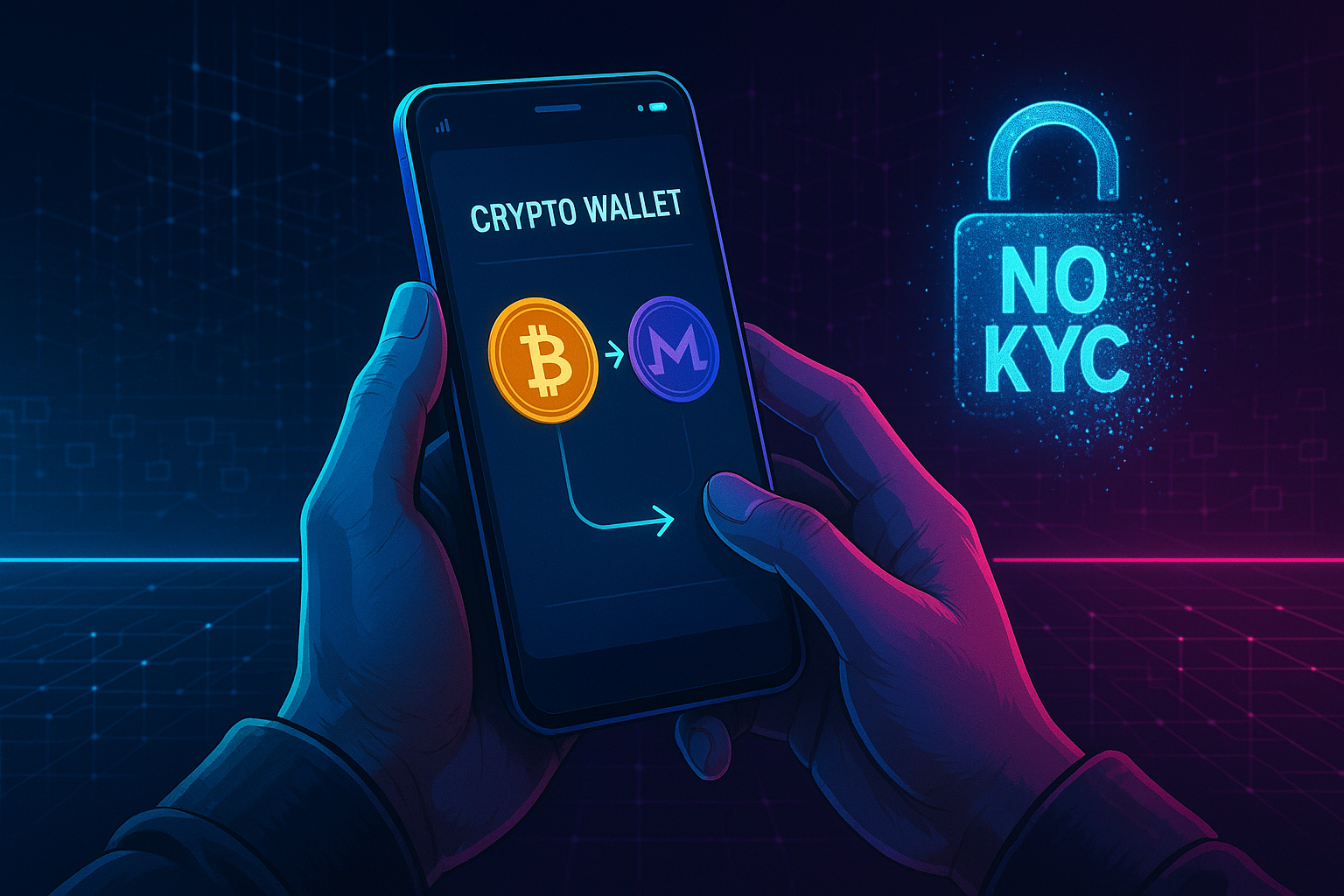
Buy Bitcoin without KYC: FAQ
Can you buy Bitcoin anonymously?
Yes, if you avoid services that ask for ID. Swapping crypto you already hold to BTC on a no-account service, or buying peer to peer, needs no ID upload. Receive the BTC in a wallet you control, and keep in mind that Bitcoin transactions are public on the blockchain.
Can I buy Bitcoin without ID?
Yes. No-account swap services like GhostSwap and P2P markets such as Bisq, RoboSats and Hodl Hodl do not ask for ID. Card purchases and most centralized exchanges do.
Is it legal to buy Bitcoin without KYC?
In most countries it is legal for you to buy Bitcoin without KYC, for example in a private P2P trade. The rules apply to businesses, and they differ by country, so check local law and report taxable gains where required.
Can I buy Bitcoin with a credit card without KYC?
Rarely. Card purchases go through payment providers that run their own identity checks. The no-ID route is to swap crypto you already hold to BTC.
How do I buy Bitcoin with Monero or USDT?
Swap it: choose XMR or USDT as the coin you send and BTC as the coin you receive, paste your Bitcoin address and send the deposit. See XMR to BTC and USDT to BTC.
How long does it take to get the Bitcoin?
Most of the time is spent waiting for your deposit to confirm. From USDT on TRON, LTC or SOL a swap usually finishes in 10–30 minutes; from XMR allow about 20–40 minutes.
Ready to Swap?
Convert your crypto instantly on no KYC crypto exchange — no KYC, no sign-up required.
Popular swaps: BTC to XMR | BTC to ETH | XMR to BTC | ETH to XMR | BTC to SOL