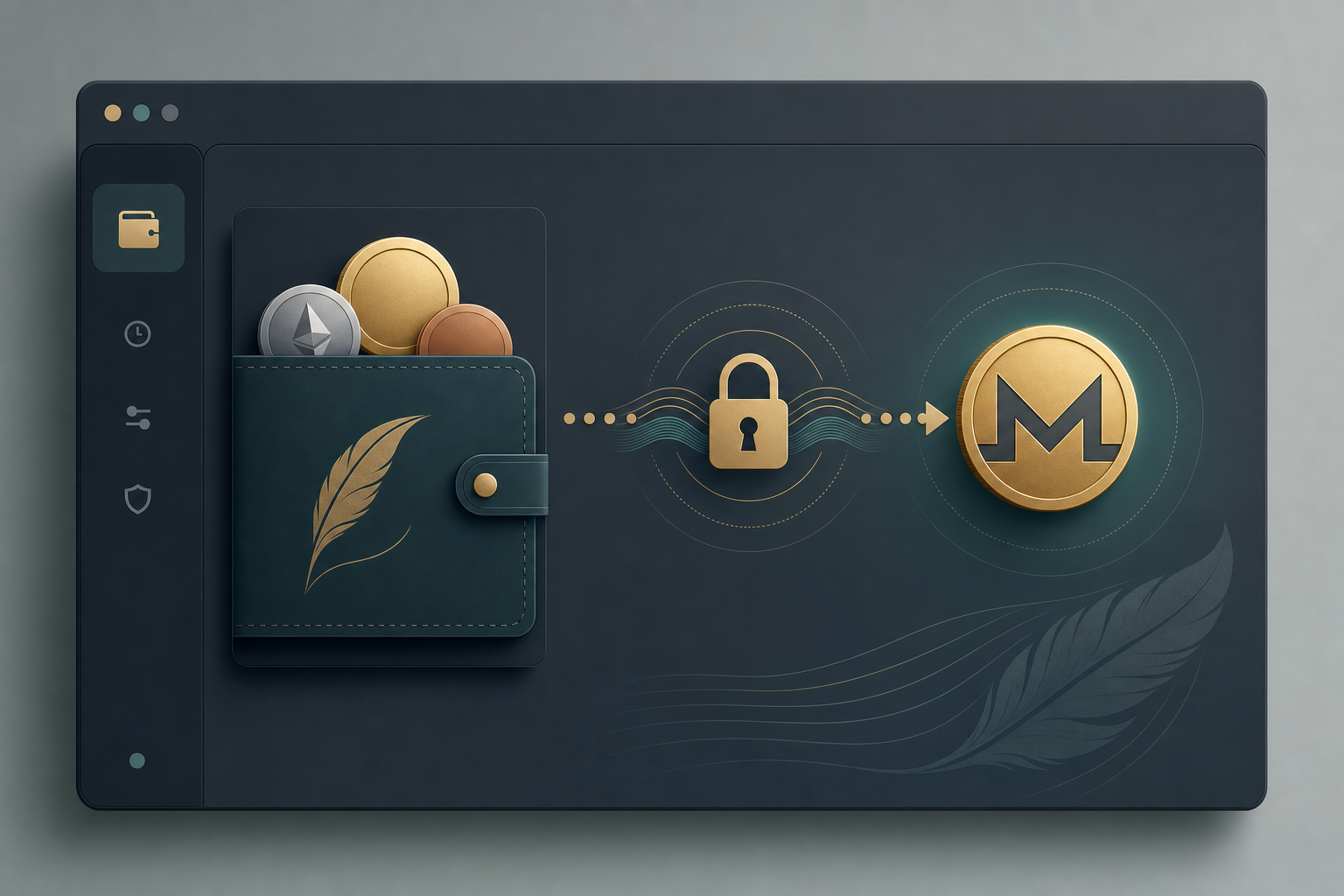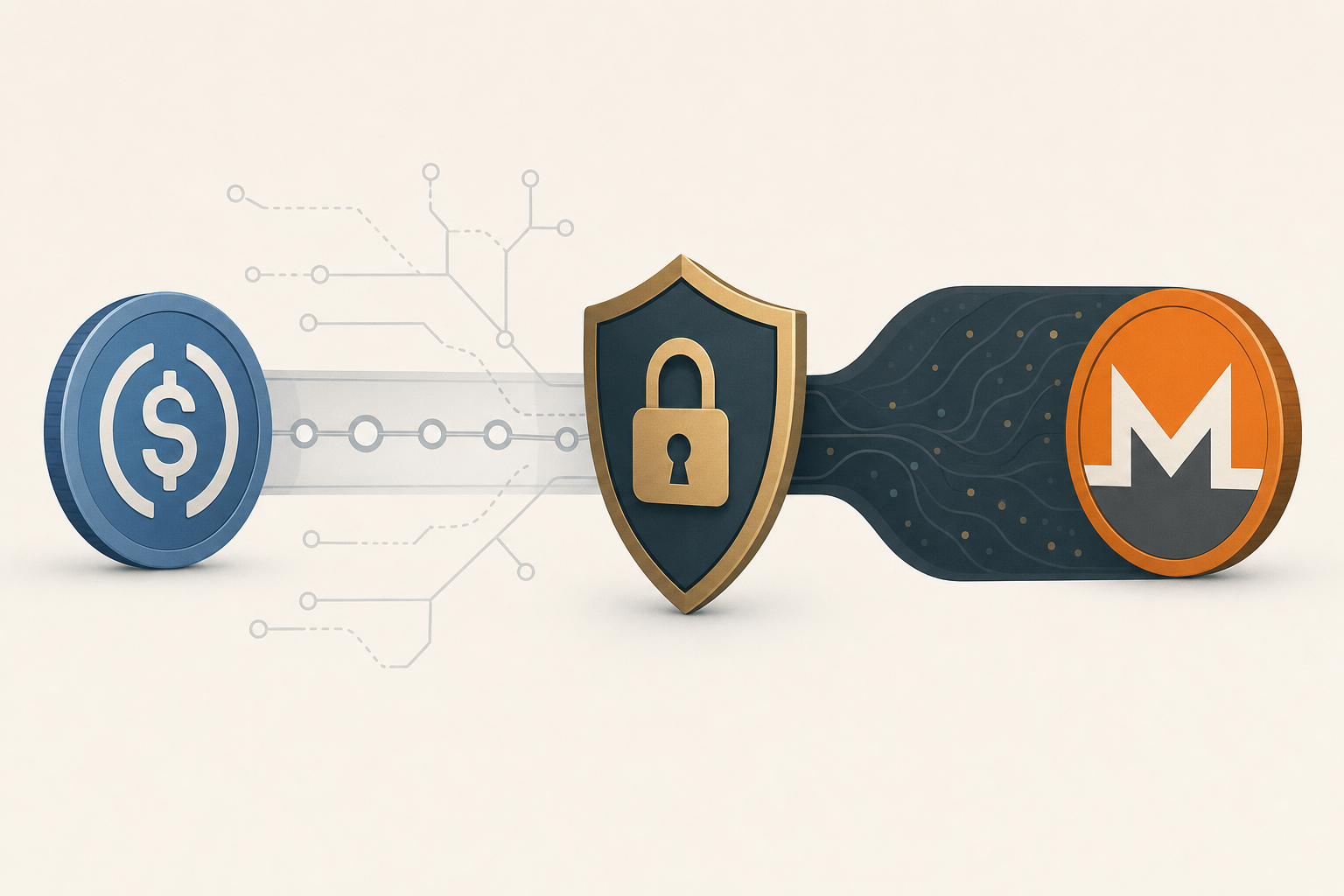
To swap USDC to Monero (XMR), you send USDC to a one-time deposit address, the service converts it at the live rate, and it forwards XMR to your Monero address — no account and no KYC on GhostSwap. The one thing to get right first is which network your USDC lives on: ERC-20 (Ethereum), TRC-20 (Tron), and SPL (Solana) are different assets to a swap engine, and picking the wrong one is the most common reason a USDC-to-XMR swap stalls.
TL;DR: Pick the correct USDC network, paste your XMR receiving address, send USDC, and receive Monero — no sign-up, non-custodial pass-through, typically ~8 minutes.
USDC to Monero swap is a crypto-to-crypto conversion from a US-dollar stablecoin (USDC) into Monero (XMR), a privacy-focused coin. Unlike a fiat purchase, it needs no bank, no card, and — on a no-KYC service — no identity verification.
What you need before swapping USDC to XMR
Before you start, confirm three things. USDC exists on multiple networks — ERC-20 on Ethereum, TRC-20 on Tron, and SPL on Solana — and each is a distinct asset. A swap engine treats USDC-ERC20 and USDC-TRC20 as separate coins, so choose the one your wallet actually holds. GhostSwap supports 1,600+ pairs across roughly 200 assets, so multiple USDC networks paired to XMR are available.
Here is your pre-swap checklist:
- Your USDC network — Check your wallet: is your USDC on Ethereum (ERC-20), Tron (TRC-20), or Solana (SPL)? Fees and confirmation times differ. TRC-20 and SPL are usually cheaper to send than ERC-20.
- A Monero receiving address — This is where your XMR lands. Monero addresses are long; copy-paste, never retype. A single wrong character sends funds nowhere recoverable.
- A USDC refund address — Optional but recommended. If the swap cannot complete, your USDC returns here without contacting support.
You do not need an account, an email, or identity verification to swap. You supply the addresses; funds pass through non-custodially and are never held by GhostSwap.
Step-by-step: swap USDC to XMR on GhostSwap
The flow is five steps from quote to received Monero. GhostSwap prices swaps at a floating rate from aggregated liquidity, so the estimate you see is an estimate — the rate that counts is the one live when your USDC confirms, typically minutes later.
- Pick the pair — Select your USDC network as the send asset and XMR as the receive asset. Open the USDC to XMR swap page or use the swap widget on the homepage.
- Enter your Monero address — Paste the XMR address where you want funds delivered. Add a USDC refund address if the form offers one.
- Send USDC — GhostSwap shows a one-time deposit address and amount. Send your USDC on the matching network. Sending the wrong network is the top cause of failed swaps.
- Conversion — Once your USDC deposit confirms on-chain, GhostSwap sources XMR at the current floating rate. This step is typically seconds.
- Receive XMR — Monero is broadcast to your address. Median swap completion is ~8 minutes; nine in ten finish within ~30 minutes, depending on network congestion. Monero itself needs 10 confirmations before funds unlock in most wallets, which adds ~20 minutes on Monero's side.
That is the whole process. No account is created at any step.
Why USDC to XMR is a privacy-sensitive swap
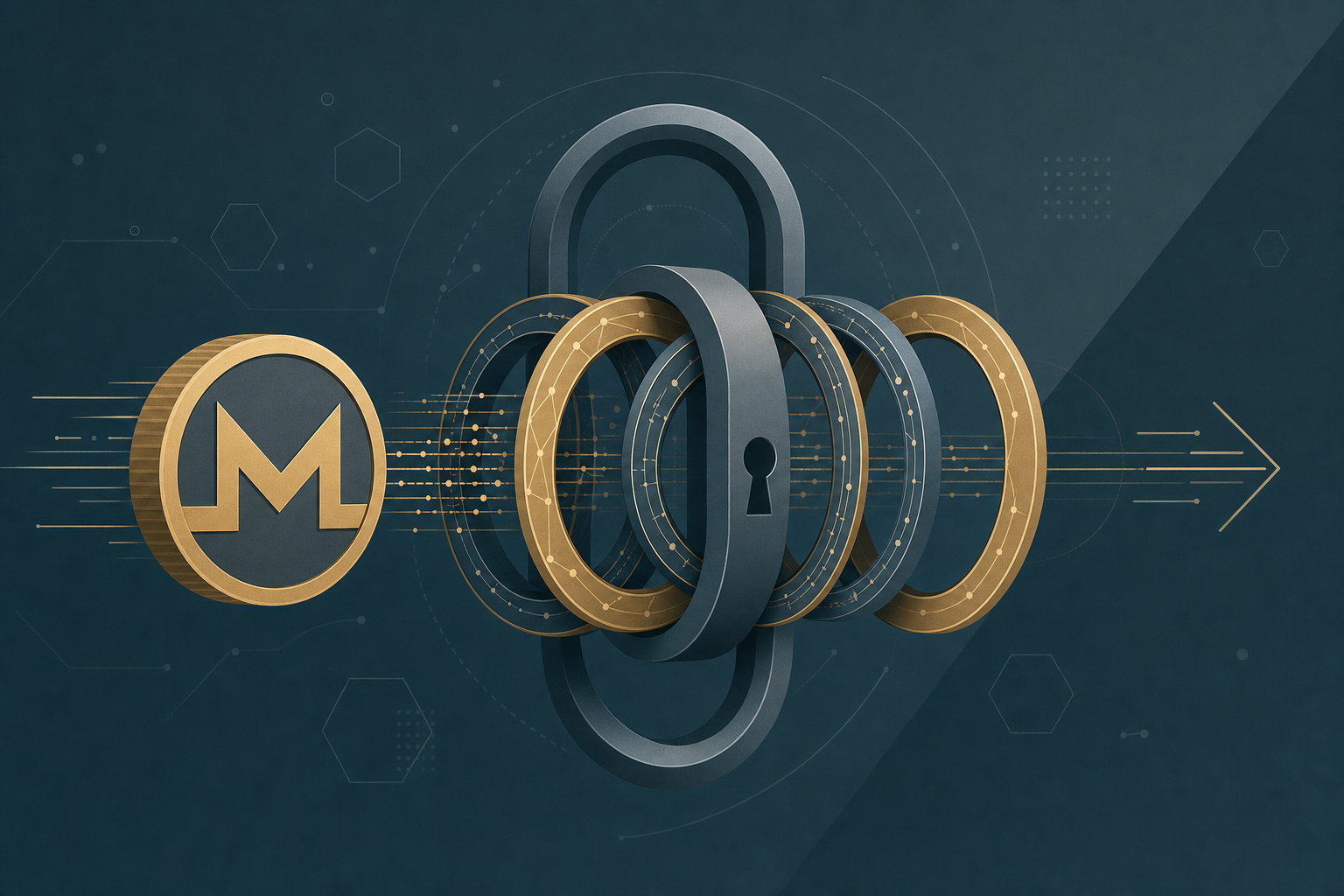
USDC and XMR sit at opposite ends of the on-chain visibility spectrum, which is why people convert between them for personal financial privacy — not evasion. USDC transfers are fully transparent: anyone can read balances and transaction history on a public block explorer. Monero uses a different privacy model — ring signatures, stealth addresses, and confidential amounts — so amounts, senders, and receivers are obscured by default.
There is a second reason USDC holders care about this move: USDC issuer Circle can freeze specific addresses. Circle confirms it can freeze USDC in blocklisted addresses under its terms (retrieved 2026-08-27). Converting to a coin without an issuer-controlled freeze function changes your custody exposure.
To be precise: a public blockchain is pseudonymous, not anonymous, and no-KYC swapping is a search term describing user intent, not a property GhostSwap claims about your on-chain footprint. What GhostSwap does provide is a non-custodial pass-through with no account and no KYC for the swap itself. What Monero provides is its own on-chain privacy model. Keep those two facts separate.
USDC-to-XMR swap options compared
Several no-KYC swap services support USDC to XMR. The differences that matter are account requirements, custody model, and how each handles the send/receive flow. Numbers below are from each provider's public site plus GhostSwap product data (retrieved 2026-08-27).
| Feature | GhostSwap | StealthEX | SimpleSwap |
|---|---|---|---|
| Account / KYC | None required for swaps | No account for basic swaps (stealthex.io, 2026-08-27) | No account for basic swaps (simpleswap.io, 2026-08-27) |
| Custody | Non-custodial pass-through | Non-custodial (stealthex.io, 2026-08-27) | Non-custodial (simpleswap.io, 2026-08-27) |
| Pair count | 1,600+ pairs | See provider site | See provider site |
| Rate type | Floating rate from aggregated liquidity | Floating and fixed (stealthex.io, 2026-08-27) | Floating and fixed (simpleswap.io, 2026-08-27) |
| Typical completion | ~8 min median (~30 min p95) | Varies | Varies |
For USDC to XMR specifically, confirm each service supports your exact USDC network (ERC-20 vs TRC-20 vs SPL) before sending. Support varies by network even when the coin ticker matches.
Non-custodial: what this means for your XMR swap
Non-custodial means funds pass through and are never held by GhostSwap. Your USDC arrives at a deposit address, gets converted, and the XMR is forwarded to the address you supplied — GhostSwap does not park a balance, hold your Monero, or require you to store anything in a GhostSwap account. There is no account, because there is nothing to hold on your behalf.
The practical upside: you never hand over an email, password, or identity documents to complete a swap. The practical responsibility: you own the receiving address. Get it right, because a swap sends XMR exactly where you point it.
FAQ
Q: Do I need an account to swap USDC to Monero?
A: No. GhostSwap requires no account, no email, and no identity verification (KYC) to swap. You supply a Monero receiving address and, optionally, a USDC refund address. Funds pass through non-custodially and are never held by GhostSwap.
Q: Which USDC network should I use to swap to XMR?
A: Use whichever network your USDC currently sits on — ERC-20 (Ethereum), TRC-20 (Tron), or SPL (Solana). They are distinct assets to a swap engine. TRC-20 and SPL are usually cheaper to send than ERC-20. Sending the wrong network is the most common cause of a stalled swap.
Q: How long does a USDC to XMR swap take?
A: Median completion is about 8 minutes, and roughly nine in ten swaps finish within 30 minutes, depending on network congestion. Monero itself requires 10 confirmations before funds unlock in most wallets, which adds around 20 minutes on Monero's side.
Q: Is swapping USDC to XMR private?
A: Monero uses ring signatures, stealth addresses, and confidential amounts, so on-chain details are obscured by default. USDC transfers are transparent on a public explorer. A public blockchain is pseudonymous, not anonymous — swapping does not erase your prior USDC history. GhostSwap provides a no-KYC, non-custodial swap; Monero provides its own on-chain privacy model.
Ready to swap
When you know which USDC network you hold and have your Monero address ready, start the conversion on the USDC to XMR swap page.
For other stablecoin-to-Monero routes, the USDT to XMR swap page follows the same flow, or begin from the GhostSwap homepage.