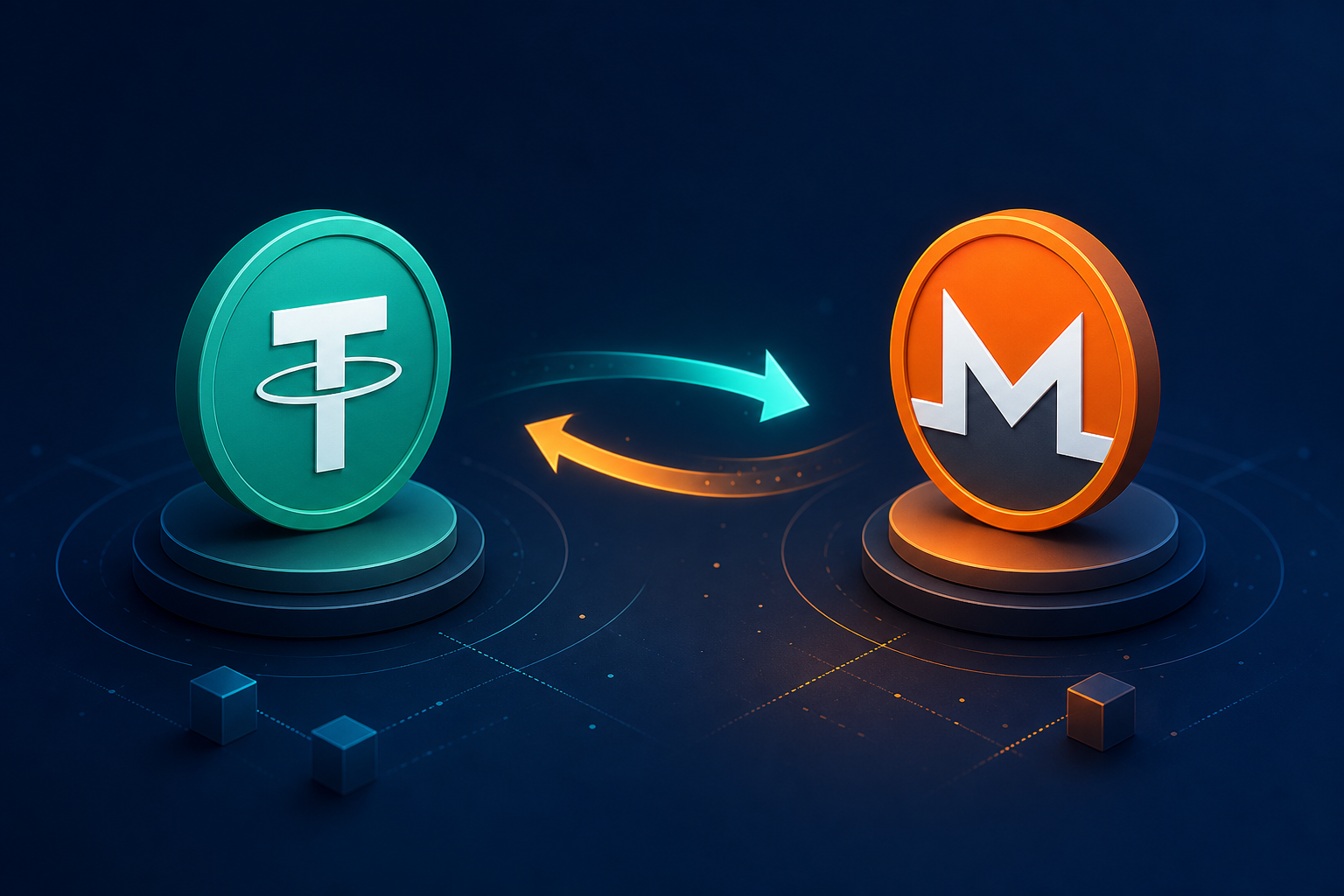
Swapping USDT to Monero converts a public, blacklist-capable stablecoin into a private, fungible cryptocurrency. USDT issuer Tether reserves the right to freeze addresses on its smart contracts (per Tether's Terms of Service, section 3 — retrieved 2026-05-24, https://tether.to/en/legal). Monero, by design, uses ring signatures, stealth addresses, and confidential transactions to keep amounts and parties private (Monero whitepaper, van Saberhagen 2013 — https://github.com/monero-project/research-lab/blob/master/whitepaper/whitepaper.pdf). Converting between the two changes the risk surface of the asset itself.
TL;DR: You can swap USDT to XMR through GhostSwap without creating an account, verifying ID, or providing email. Send USDT (TRC20 or ERC20) to a one-time deposit address, receive XMR at the wallet you specify. Median completion ~8 minutes.
Why people swap USDT to Monero
USDT is the largest dollar-pegged stablecoin by volume. It's also one of the most surveilled assets in crypto: every TRC20 and ERC20 transfer is public, and Tether has frozen hundreds of addresses at the request of law enforcement and OFAC.
Monero is the opposite design. Transaction amounts, sender, and recipient are obscured at the protocol level. There is no public balance ledger to inspect.
People move USDT to XMR for several reasons:
- Long-term self-custody where fungibility matters
- Reducing on-chain footprint after consolidating from exchanges
- Operational privacy (donations, payroll for contractors, savings)
- Hedging against a centralised stablecoin issuer's freeze authority
None of this is regulatory evasion. It's the standard rationale for choosing a non-surveilled bearer asset over a permissioned one.
TRC20 vs ERC20 — pick the right USDT network first
USDT runs on multiple chains. The two you'll see most often when swapping are TRC20 (Tron) and ERC20 (Ethereum). The choice affects fees and finality.
| Network | Typical fee | Finality | When to pick it |
|---|---|---|---|
| TRC20 (Tron) | Under $1 (often a few cents); see Tronscan live fees, retrieved 2026-05-24, https://tronscan.org/#/data/stats2/network/transactionFee | ~3 minutes to practical finality (19 super-representative confirmations; Tron documentation, https://developers.tron.network/docs/blockchain-basics, retrieved 2026-05-24) | Smaller swaps, lower cost priority |
| ERC20 (Ethereum) | Variable: typically $3–$15+ depending on gas (see Etherscan gas tracker, https://etherscan.io/gastracker, retrieved 2026-05-24) | ~12 block confirmations for high-value safety (~2.5 minutes per ethereum.org Proof-of-Stake finality docs, https://ethereum.org/en/developers/docs/consensus-mechanisms/pos/, retrieved 2026-05-24) | When your USDT is already on Ethereum or you need ETH-ecosystem interop |
If you're sending from a centralised exchange that's about to delist privacy-adjacent flows, withdraw on TRC20 to keep the fee low. If you're consolidating from DeFi positions, ERC20 may already be where your USDT lives.
How to swap USDT to XMR on GhostSwap
- Open the swap widget at ghostswap.io. Pick USDT (TRC20 or ERC20) as the source and XMR as the destination.
- Enter the amount. You'll see a floating-rate estimate. The final XMR amount is locked when your USDT deposit is detected on-chain — not when you click. Floating-rate pricing from aggregated liquidity.
- Provide your XMR receiving address and optionally a USDT refund address (recommended in case something goes wrong on the deposit side).
- Send USDT to the one-time deposit address. Double-check the network. Sending TRC20 USDT to an ERC20 address (or vice versa) is unrecoverable.
- Wait. Median completion is ~8 minutes; p95 is ~30 minutes depending on chain congestion. You'll see status updates without needing to log in — the order ID is your only handle.
No account is created at any step. No email is collected. No identity verification or KYC is performed for the swap.
GhostSwap vs other no-KYC USDT→XMR routes
| GhostSwap | SimpleSwap | ChangeNOW | StealthEX | |
|---|---|---|---|---|
| Account required | No | No (for swaps) | No (for swaps) | No (for swaps) |
| Email required | No | No | No | No |
| KYC for standard swaps | None | None (may request on flagged orders, per simpleswap.io/faq, retrieved 2026-05-24) | None (may request on flagged orders, per changenow.io/faq, retrieved 2026-05-24) | None (may request on flagged orders, per stealthex.io/faq, retrieved 2026-05-24) |
| Custody model | Non-custodial pass-through | Non-custodial | Non-custodial | Non-custodial |
| USDT networks accepted | TRC20, ERC20 | TRC20, ERC20, others | TRC20, ERC20, others | TRC20, ERC20, others |
| Pair count | 1,600+ | ~1,500 (per simpleswap.io, retrieved 2026-05-24) | ~1,300 (per changenow.io, retrieved 2026-05-24) | ~1,000 (per stealthex.io, retrieved 2026-05-24) |
All four services run a similar non-custodial pass-through model. The practical differences are pair coverage, the conditions under which orders get flagged for additional review, and the UI itself. Compare quotes directly — floating-rate pricing means the headline number varies in real time.
Troubleshooting common USDT→XMR issues
Wrong network sent. If you sent TRC20 to an ERC20 address or vice versa, the deposit is unrecoverable at the protocol level. There is no support ticket that can fix it. Triple-check the network selector before clicking send on your sending wallet.
Tether compliance hold. In rare cases, USDT addresses can be frozen by Tether on the issuer's own initiative. If you're moving funds that originated from a flagged source, the freeze applies at the contract level, not at GhostSwap's level. The swap can't complete because the deposit never arrives.
Refund needed. If your deposit lands outside the quote's expiry window (typically due to slow network confirmation), the order auto-refunds to your refund address. Always provide one.
XMR receiving wallet rejects the transaction. Verify your XMR address is a primary or sub-address from a wallet you control (Cake Wallet, Monerujo, Feather, or the official GUI). Integrated addresses also work.
FAQ
Q: Do I need to verify my identity to swap USDT to Monero on GhostSwap?
A: No. There's no account, no email, and no identity verification required for swaps. You supply a receiving XMR address and optionally a USDT refund address. That's the entire flow.
Q: Can GhostSwap freeze my funds during a USDT→XMR swap?
A: GhostSwap is non-custodial — funds pass through, never held. The service can't freeze what it doesn't custody. Note: GhostSwap is not a registered financial service. Separately, Tether (the issuer of USDT) can freeze USDT at the contract level. That risk is intrinsic to USDT itself, not to the swap service.
Q: Which network is cheaper — TRC20 or ERC20 USDT?
A: TRC20 is typically cheaper — fees are usually under $1 (often a few cents per Tronscan, retrieved 2026-05-24). ERC20 fees vary with Ethereum gas, commonly $3–$15+ (per Etherscan gas tracker, retrieved 2026-05-24). For smaller swaps the cost difference is significant. For larger swaps the gas matters less proportionally.
Q: How long does a USDT to XMR swap take?
A: Median completion is ~8 minutes. The 95th percentile is ~30 minutes — depends on USDT network congestion and Monero block timing.
Ready to swap
Go to the GhostSwap homepage to start a USDT→XMR swap. No account, no email, no KYC for swaps. Floating-rate pricing from aggregated liquidity across 1,600+ pairs.
For other Monero swap routes, see the BTC to XMR pair page.
GhostSwap is not a registered financial service.