Will Solana Reach $1,000? Realistic Analysis for 2026-2030
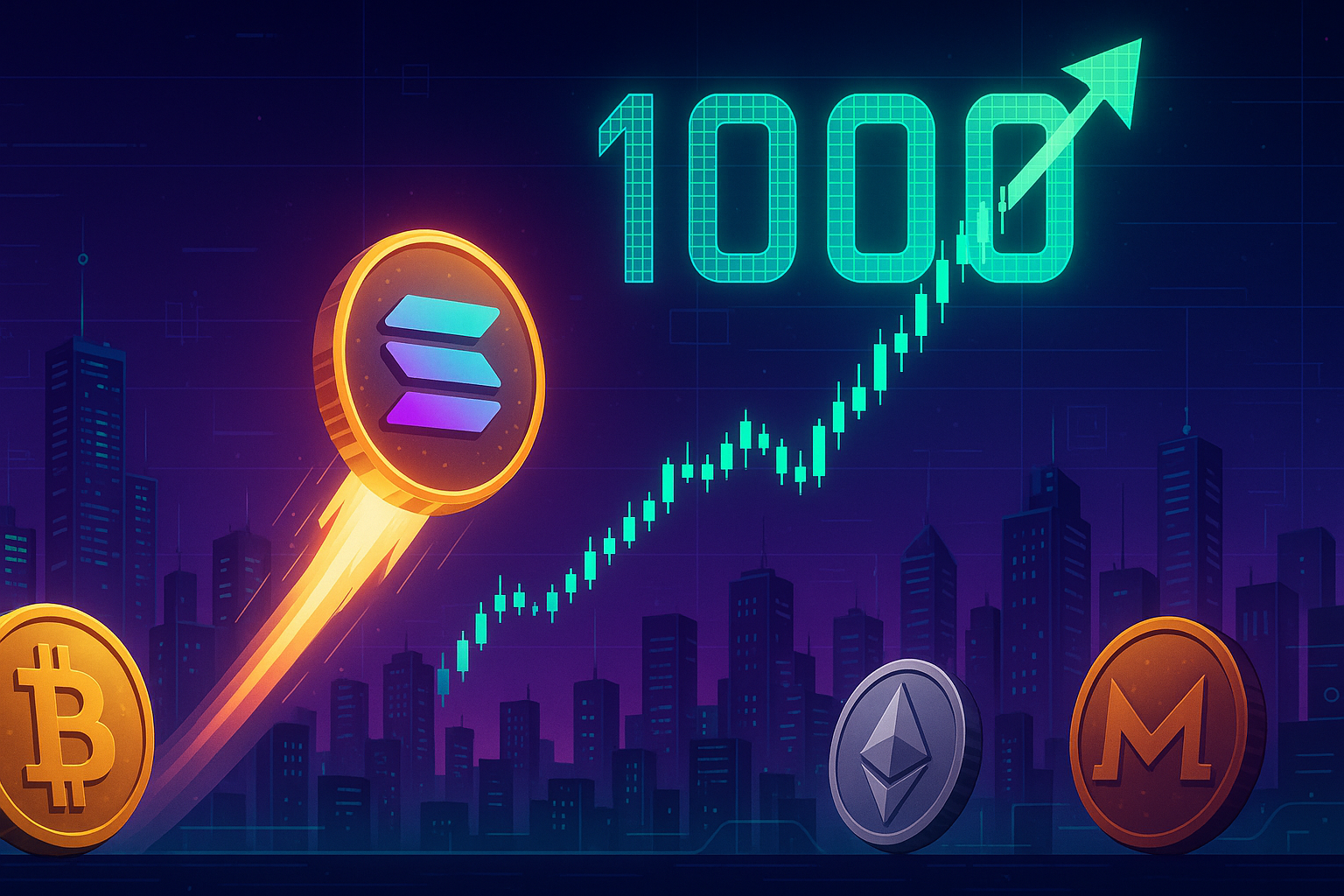
Based on current analysis, Solana reaching $1,000 is possible but challenging. Here is a data-driven breakdown of what would realistically need to happen for SOL to hit four digits and what could prevent it.
In this guide, we will look at Solana’s current position, the market cap required for a $1,000 price, bullish and bearish scenarios, and what analysts and on-chain data suggest for 2026-2030. If you are actively trading SOL or looking to reposition your portfolio, you can swap SOL for BTC privately in seconds without creating an account.
Disclaimer: This is not financial advice. Always do your own research and never invest money you cannot afford to lose.
Solana’s Current Position
Before asking “will Solana reach 1000,” it is critical to understand where the asset stands today in terms of price, market capitalization, and recent performance.
Solana price, market cap and ranking (May 2026)
- Current SOL price: $90.94
- Market cap: $52.50 billion
- Market cap rank: #7 among all cryptocurrencies
- Circulating supply: 578.00 million SOL
- Total supply: 626.36 million SOL
- Max supply: Unlimited (inflationary with ongoing emissions)
From a pure market structure perspective, Solana is already a top-tier Layer 1 blockchain by value. According to public market data from major aggregators such as CoinGecko and CoinMarketCap, SOL consistently sits in the top 10 by market cap, competing directly with Ethereum, BNB Chain, and other smart contract platforms.
Recent performance and volatility
- 24h price change: -1.00%
- 7d price change: +2.56%
- 30d price change: +5.78%
- 1-year price change: -49.79%
- All-time high (ATH): $293.31 on 2025-01-19
- All-time low: $0.5008 on 2020-05-11
Over the last year, SOL has almost halved in price from its 2025 all-time high. That drawdown illustrates how volatile large-cap altcoins remain, even after years of development and adoption. At the same time, the long-term chart still shows an extraordinary move from under $1 in 2020 to near $300 in 2025.
This combination of high volatility, large historical gains, and persistent top-10 market cap is central to any realistic $1,000 Solana price prediction.
What Would It Take for Solana to Reach $1,000?
To evaluate “will Solana reach 1000,” we first need to quantify what a $1,000 SOL price actually means in market cap terms.
Required market cap: simple math
We will use the current circulating supply of 578 million SOL for this calculation.
Target price: $1,000 per SOL
Formula: Market cap = Price × Circulating supply
Market cap at $1,000:
- $1,000 × 578,000,000 SOL = $578,000,000,000
So, for Solana to reach $1,000, it would need a market capitalization of roughly $578 billion, assuming the circulating supply stays close to current levels. Given Solana’s inflationary model and potential future emissions, the actual required cap could be somewhat higher if supply expands significantly by 2030.
How big of an increase is that from today?
- Current market cap: $52.50 billion
- Required market cap at $1,000: ~$578 billion
Required multiple:
- $578B / $52.50B ≈ 11x increase from today’s market cap
In other words, Solana would need to grow about 1,000 percent from its current valuation to touch $1,000. That is a large but not unprecedented move in crypto over a multi-year bull cycle.
Comparing Solana’s target to other blue chips
For context, here is how a $578B Solana market cap compares to historical and hypothetical values of other major assets:
- Bitcoin: BTC’s market cap surpassed $1 trillion at its 2021 and 2024 peaks, more than 2x the Solana $1,000 target cap.
- Ethereum: ETH has previously approached the $500B range during strong bull markets, roughly comparable to a $1,000 SOL scenario.
- Top tech stocks: Mega-caps like Apple and Microsoft surpassed multi-trillion valuations, far beyond this range, though they operate in entirely different markets.
This comparison shows that a $500B–$600B valuation is ambitious but not outlandish for a leading smart contract platform if crypto markets experience another major expansion and Solana captures a significant share of overall web3 activity.
You can track your SOL exposure versus Bitcoin directly and rebalance any time by using a non-custodial SOL/BTC swap with no registration.
Bull Case: How Solana Could Reach $1,000
For the optimistic scenario, we should examine the structural advantages and growth drivers that could push Solana’s valuation into the hundreds of billions.
1. High-throughput, low-fee infrastructure advantage
Solana’s core value proposition is its high throughput and low transaction costs. The network uses a combination of Proof of History (PoH) and Proof of Stake (PoS) to achieve sub-second block times and very high potential TPS (transactions per second), while keeping fees typically under a cent during normal network conditions.
This design has made Solana a preferred base layer for:
- DeFi protocols that require fast execution and granular arbitrage
- NFT marketplaces and gaming platforms where low fees are critical
- On-chain order books and DEXs experimenting with centralized-exchange-like performance
If Solana continues to improve its stability and scales without sacrificing decentralization, it could become one of the primary execution layers for consumer-facing crypto apps. That kind of adoption could justify a multi-hundred-billion valuation.
2. Growing Solana DeFi, NFT, and consumer app ecosystems
Beyond the base layer, what ultimately gives a smart contract platform value is the ecosystem built on top. Solana has seen strong growth in:
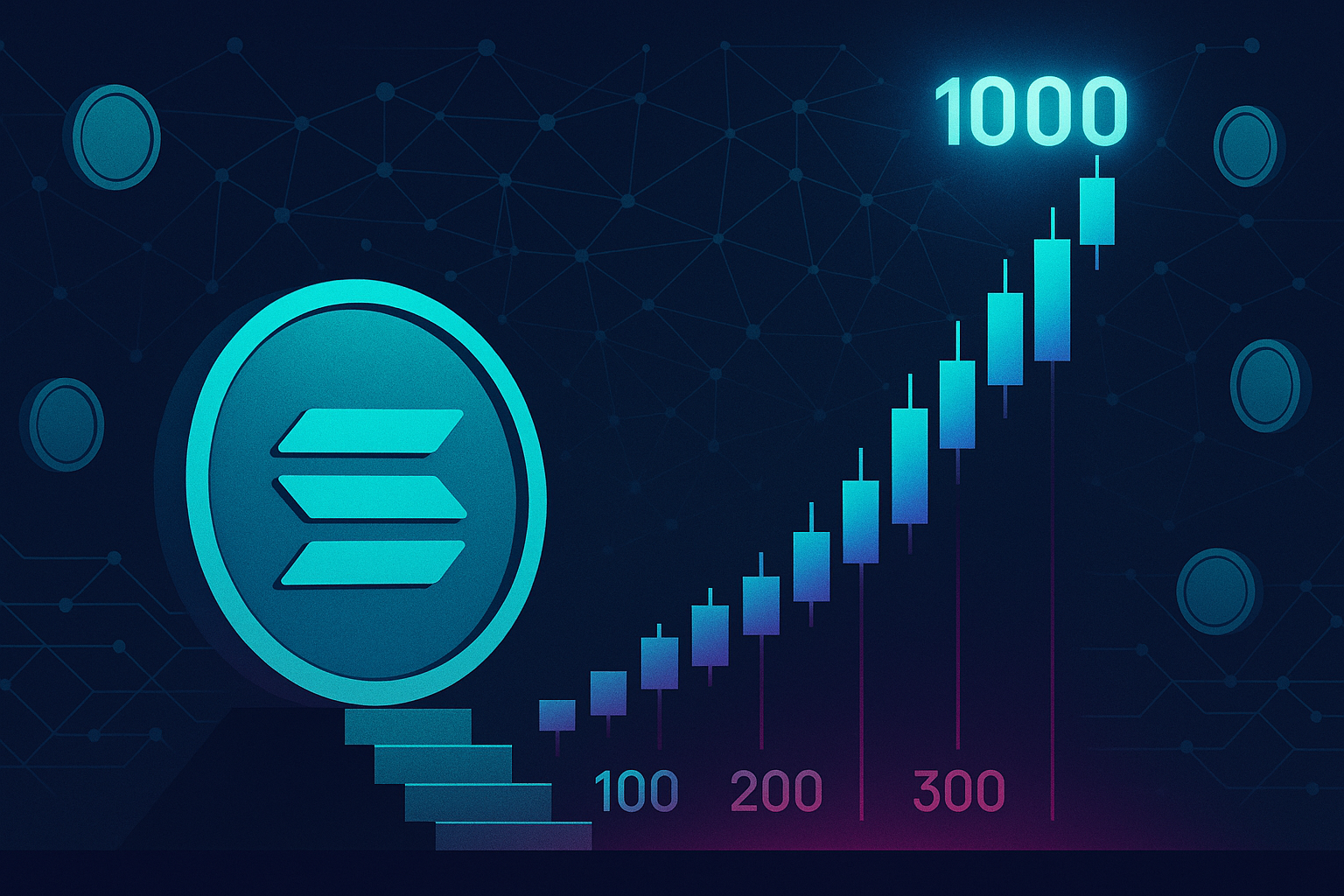
- DeFi: lending platforms, perpetual futures DEXs, liquid staking, and stablecoin infrastructure
- NFTs: collections, gaming assets, and creator tools that leverage cheap minting and trading
- Consumer apps: wallets, social apps, and on-chain payments with mobile-friendly UX
If the next bull cycle is driven by real user adoption in gaming, social, micropayments, and DeFi, Solana’s performance characteristics could attract millions of active users. A surge in on-chain activity, transaction fees, and staking demand can all feed into higher perceived value for SOL.
3. Institutional interest and regulatory clarity
For Solana to sustain a $500B+ valuation, institutional participation would need to be significant. Over time, that could include:
- Spot and derivatives products on large, regulated trading venues
- Solana-based tokenization of real-world assets (RWAs)
- Institutional-grade DeFi on Solana with compliance layers and KYC-gated pools
Clearer regulations around crypto securities and commodities in major jurisdictions could open the door to pension funds, asset managers, and corporates allocating to SOL-based products. This kind of capital inflow is typically what pushes crypto assets into the upper tiers of market cap.
You can swap SOL for BTC, ETH, USDT and 1,500+ other coins on GhostSwap without KYC.
4. Macro environment and total crypto market expansion
A $1,000 Solana price is realistically dependent on the entire crypto market expanding substantially. For SOL to be worth ~$578B, the total crypto market cap would likely need to be several trillions of dollars, with Bitcoin perhaps above previous highs and Ethereum at or beyond its own peak valuations.
Drivers for that kind of expansion could include:
- Wider adoption of stablecoins and crypto payments
- More favorable monetary policies and inflation concerns
- Integration of crypto rails in mainstream fintech and banking platforms
In such an environment, leading Layer 1 chains like Solana could trade at valuations comparable to major global tech companies, which makes a $1,000 price less far-fetched.
Bear Case: Why Solana May Not Reach $1,000
To answer “will Solana reach 1000” honestly, we also need to look at serious obstacles that could keep SOL far below that target.
1. Intense competition from other Layer 1 and Layer 2 networks
Solana is not alone. Ethereum and its Layer 2 rollup ecosystem, BNB Chain, Avalanche, Aptos, Sui, and many others are all competing for the same DeFi, NFT, and app developer mindshare.
Key risks include:
- Ethereum scaling: If rollups and future Ethereum upgrades solve congestion and fee issues, developers may prefer Ethereum’s larger security and liquidity base.
- New entrants: Next-generation high-throughput chains could offer similar or better performance with improved decentralization or developer tooling.
- Multi-chain fragmentation: Instead of one “winner,” activity may spread across many chains, capping Solana’s share of the total value.
If Solana fails to maintain a distinct and defensible advantage in user experience and ecosystem depth, its long-term market cap ceiling could be significantly lower than $500B.
2. Network reliability, outages, and technical concerns
Historically, Solana has faced network outages and performance issues during times of high load. Although the core team and validator community have deployed multiple upgrades to improve stability, these incidents have raised questions about the network’s resilience and decentralization.
Markets are forward-looking. If investors and developers believe that Solana’s design inherently sacrifices reliability or censorship resistance, they may discount the value of SOL, especially relative to more conservative architectures like Ethereum. A persistent perception of fragility could limit institutional adoption as well.
3. Tokenomics, inflation, and selling pressure
Unlike Bitcoin, Solana has an unlimited maximum supply and ongoing inflationary emissions to support staking rewards. Although inflation is scheduled to decline over time, it still represents a structural source of new supply entering the market.
Additional downward pressure can come from:
- Early investor and team unlocks
- Validator selling of staking rewards
- Project treasuries and ecosystem funds distributing or liquidating SOL incentives
If demand growth does not sustainably outweigh this issuance and selling pressure, SOL may struggle to maintain high valuations over many years, let alone push into the $1,000 range.
4. Regulatory, macroeconomic, and adoption risks
Crypto remains highly sensitive to regulatory news and macro trends. Material negative developments could include:
- Harsh regulatory classification of SOL in key jurisdictions
- Restrictions on DeFi and self-custody impacting usage
- Prolonged risk-off macro environments that reduce appetite for speculative growth assets
If the next decade brings more restrictive rules or repeated crypto market crashes, even fundamentally strong projects like Solana may find it difficult to attain and sustain a $500B+ valuation.
Expert Opinions on Solana
Public commentary on Solana from analysts and industry participants typically falls into a few categories, ranging from very bullish to skeptical. While concrete price targets for “Solana $1,000” are speculative, sentiment trends are useful to understand.
Bullish analyst and builder perspectives
Many builders in the Solana ecosystem highlight:
- The network’s developer activity and hackathon participation
- Rapid growth in on-chain volume in DeFi and NFT markets
- Continuous core upgrades to improve throughput and stability
Supporters argue that if any chain besides Ethereum can capture mass-market consumer applications at scale, Solana is a prime candidate due to its performance and user experience. In that scenario, some long-term projections place SOL among the top few assets by market cap, potentially in the valuation range a $1,000 price implies.
Skeptical and cautious viewpoints
On the other hand, more cautious voices point to:
- Past network outages and the complexity of maintaining such high throughput
- Concentration of stake among relatively few validators or entities
- Uncertainty about long-term tokenomics and sustainability of incentives
Many traditional analysts also warn that Layer 1 valuations can be cyclical, peaking in bull runs and underperforming in bear markets as attention shifts to new narratives. From that perspective, treating “Solana $1,000” as guaranteed is risky, regardless of Solana’s technical strengths.
Always remember that no expert can predict prices with certainty. Any Solana price prediction 2030 or beyond should be considered speculative and highly uncertain.
Our Verdict
Bringing all of this together, how likely is a $1,000 Solana price, and on what kind of timeline?
Probability and timeframe for $1,000 SOL
Considering Solana’s:
- Current top-10 position and strong ecosystem momentum
- Technical edge in throughput and fees
- Past performance and volatility
- Competitive and regulatory risks
Our qualitative view is:
- 2026: Solana reaching $1,000 by 2026 appears unlikely, as it would require an 11x increase in market cap in a relatively short time along with a large expansion of the overall crypto market.
- 2027–2030: Solana reaching $1,000 in the late 2020s is possible but challenging. It likely requires a major multi-year bull cycle, strong institutional participation, continued network stability improvements, and Solana capturing a leading share of DeFi, NFTs, and consumer apps.
In other words, “will Solana reach 1000” has a cautiously positive but uncertain answer over a 5–10 year horizon, with significant upside potential but equally significant risks.
Practical implications for investors and traders
For long-term holders, the $1,000 target can be a useful thought experiment about Solana’s potential share of the future web3 economy. For short- and medium-term traders, focusing on support and resistance levels, relative strength versus BTC and ETH, and ecosystem news may be more practical than anchoring on a distant round number.
Either way, your strategy should account for volatility, diversification, and risk management. You can adjust your exposure in a non-custodial way using a private exchange to swap SOL against BTC or other assets when market conditions change.
Ready to Trade Solana?
If you want to position around potential long-term scenarios for Solana, you do not need an account or KYC to get started. On GhostSwap, you can instantly trade SOL for BTC and 1,500+ other assets using your own wallet, with non-custodial execution and no centralized account risk.
Swap SOL for BTC on GhostSwap and manage your Solana exposure privately and efficiently.
Frequently Asked Questions
Will Solana reach $1,000 in 2026?
Based on current data, Solana hitting $1,000 in 2026 is unlikely. At a current price of $90.94 and market cap of $52.50B, SOL would need an approximately 11x increase in market capitalization to around $578B in a relatively short period.
While crypto markets can move quickly, such a jump would probably require an extreme bull market, rapid institutional adoption, and Solana firmly establishing itself as a dominant platform for DeFi, NFTs, and consumer apps. It is not impossible, but it is a high bar within that timeframe.
What is the highest SOL can go?
There is no fixed “maximum” price for SOL, since its supply is effectively uncapped and price is determined by market demand. Solana has already reached an all-time high of $293.31 in January 2025.
In theory, if the total crypto market expands into the multi-trillion-dollar range and Solana captures a large share of on-chain activity, SOL could trade significantly above previous highs. A $1,000 price would imply a market cap of around $578B at today’s supply. Higher prices are mathematically possible, but each step up requires exponentially more capital and adoption, so expectations should remain conservative and risk-aware.
Is Solana a good investment?
Whether Solana is a good investment depends on your risk tolerance, time horizon, and conviction in its technology and ecosystem. On the positive side, Solana offers:
- High throughput and low fees suitable for consumer-scale apps
- A growing DeFi, NFT, and app ecosystem
- Top-10 market cap status and strong brand recognition
On the risk side, investors must consider:
- Historical network outages and technical complexity
- Strong competition from Ethereum and other Layer 1s
- Regulatory uncertainty and macro volatility
Many investors choose to hold Solana as part of a diversified crypto portfolio rather than a single concentrated bet. Always do your own research and consider consulting a financial professional. This is not financial advice.
Where can I buy Solana without KYC?
If you prefer to swap SOL without KYC and keep control of your keys, non-custodial instant swap platforms are a practical option. GhostSwap allows you to trade Solana directly from your own wallet for BTC, ETH, stablecoins and 1,500+ other assets with no registration, no accounts, and no custodial risk.
Simply connect your wallet, choose the pair (for example, SOL to BTC), and execute the swap. For a private, account-free experience, GhostSwap is a convenient way to access Solana liquidity while maintaining self-custody.
Disclaimer: This is not financial advice. Cryptocurrency trading involves high risk, and you should carefully consider your objectives and level of experience before participating.