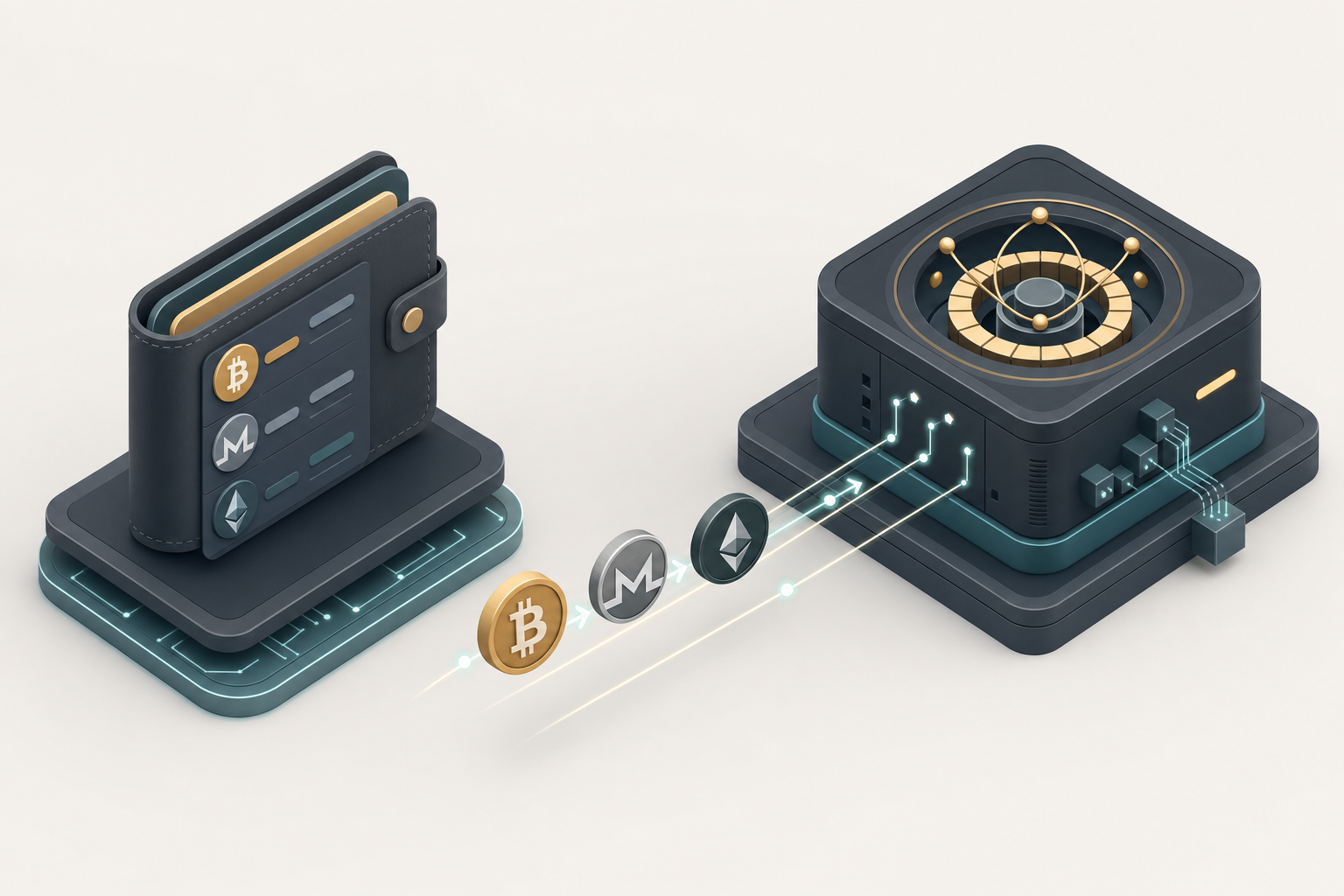
A crypto swap revenue-share program lets a wallet or app earn a cut of the swap fee every time one of its users converts one coin for another through an integrated exchange engine. The wallet embeds the exchange's swap flow — usually through an API or widget — and the exchange splits the per-swap fee back to the partner. The user swaps inside the wallet they already trust; the wallet earns on volume it already routes.
TL;DR: A crypto swap revenue-share program pays a wallet or app a share of the swap fee on every swap its users make through an integrated exchange API. GhostSwap offers a non-custodial, no-KYC swap engine across 1,600+ pairs that wallet partners can integrate and earn on.
A crypto swap revenue-share program is a partnership where an exchange shares part of its per-swap fee with the wallet, app, or site that sends it swap volume, typically via an API or embeddable widget.
What is a crypto swap revenue share program?
A crypto swap revenue-share program is a fee-split arrangement between an exchange and a distribution partner — most often a non-custodial wallet, a portfolio app, or a swap aggregator. The partner integrates the exchange's swap flow; the exchange pays back a portion of the fee on each completed swap. The partner earns on volume; the exchange gets distribution.
Three models dominate in 2026:
- API integration — the partner calls the exchange's REST API to fetch quotes, create swap orders, and track status, rendering the flow inside its own UI. Highest control, highest engineering lift.
- Embeddable widget — the partner drops a hosted iframe or script into its app. Lowest lift, less UI control.
- Referral / affiliate link — the partner sends users to the exchange's site with a tracking parameter. No code, lowest conversion, lowest engineering cost.
For wallet developers, API integration is usually the right call: it keeps the user inside the wallet, preserves the wallet's design, and pays on every swap rather than on click-through.
GhostSwap is a no-KYC crypto exchange. No account, no email, and no identity verification are required for end users to swap. Funds pass through non-custodially — GhostSwap never holds them. That matters for wallet partners whose users chose a self-custody wallet specifically to avoid handing funds and identity to a third party.
How to integrate GhostSwap into your wallet or app
Integrating a non-custodial swap engine into a wallet follows a consistent shape regardless of which exchange you pick. With GhostSwap, the flow is API-first and the end user never creates an account.
- Read the API reference — endpoints for supported pairs, live quotes, order creation, and status polling are documented at the GhostSwap API reference.
- Fetch a quote — your wallet requests a floating-rate quote for the user's chosen pair from GhostSwap's 1,600+ supported pairs across 200+ assets.
- Create the order — your wallet submits the user's receiving address and a refund address. GhostSwap returns a deposit address.
- User sends funds — the user's wallet sends the source coin to the deposit address. Funds pass through non-custodially; GhostSwap never holds them.
- Poll status and confirm — your wallet polls the order endpoint until the swap completes. Median completion is about 8 minutes, with a 95th-percentile near 30 minutes depending on source-chain congestion.
Because there is no account step, your integration never has to collect or store user identity to enable a swap. The user supplies a receiving address and a refund address — nothing else. For partnership and revenue-share terms specifically, contact the GhostSwap team through the contact page; fee-split terms are set per partner and are not published.
GhostSwap partner program vs. other no-KYC swap services
Most no-KYC swap services that support wallet integration share a similar non-custodial, account-free model. The differences are in pair count, integration surface, and published program terms. The table below compares GhostSwap against two named no-KYC competitors that publish affiliate/partner pages.
| Feature | GhostSwap | SimpleSwap | Trocador |
|---|---|---|---|
| End-user account / KYC | None required | None required for swaps | None required |
| Custody | Non-custodial pass-through | Non-custodial | Non-custodial / aggregator |
| Supported pairs | 1,600+ | 1,000+ (per their site) | Aggregates multiple providers |
| Integration | API + widget | API + widget | API |
| Published partner page | Terms set per partner via contact | Affiliate program page published | Partner/API docs published |
Sources: GhostSwap pair count and completion times from the product-truth API, retrieved 2026-06-21. SimpleSwap affiliate program (retrieved 2026-06-21). Trocador (retrieved 2026-06-21). Competitor pair counts and program details reflect each provider's own published pages as of the retrieval date and may change.
GhostSwap does not publish a fixed revenue-share percentage publicly — terms are set per partner. If your evaluation requires a specific fee-split figure before integration, request it through the contact page.
API documentation and integration requirements
The GhostSwap swap engine is API-first. A wallet integration needs four core capabilities, all documented in the GhostSwap API reference:
- Quote endpoint — returns a floating-rate quote for a given pair and amount. Pricing comes from aggregated liquidity from leading crypto markets.
- Order creation — accepts the user's receiving address and a refund address; returns a deposit address.
- Status polling — returns the live state of a swap order so your UI can show progress until completion.
- Supported-pairs list — returns the current set of 1,600+ pairs across 200+ assets so your wallet only surfaces routes that exist.
Minimum requirements for a clean integration:
- The ability to generate or accept a user receiving address per swap.
- A refund address for the rare case a swap can't complete.
- Polling logic to track order status to completion (median ~8 minutes, p95 ~30 minutes).
- A UI that surfaces the floating-rate nature of the quote — the rate settles when funds arrive, not when the user clicks.
GhostSwap is not a registered financial service. Wallet partners are responsible for their own legal and regulatory obligations in the markets they serve.
Common questions from wallet developers
Q: What is a crypto swap revenue share for wallet partners?
A: It's a fee-split arrangement where an exchange pays a wallet a share of the swap fee on every swap routed through an integrated API or widget. The wallet earns on swap volume it already handles, and the user swaps without leaving the wallet.
Q: Do my users need an account or KYC to swap through GhostSwap?
A: No. GhostSwap requires no account, no email, and no identity verification for users to swap. Your integration collects a receiving address and a refund address — nothing else. Funds pass through non-custodially and are never held by GhostSwap.
Q: How many pairs and how fast are swaps?
A: GhostSwap supports 1,600+ pairs across 200+ assets. Median swap completion is about 8 minutes, with a 95th-percentile near 30 minutes depending on source-chain congestion (product-truth API, retrieved 2026-06-21).
Q: What's the revenue-share percentage?
A: GhostSwap sets fee-split terms per partner and does not publish a fixed figure. Request specific terms through the contact page before you begin integration.
Q: Is GhostSwap custodial — does it hold my users' funds?
A: No. GhostSwap is non-custodial. Funds pass through the swap engine and are never held by GhostSwap. The user's coins move from their wallet to the deposit address to their receiving address.
Start an integration
If you build a wallet or app and want your users to swap across 1,600+ pairs without an account, start with the GhostSwap API reference and reach the team through the contact page for partner terms. You can also test the live swap flow from the GhostSwap homepage swap widget before you wire up the API.
Questions about the swap mechanics behind a partner integration are answered inline above; for hands-on testing, the homepage hosts the live widget.