Cardano Price Prediction 2026-2030: Can ADA Reclaim $1 and Beyond?
| Year | Low | Average | High |
|---|---|---|---|
| 2026 | $0.18 | $0.35 | $0.70 |
| 2027 | $0.28 | $0.65 | $1.10 |
| 2028 | $0.40 | $0.95 | $1.60 |
| 2029 | $0.55 | $1.25 | $2.10 |
| 2030 | $0.70 | $1.70 | $2.80 |
Based on current market conditions and realistic growth assumptions, our Cardano price prediction suggests a gradual recovery from the current $0.2420 level, with a potential retest of the $1 region between 2027 and 2028 in a constructive market cycle. In a more optimistic scenario, ADA could approach its previous all-time high near $3 by 2030, while a prolonged bear market might keep prices under $1 for the rest of the decade.
This is not financial advice. Cryptocurrency markets are volatile. Always do your own research before investing.
If you want to position early or rebalance your portfolio, you can swap ADA to BTC instantly using a non-custodial, no-KYC exchange like GhostSwap.
Cardano Price Overview
Cardano (ADA) is a third-generation proof-of-stake blockchain focused on scalability, formal verification, and peer-reviewed research. It aims to provide a secure, energy-efficient base layer for smart contracts, DeFi, identity solutions, and real-world asset tokenization.
As of 24 September 2026, the live Cardano price data is:
- Current ADA price: $0.2420
- Market cap: $9.08 billion (Rank #17)
- 24h trading volume: $585.20 million
- All-time high (ATH): $3.09 on 1 September 2021
- All-time low (ATL): $0.0193 on 12 March 2020
- Circulating supply: 37.53 billion ADA
- Total / max supply: 45 billion ADA
- Price change (24h): -2.56%
- Price change (7d): +20.60%
- Price change (30d): +12.82%
- Price change (1y): -70.44%
Trading near $0.24, ADA is down more than 90% from its ATH, reflecting a prolonged bear market in altcoins and a rotation of capital toward Bitcoin and newer layer-1 platforms. Yet, the project still commands a multibillion-dollar valuation, indicating continued investor and developer interest.
You can track live Cardano market data on platforms like CoinGecko and CoinMarketCap, or follow updates from the official Cardano website.
Cardano Price History
Understanding Cardano’s price history is crucial when building any Cardano price prediction, because past market cycles often influence future investor psychology.
Early trading and initial growth (2017-2019)
Cardano launched in 2017 during the ICO boom. ADA’s early trading saw prices surge with the broader crypto market into early 2018, followed by a brutal bear market.
- Late 2017: ADA first lists on major exchanges and rallies with Bitcoin’s run-up.
- 2018 bear market: Like most altcoins, ADA falls more than 90% from its initial highs.
- 2019: Price stabilizes in the low cents range as the team focuses on protocol research and development.
Capitulation and all-time low (March 2020)
The global market crash in March 2020 (COVID-19 shock) saw ADA touch its all-time low of $0.0193 on 12 March 2020. This represented a point of maximum pessimism for many crypto assets.
From this low, ADA entered a new accumulation phase, supported by Cardano’s ongoing roadmap milestones such as Byron, Shelley, and Goguen.
Major bull run and smart contract hype (2020-2021)
The 2020-2021 bull market was transformative for Cardano.
- Mid-2020 to early 2021: As the Shelley upgrade brought staking and decentralization, ADA climbed steadily, crossing the $1 mark.
- September 2021 ATH: Ahead of the Alonzo hard fork, which enabled smart contract functionality, ADA hit its all-time high of $3.09 on 1 September 2021.
- Speculation around DeFi, NFTs, and future dApp ecosystems on Cardano contributed heavily to this surge.
Post-ATH decline and macro headwinds (2022-2024)
After the euphoric peak, ADA entered an extended downtrend.
- Tightening macro conditions, rate hikes, and risk-off sentiment weighed heavily on altcoins.
- Delays and slower-than-expected growth in Cardano’s DeFi and dApp ecosystem compared to competitors like Ethereum and newer L1s hurt relative performance.
- High expectations around TVL, dApp usage, and institutional adoption were not immediately met, contributing to valuation compression.
By 2024, ADA traded far below its all-time high, though it remained within the top crypto assets by market cap.
Current phase: Deep drawdown but active development (2025-2026)
Today, with ADA at $0.2420 and down approximately 70% over the past year, the asset is in a deep drawdown phase. Yet the 7-day price gain of over 20% and a 30-day gain of nearly 13% show signs of short-term accumulation and volatility.
Key characteristics of the current phase include:
- Lower valuations relative to the 2021 peak, but still significant market cap.
- Ongoing work on scalability, governance, and sidechains in the Cardano ecosystem.
- Increased competition from other layer-1s and layer-2s, which pressures Cardano to differentiate through research-driven design and on-chain governance.
This cyclical background sets the stage for our Cardano price prediction scenarios for 2026 through 2030.
Cardano Technical Analysis
Fundamentals matter over the long term, but technical analysis (TA) can help identify likely support and resistance levels and potential trend shifts in the shorter to medium term.
Key support and resistance levels
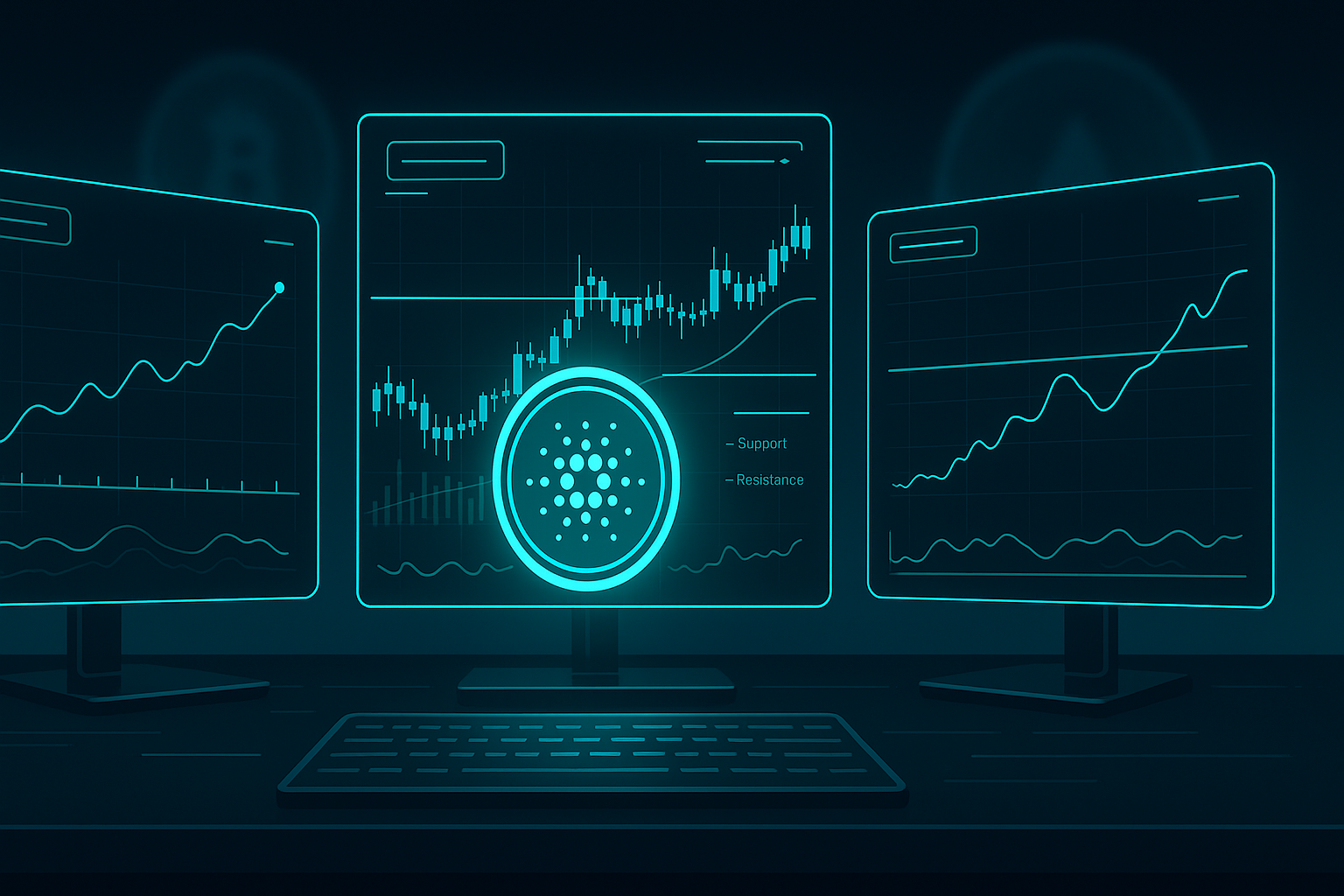
Based on ADA’s trading structure around $0.24 and its historical price zones, several technical levels are noteworthy:
- Immediate support: $0.20 to $0.22
This band roughly aligns with previous consolidation zones and psychological support. If ADA fails to hold this area, downside toward the mid-teens becomes more likely. - Stronger support: $0.15 to $0.18
Below current prices, this region may attract buyers who view ADA as “cheap” relative to past cycles. - First major resistance: $0.30 to $0.35
This is a critical zone where many short-term traders who bought higher may look to exit. Clearing it with strong volume would be a constructive sign. - Secondary resistance: $0.50 to $0.60
This area served as support and resistance in prior cycles and would likely be a significant profit-taking level if ADA rallies from here. - Macro resistance: $1.00
The $1 mark is both a psychological and historical inflection point. Reclaiming and holding above $1 would likely signal a major trend shift.
Moving averages and trend structure
While exact real-time moving averages are not provided, we can outline general interpretations relevant to Cardano’s current stage:
- Short-term MAs (20-50 day): Given ADA’s +20.60% move over the past week and +12.82% over the past month, short-term moving averages are likely turning upward or flattening. This usually reflects a relief rally or early accumulation.
- Medium-term MAs (100 day): After a 70% decline over the past year, medium-term moving averages are likely above the spot price, acting as dynamic resistance.
- Long-term MAs (200 day): The 200-day moving average is a critical gauge of the macro trend. ADA trading below this level would confirm a bear-market structure; a decisive move above it with volume is often an early signal of a new bull phase.
Momentum indicators: RSI and trend strength
The Relative Strength Index (RSI) measures momentum on a scale of 0 to 100. While we do not have the exact figure at this moment, the following general patterns are useful:
- RSI below 30: Oversold conditions often align with attractive long-term entries during macro-support zones, though prices can remain oversold for extended periods.
- RSI 40-60: Neutral consolidation, commonly seen during accumulation or distribution phases.
- RSI above 70: Overbought conditions, which often accompany strong rallies and precede pullbacks.
Given ADA’s strong weekly bounce but deep yearly losses, momentum may be recovering from oversold territory. That fits the narrative of a market searching for a bottom rather than one at peak euphoria.
Patterns and market structure
Cardano has displayed classic crypto cycle behavior:
- A parabolic advance into 2021.
- A protracted, multi-year drawdown with lower highs and lower lows.
- Recent signs of a possible accumulation base at depressed prices.
If this base-building continues, a rounded bottom or long-term accumulation range between approximately $0.15 and $0.50 could form, setting the foundation for the next multi-year uptrend. For traders, respecting clear support and resistance and managing risk is more important than trying to pick exact tops and bottoms.
You can swap ADA for BTC, ETH, USDT and 1,500+ other coins on GhostSwap without KYC if you want to react quickly to these technical levels.
Cardano Price Prediction 2026
Price predictions are inherently uncertain, but scenario analysis helps frame realistic expectations. For 2026, we consider macro conditions, Bitcoin’s halving cycle, and Cardano’s fundamental progress.
Assumptions for 2026
- We are roughly in the mid-stage of a post-halving environment, where Bitcoin may be stabilizing or consolidating after a major move.
- Altcoin capital rotation may gradually improve, especially if regulatory clarity progresses.
- Cardano continues to roll out scalability and governance upgrades, though adoption may still lag more established DeFi hubs.
Bear case 2026
In a bearish scenario, several factors could weigh on ADA:
- Global risk-off sentiment, recession fears, or stricter crypto regulation in key markets.
- Slower developer and user adoption relative to Ethereum, layer-2 networks, and newer L1 competitors.
- Investors favoring Bitcoin and a handful of dominant smart contract platforms, leaving ADA as a “forgotten large cap.”
Bear case 2026 target:
Low: $0.18
Average in bear case: $0.22 to $0.28
Base case 2026
In a moderate outcome, Cardano stabilizes and slowly appreciates from current levels.
- Network usage grows gradually as more dApps and real-world use cases emerge.
- Regulatory frameworks in major jurisdictions do not ban or heavily restrict proof-of-stake networks.
- Market sentiment improves from extreme pessimism to cautious optimism.
Base case 2026 target:
Average: $0.35
Trading range: $0.25 to $0.50
Bull case 2026
In an optimistic scenario for 2026:
- Cardano delivers meaningful throughput improvements and user experience upgrades that attract new builders.
- The broader market enjoys a constructive environment, with altcoins capturing renewed interest after Bitcoin’s cycle moves.
- Key partnerships, institutional experiments, or real-world deployments on Cardano’s infrastructure gain visibility.
Bull case 2026 target:
High: $0.70
Short-term spikes could overshoot during strong speculative rallies.
Cardano Price Prediction 2027
By 2027, markets may be in a new phase of the crypto cycle, potentially setting the stage for more decisive moves in altcoins like ADA.
Macro and ecosystem context for 2027
- Post-halving dynamics for Bitcoin may have played out, with capital rotating more aggressively into altcoins if sentiment is positive.
- Cardano’s on-chain governance could be more mature, and Voltaire-related features might be fully deployed.
- Competition from Ethereum rollups, modular blockchains, and other layer-1s will be intense, forcing Cardano to demonstrate unique value.
Bear case 2027
In a continued underperformance scenario:
- Cardano fails to gain significant TVL or user traction versus incumbent DeFi ecosystems.
- Major institutions and developers favor other platforms, leaving Cardano as a niche or research-first chain.
- Regulatory classification of some staking tokens as securities could dampen investor appetite in certain regions.
Bear case 2027 target:
Low: $0.28
Average in bear case: $0.35 to $0.45
Base case 2027
In a neutral to positive environment:
- Cardano’s ecosystem sees moderate but steady growth in active addresses, dApps, and on-chain volume.
- Interoperability solutions increase fungibility between ADA and other major assets, improving liquidity.
- Investors recognize Cardano as a credible, if not dominant, smart contract platform.
Base case 2027 target:
Average: $0.65
Likely range: $0.45 to $0.90
Bull case 2027
In a strongly bullish scenario:
- Cardano gains visible “flagship” applications, such as high-volume DeFi protocols, gaming ecosystems, or RWA platforms.
- Network performance and tooling improve enough to attract cross-chain liquidity and developers from competing chains.
- Macro conditions are supportive for risk assets, and crypto experiences widespread adoption tailwinds.
Bull case 2027 target:
High: $1.10
A decisive reclaim of $1 would be a psychological milestone and could attract fresh retail interest.
Cardano Price Prediction 2028
By 2028, the crypto market could be in or approaching another halving-related cycle, and the industry landscape may look very different. The long-term viability of Cardano’s research-driven approach will likely be clearer.
Key themes for 2028
- Maturity of on-chain governance, treasury systems, and community-led upgrades on Cardano.
- Level of entrenched network effects on leading smart contract platforms.
- Regulatory clarity around staking, DeFi, stablecoins, and tokenized real-world assets.
Bear case 2028
Risks in a downbeat scenario include:
- Cardano’s ecosystem stagnates or becomes overshadowed by competing platforms that innovate faster.
- Persistent regulatory pressure on DeFi or staking reduces on-chain activity.
- Macroeconomic shocks reduce risk appetite across all digital assets.
Bear case 2028 target:
Low: $0.40
Average in bear case: $0.50 to $0.70
Base case 2028
Under more balanced conditions:
- ADA benefits from steady user growth and recurring revenue streams (fees, staking rewards) in its ecosystem.
- Interoperability solutions make Cardano part of a multi-chain landscape rather than an isolated network.
- Investors increasingly evaluate L1s based on real usage metrics, where Cardano holds its own in a diversified ecosystem.
Base case 2028 target:
Average: $0.95
Likely range: $0.70 to $1.30
Bull case 2028
In a strongly bullish trajectory:
- Cardano manages to position itself as a key platform for identity, compliance-aware DeFi, or large-scale tokenization programs.
- Staking participation and governance drive a strong community flywheel that supports market confidence.
- Crypto adoption by institutions and governments grows, with Cardano playing a visible role in at least some initiatives.
Bull case 2028 target:
High: $1.60
An extended bull market could briefly push prices even higher, but our projection stays within historically grounded multiples of current market cap.
Cardano Price Prediction 2029-2030
Looking out to 2029 and 2030, predictions become more speculative. Still, long-term investors often care most about where ADA could be by the end of the decade.
Long-term structural factors
- Adoption: How many daily active users, developers, and high-value applications run on Cardano.
- Competitive landscape: Whether the market consolidates around a few dominant chains or remains fragmented.
- Regulation and macro: Treatment of staking, DeFi, and tokenization, as well as inflation, interest rates, and global risk appetite.
- Technological relevance: Whether Cardano’s research-first, formally verified approach proves to be a durable edge or becomes less relevant.
Cardano price prediction 2029
By 2029, crypto may be in another post-halving phase, with previous cycles showing that strong altcoin runs often occur around these times, though there are no guarantees.
- Bear case 2029:
If ADA fails to keep up and remains a secondary or tertiary chain, prices may remain subdued.
Low: $0.55
Average bear scenario: $0.70 to $0.90 - Base case 2029:
Cardano maintains a solid, if not dominant, role in a multi-chain ecosystem, with healthy usage and a robust community.
Average: $1.25
Likely range: $0.90 to $1.70 - Bull case 2029:
Strong adoption in key verticals, favorable regulation, and a broad crypto bull market push ADA well above $1.
High: $2.10
Cardano price prediction 2030
By 2030, any Cardano price prediction must account for dramatic potential changes in both technology and regulation. The difference between success and stagnation could be enormous.
- Bear case 2030:
Cardano remains part of crypto’s “long tail” of legacy L1s, overshadowed by newer solutions or major incumbents.
Low: $0.70
Average bear scenario: $0.80 to $1.10 - Base case 2030:
ADA is a respected, widely used chain, though not necessarily the market leader. Adoption and utility support a significant, but not extreme, valuation.
Average: $1.70
Likely range: $1.20 to $2.20 - Bull case 2030:
Cardano delivers on its governance vision, attracts major institutional and public-sector use cases, and benefits from a maturing crypto macro environment.
High: $2.80
Approaching, but not exceeding, the previous ATH of $3.09 keeps this estimate conservative relative to some hyper-bullish forecasts.
Investors should remember that reaching or revisiting all-time highs typically requires both strong fundamentals and an accommodative macro cycle. It is possible for a project to execute well yet still underperform if market conditions are unfavorable.
Is Cardano a Good Investment?
Whether Cardano is a good investment depends on your risk tolerance, time horizon, and conviction in the project’s fundamentals compared to its competition.
Cardano investment positives
- Research-driven design: Cardano emphasizes academic rigor and formal verification, which may appeal to institutions and high-assurance applications.
- Proof-of-stake efficiency: ADA’s staking model offers energy efficiency and yield opportunities for holders who participate in securing the network.
- Strong community and brand: Despite price drawdowns, Cardano maintains a large, active community and consistent visibility in the top crypto rankings.
- Long-term roadmap: A focus on governance, sustainability, and real-world use cases provides a clear narrative for long-term investors.
Risks and challenges
- Execution risk: Delivering on ambitious roadmaps on time is difficult. Delays or missed milestones can impact sentiment and adoption.
- Competition: Ethereum and its layer-2 ecosystem, as well as other L1s, compete heavily for the same developers and users.
- Regulatory risk: Unfavorable rulings on staking, token classification, or DeFi could affect ADA’s accessibility and demand.
- Market risk: ADA remains a highly volatile asset, currently trading over 90% below its ATH. Large drawdowns and long periods of underperformance are possible.
Who might consider ADA?
- Long-term crypto believers who want exposure to a diversified set of smart contract platforms.
- Investors who value formal methods, governance, and a slower, research-oriented approach.
- Traders looking to capitalize on volatility using non-custodial tools, for example by using a private exchange to swap ADA and BTC quickly during market swings.
As always, it is wise to size positions conservatively and treat any Cardano price prediction as a rough guide, not a promise.
What Experts Say About Cardano
Analyst and expert opinions can provide context for your own research, but they should never be followed blindly. Views on Cardano remain divided.
Analyst and research firm perspectives
- Crypto research firms: Some long-term oriented research outlets highlight Cardano’s governance roadmap and emphasis on verifiable code as potential strengths for regulated DeFi, but flag its slower ecosystem growth versus Ethereum as a major risk.
- Technical analysts: Many TA-focused analysts note that ADA’s long-term structure reflects a classic boom-and-bust cycle. Some argue that such deep drawdowns can precede large upside in future cycles if the project remains fundamentally active.
- Macro strategists: Broader crypto strategists often group ADA with other large-cap altcoins that could benefit from the next liquidity wave, but caution that capital may increasingly concentrate in fewer winners over time.
Investors should read multiple independent sources, including primary materials from the Cardano development organizations, before forming conclusions about long-term value.
Factors That Could Affect ADA Price
Several key drivers could significantly influence the trajectory of Cardano’s price over the next 4 to 5 years.
1. Network adoption and usage
- dApp ecosystem: The number and quality of decentralized applications, their user bases, and transaction volumes will be central to ADA’s value proposition.
- DeFi and liquidity: Total value locked (TVL), lending markets, DEX volumes, and on-chain stablecoins are major indicators of economic activity.
- Real-world integrations: Partnerships with enterprises, governments, or NGOs, especially in identity and supply chain, could expand Cardano’s relevance.
2. Technology and scalability
- Throughput and fees: If Cardano can support high transaction volumes at low cost during peak usage, it becomes more attractive to builders.
- Developer tools: Wallets, SDKs, and documentation must be robust and user-friendly to attract new developers.
- Interoperability: Bridges and cross-chain messaging that securely connect Cardano to other ecosystems will impact liquidity and user choice.
3. Regulation and legal environment
- Staking rules: How regulators treat staking rewards and whether staking services are considered securities offerings in some jurisdictions.
- DeFi compliance: Requirements for KYC/AML or compliance layers on DeFi protocols could change user behavior and infrastructure design.
- Exchange access: Listing status on major centralized exchanges and policy decisions around proof-of-stake assets can affect liquidity.
4. Macro and market cycles
- Bitcoin cycles: Historically, altcoins like ADA have benefited from post-halving bull markets, although past performance is no guarantee.
- Interest rates and risk appetite: Higher rates tend to hurt speculative assets; easing policies can rejuvenate interest in crypto.
- Global adoption narrative: Institutional and retail acceptance of crypto as an asset class influences all major tokens.
5. Competitive dynamics
- Ethereum and L2s: If Ethereum’s scaling roadmap and rollup ecosystem succeed overwhelmingly, it may absorb much of the smart contract demand.
- Other L1s: Performance, incentives, and marketing from competing layer-1 chains can either crowd out Cardano or push it to specialize.
These factors interact in complex ways. No single variable will determine ADA’s price, which is why diversified strategies and flexible expectations are essential.
Ready to Trade Cardano?
Swap ADA instantly on GhostSwap — no KYC, no registration, no hassle. Choose from over 1,500 cryptocurrency pairs and keep control of your keys with our non-custodial engine. You can start with a simple ADA to BTC swap and explore other pairs from there.
Frequently Asked Questions
Will Cardano reach $1?
Our Cardano price prediction suggests that ADA has a realistic chance to revisit the $1 region between 2027 and 2028 in a constructive market cycle, especially in the base and bull scenarios. In our 2027 projection, the average price estimate is around $0.65 with a bull-case high of $1.10, while for 2028 the average estimate is near $0.95 with a high of $1.60.
However, this outcome is not guaranteed. It depends on broader crypto market conditions, Cardano’s actual ecosystem growth, and regulatory developments. Investors should plan for scenarios where $1 takes longer to reclaim, or in a severe bear market, is not revisited during this decade.
Is Cardano a good long-term investment?
Cardano can be a compelling long-term investment for those who believe in its research-driven philosophy, governance roadmap, and potential to support high-assurance applications. Its large community, energy-efficient proof-of-stake consensus, and ongoing development are positives.
On the other hand, the project faces stiff competition, regulatory uncertainty, and execution risk. ADA has also shown that it can suffer deep drawdowns, with the current price more than 90% below the 2021 ATH. A prudent approach is to treat ADA as a high-risk, high-volatility asset within a diversified portfolio and to invest only what you can afford to lose.
What will ADA be worth in 2030?
Our data-driven Cardano price prediction for 2030 outlines three broad scenarios:
- Bear case: Low around $0.70, with prices mostly under $1.10 if adoption disappoints or regulations are harsh.
- Base case: Average around $1.70, with a likely range between $1.20 and $2.20 if Cardano becomes a solid but not dominant smart contract platform.
- Bull case: High up to roughly $2.80, approaching but not exceeding the previous ATH of $3.09, in the event of strong ecosystem growth and favorable macro conditions.
These are estimates based on current information and historical cycles, not guarantees. New technologies, regulatory changes, or black swan events could materially alter Cardano’s trajectory by 2030.
Where can I buy/swap Cardano?
You can acquire ADA on major centralized exchanges or by swapping other cryptocurrencies for ADA using a non-custodial instant swap service. If you prefer to avoid sign-ups and KYC, you can use GhostSwap to swap ADA for BTC, ETH, USDT, and 1,500+ other assets directly from your wallet.
Just select the assets and amounts you want to exchange, provide your receiving address, and let GhostSwap handle the routing and execution. This approach allows you to stay in control of your private keys while rebalancing your portfolio quickly.
Is Cardano better than Ethereum or other competitor coins?
Whether Cardano is “better” than Ethereum or other competitor layer-1s depends on what metrics you prioritize. Ethereum currently leads in adoption, TVL, and developer activity, especially with the growth of its layer-2 ecosystem. Many alternative chains focus on high throughput and low fees, but may sacrifice some decentralization or long-term resilience.
Cardano’s edge lies in its emphasis on peer-reviewed research, formal verification, and a carefully structured governance model. This could make it attractive for certain regulated or high-assurance use cases. However, the market may ultimately reward platforms that deliver the best combination of performance, security, and user experience at scale.
For most investors, the question is not whether Cardano is absolutely better than competitors, but whether it will capture enough sustainable usage and value to justify its valuation over time. Comparing multiple projects and diversifying across them is often more prudent than betting on a single winner.