9 Best Ways To Buy Bitcoin With No KYC In 2026
If you want to buy Bitcoin with no KYC in 2026, your best options are non-custodial swap services, P2P marketplaces, DEXs, Bitcoin ATMs, and in-person cash trades. The safest routes combine self-custody, minimal data sharing, and transparent fees. For many users, a non-custodial instant swap like GhostSwap is the simplest balance of privacy, speed, and security.
Here is a quick overview of the top no-KYC methods, then we will dive into detailed pros, cons, and best use cases for each.
- Non-custodial instant swaps (GhostSwap) – Best all-around for fast, private BTC purchases using other coins.
- Cryptocurrency ATMs – Best for buying BTC with cash locally, often with partial or no KYC for small amounts.
- P2P marketplaces – Best for flexible payment methods and negotiating terms directly with sellers.
- Bitcoin meetups & in-person cash trades – Best for maximum privacy when done safely.
- Decentralized exchanges (DEXs) – Best for on-chain swaps from other crypto to BTC or wrapped BTC.
- Gift cards & voucher platforms – Best for converting store credit or gift cards into BTC without full ID.
- Prepaid debit cards – Best for separating your bank identity from your BTC purchases.
- Mining pools & cloud mining payouts – Best for earning BTC rather than buying it on an exchange.
- Bitcoin-backed earning apps & rewards – Best for stacking small amounts of BTC over time without KYC.
Below you will find detailed breakdowns, a comparison table, and tips to keep your no-KYC Bitcoin strategy safe and realistic in 2026.
How We Chose This List
Security First: Self-Custody & Smart OpSec
Buying Bitcoin without KYC only makes sense if you can also keep it secure.
We prioritized methods that let you control your private keys, work smoothly with reputable wallets, and avoid unnecessary custodial risk.
Approaches that routinely involve meeting strangers or sending bank transfers to individuals are included, but only when there are clear safety practices and dispute protections.
Fees & Price Transparency
No-KYC usually costs more than fully verified exchange trading.
We focused on methods that either publish their fee structure clearly or allow you to see the effective rate before confirming the trade.
Hidden spreads, surprise ATM surcharges, or unclear P2P markups all got marked down in our evaluation.
Speed & Reliability
Some no-KYC methods are instant, while others can take hours or days.
We scored options higher if you can reliably get BTC in your own wallet within an hour, with predictable blockchain confirmation times and support if something goes wrong.
Privacy & Data Minimization
The core of any “buy Bitcoin no KYC” strategy is minimizing the personal data you share.
We prioritized platforms and methods that avoid government ID uploads, selfies, and full banking profiles, while still being lawful where they operate.
Note that your local regulations may differ, and you are responsible for complying with applicable laws and tax rules.
Coin & Payment Method Flexibility
Finally, we considered how easy it is to use different assets and payment rails.
Being able to swap altcoins, stablecoins, or wrapped assets into BTC gives you more flexibility and can improve your privacy posture.
Similarly, methods that support multiple fiat options or cash were ranked higher for versatility.
1. GhostSwap — Best Overall Non-Custodial Way To Buy Bitcoin With No KYC
Overview
GhostSwap is a non-custodial instant swap platform that lets you exchange over 1,500 cryptocurrencies directly into BTC without creating an account or submitting KYC documents.
You stay in control of your coins at all times: you send crypto from your wallet, receive BTC back to your own Bitcoin address, and the service never holds long-term balances.
This makes it one of the simplest and fastest ways to buy Bitcoin no KYC if you already hold other coins or stablecoins, or if you can acquire them elsewhere.
Key Stats
- Type: Non-custodial instant swap
- Verification: No account, no KYC for standard limits
- Assets supported: 1,500+ trading pairs
- Custody: You control your wallet and private keys
- Typical speed: Minutes, depending on blockchain confirmation
How It Works
Using GhostSwap is straightforward.
You choose the pair (for example, USDT to BTC), enter the BTC address you control, and lock in a rate quote with a time limit.
You then send the source asset from your own wallet to the provided address; once it confirms, GhostSwap sends BTC to your Bitcoin wallet, completing the swap without ever holding your funds in a centralized account.
Pros
- No sign-up, account, or KYC process for ordinary swaps.
- Non-custodial design reduces platform risk; your BTC goes straight to your wallet.
- Huge coin selection, including major chains and many altcoins and stablecoins.
- Transparent rate quotes before you send anything.
- Good balance of privacy, speed, and usability for most users.
Cons
- Requires you to already have some crypto or a way to acquire it (fiat on-ramps may still be KYCed).
- Blockchain network fees apply on both sides of the transaction.
- Not ideal for large OTC-sized purchases that require negotiated pricing.
If you already hold coins on a self-custody wallet or another platform, using a non-custodial swap to convert a portion of them to BTC protects both your privacy and your custody of funds.
2. Bitcoin ATMs — Best For Cash Purchases With Minimal Data
Overview
Bitcoin ATMs let you deposit physical cash and receive BTC directly to a wallet you control.
In many regions, small-amount purchases can still be made with limited or no KYC, often just requiring a phone number or SMS verification.
However, regulations are tightening in many countries, so you need to check your local machines and limits.
Key Stats
- Type: Physical ATM terminals
- Verification: Varies by operator and country; low-limit KYC-light in some areas
- Payment: Cash, and sometimes debit card
- Speed: On-the-spot; on-chain confirmation time still applies
- Coverage: Tens of thousands of ATMs globally (numbers change over time)
Pros
- Lets you trade physical cash for BTC with minimal bank involvement.
- Immediate, in-person experience with clear step-by-step instructions.
- Good option for people without bank accounts or in cash-heavy economies.
Cons
- Fees are often significantly higher than online services.
- Many ATMs now require full KYC above relatively low thresholds.
- Requires you to physically travel to a machine, which may affect privacy.
Tips For Using Bitcoin ATMs Privately
Before visiting an ATM, research the operator’s KYC policy and limits.
Use a fresh Bitcoin address from a privacy-conscious wallet for each purchase, and avoid repeatedly buying at the same time and location with predictable patterns.
Check fee structures on sites that track ATM operators or on the machine itself before inserting cash.
3. P2P Marketplaces — Best For Flexible Payment Methods
Overview
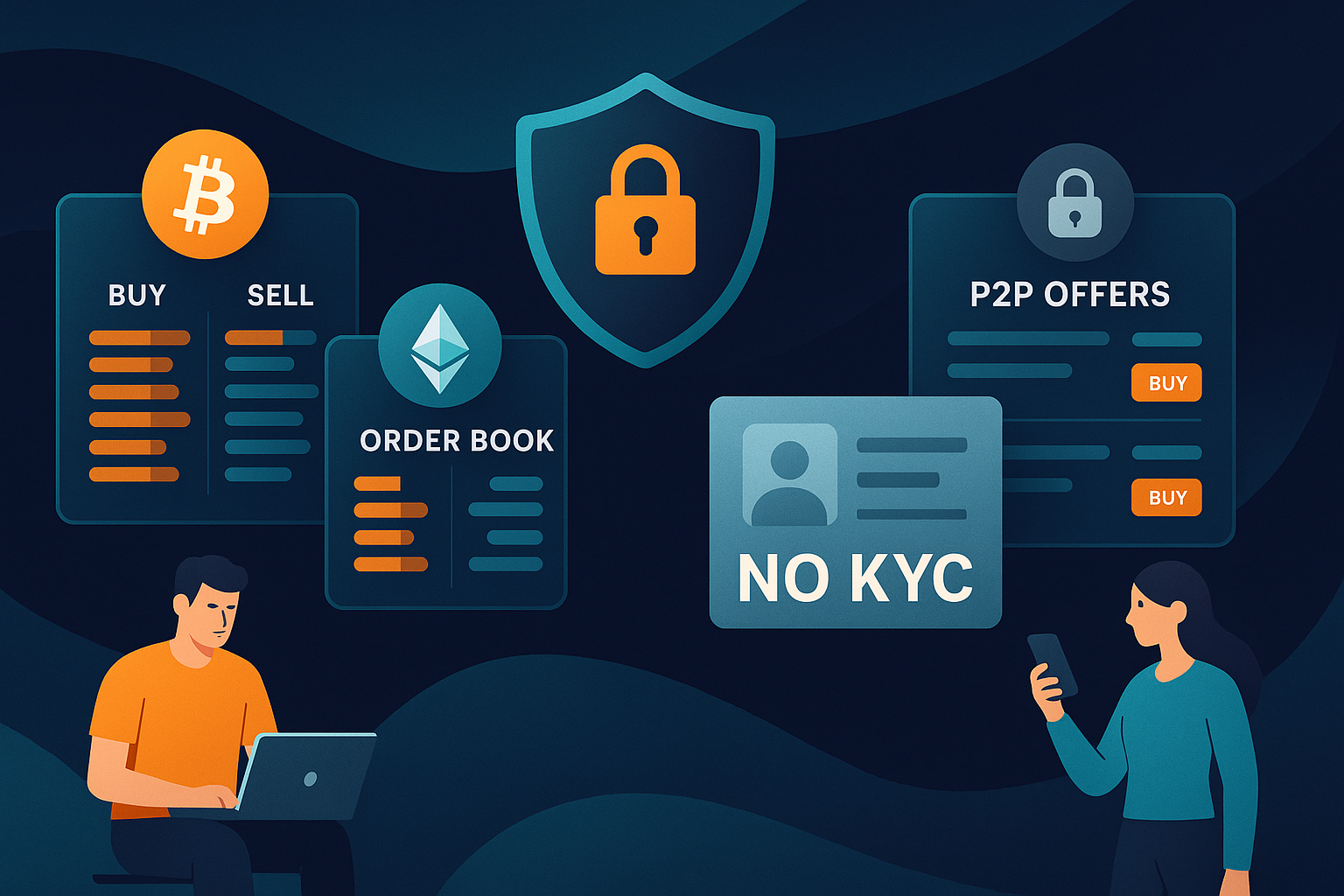
Peer-to-peer (P2P) marketplaces connect individual buyers and sellers of Bitcoin directly.
These platforms list offers with different payment methods such as bank transfers, mobile money, gift cards, or local payment apps.
Some P2P platforms require KYC, while others allow pseudonymous accounts and rely on reputation and escrow instead.
Key Stats
- Type: Online P2P order book & escrow
- Verification: Platform-dependent, ranging from no KYC to full KYC
- Payment: Bank transfers, mobile wallets, gift cards, cash deposits, and more
- Speed: Ranges from minutes to hours depending on counterparties
Pros
- Very broad choice of payment rails, including region-specific options.
- Possibility to negotiate price, limits, and terms with individual sellers.
- Escrow systems help reduce direct counterparty risk.
Cons
- Platform and local regulations may still require KYC at some point.
- Higher risk of scams and chargeback disputes if you do not follow best practices.
- Bank transfers or payment apps may reveal your real identity to the counterparty.
How To Use P2P Marketplaces Safely
Always trade with sellers who have strong reputation scores, a long trade history, and good feedback.
Keep all communication on-platform so that escrow and support can help if there is a dispute.
If you plan to convert altcoins you already hold, you can first swap them to BTC on a private service, then optionally use P2P only for fiat interactions when necessary.
4. Bitcoin Meetups & In-Person Cash Trades — Best For Maximum Privacy (High Caution)
Overview
Buying Bitcoin with cash from an individual at a meetup or via a trusted contact can be one of the most private methods if done correctly.
There is no platform, no online account, and no digital trail beyond the blockchain itself.
At the same time, this route carries the highest personal safety and scam risks if you are not extremely careful.
Key Stats
- Type: In-person trade
- Verification: None, purely peer-to-peer
- Payment: Physical cash
- Speed: Instant exchange once both parties agree
Pros
- No centralized platform or account data to compromise.
- Minimal financial footprint beyond the cash withdrawal itself.
- Can build local networks of trusted traders over time.
Cons
- Personal safety risk when meeting strangers with cash.
- No formal escrow or dispute resolution if something goes wrong.
- Difficult to scale to large or frequent trades without becoming noticeable.
Best Practices For In-Person Trades
Only meet in public, well-lit locations covered by security cameras, such as bank lobbies during business hours.
Verify that BTC has been broadcast to the network and is visible in your wallet before leaving the meetup.
Avoid sharing unnecessary personal details and never reveal your total holdings or financial situation.
5. Decentralized Exchanges (DEXs) — Best For On-Chain Crypto-to-BTC Swaps
Overview
Decentralized exchanges let you swap tokens directly from your wallet using on-chain smart contracts.
Most DEXs do not require any account or KYC; they simply interact with your wallet address.
While many DEXs specialize in ERC-20 or other chain-specific tokens, you can often acquire wrapped Bitcoin (such as WBTC) or BTC on compatible chains, and then convert to native BTC via a bridge or non-custodial swap service.
Key Stats
- Type: On-chain automated market maker or order book
- Verification: Wallet-only, no identity required
- Payment: Any supported tokens on the given chain
- Speed: Transaction confirmation times on the base blockchain
Pros
- No centralized account means fewer honeypots of personal data.
- Huge range of DeFi tokens that can be swapped into BTC-related assets.
- Composability with other on-chain privacy tools.
Cons
- On-chain transactions are publicly visible, which can impact privacy.
- Smart contract risks and potential front-running or MEV issues.
- Often requires bridging or secondary swaps to end up with native BTC.
Practical Workflow
A common workflow is to acquire stablecoins (for example, USDT or USDC) via a fiat on-ramp, move them to your self-custody wallet, trade into BTC or wrapped BTC on a DEX, then use a non-custodial platform like GhostSwap to move into native Bitcoin on the chain you prefer.
You can swap BTC, ETH, USDT and 1,500+ other coins on GhostSwap without KYC.
This layered approach lets you keep centralized KYC data with a single provider while distributing your swaps and storage across more private tools.
6. Gift Card & Voucher Platforms — Best For Converting Store Credit Into BTC
Overview
Gift card trading platforms allow users to buy or sell store credit for various retailers in exchange for Bitcoin.
Depending on the platform and jurisdiction, some of these services still operate with relaxed or tiered KYC requirements.
If you have unused gift cards, this can be a way to turn them into BTC without going through the usual exchange route.
Key Stats
- Type: Online marketplace for gift cards and vouchers
- Verification: Ranges from email-only to more detailed checks
- Payment: Gift cards, store vouchers, sometimes prepaid cards
- Speed: Usually minutes to hours per transaction
Pros
- Useful for monetizing unused store credit.
- Often more flexible than strict fiat exchange rules.
- Can avoid linking your bank account directly to BTC purchases.
Cons
- High scam risk if you use unofficial or unvetted marketplaces.
- Discounts on card value often mean a worse effective BTC rate.
- Regulations are evolving, and some platforms may introduce stricter KYC.
Best Use Cases
Gift card conversions are most logical for small, opportunistic BTC purchases instead of a primary on-ramp strategy.
Once you have BTC, you can move it to private storage or swap it to other coins privately via a platform such as GhostSwap’s instant swap interface.
7. Prepaid Debit Cards — Best For Segregating Banking Identity
Overview
Prepaid debit and virtual cards can help isolate your main bank identity from your Bitcoin purchases.
Some no-KYC or light-KYC card providers still exist in specific regions, although pressure from regulators is increasing.
Used correctly, these cards can be paired with merchant processors or services that sell BTC without demanding full ID upfront.
Key Stats
- Type: Prepaid debit and virtual cards
- Verification: Varies from email-only to full KYC
- Payment: Top-ups via cash, vouchers, or bank transfer
- Speed: Instant card payments once funded
Pros
- Segregates your main bank account from crypto-facing transactions.
- Useful for international purchases where local banks are restrictive.
- Can be combined with other methods for a layered privacy approach.
Cons
- Card issuers may suddenly tighten KYC or freeze accounts.
- Fees for issuance, maintenance, and foreign currency usage can be high.
- Still leaves a trail with the card provider and connected merchants.
Layered Strategy Example
You might load a prepaid card with cash, use it to buy a stablecoin from a non-custodial service that accepts card payments, then move that stablecoin into a private wallet.
From there, swap into BTC via a DEX or a non-custodial swap tool, achieving BTC ownership with more compartmentalized data trails.
8. Mining Pools & Cloud Mining Payouts — Best For Earning BTC Instead Of Buying
Overview
Rather than directly buying BTC, you can earn it through mining payouts.
In 2026, industrial-scale mining dominates, but hobbyists can still contribute hashpower via mining pools and receive periodic Bitcoin payouts.
Many legitimate pools require some registration, but they often do not require full KYC if you are only providing hashpower and a payout address.
Key Stats
- Type: Mining pools, potentially cloud mining providers
- Verification: Typically account-only, limited KYC for hashpower contributors
- Payment: BTC payouts to your specified address
- Speed: Ongoing rewards based on mined blocks and pool shares
Pros
- Earn BTC as income instead of making a discrete purchase.
- Payouts go directly to your Bitcoin address.
- Can be combined with home solar or cheap electricity where available.
Cons
- Mining hardware is expensive and competitive.
- Cloud mining has a high incidence of scams and unprofitable contracts.
- Local laws and energy prices can make mining uneconomical.
Reality Check
For most users, mining is not the most efficient way to obtain BTC per dollar spent, especially after hardware, electricity, and maintenance.
It does, however, offer a different risk and privacy profile compared to traditional purchases, and can be used as a supplemental strategy.
For current Bitcoin supply and emissions data, sites like CoinGecko or CoinMarketCap provide up-to-date on-chain and market statistics.
9. Bitcoin-Backed Earning Apps & Rewards — Best For Slow, Steady Stacking
Overview
Cashback apps, shopping rewards, and micro-earning platforms that pay out in BTC can help you accumulate small balances over time.
Some of these services require only email sign-up and basic anti-fraud checks rather than full KYC, especially if withdrawals stay below certain thresholds.
They are not suitable for large, immediate BTC acquisition, but they complement other no-KYC methods.
Key Stats
- Type: Shopping rewards, cashback, and microtask platforms
- Verification: Usually account-based, KYC thresholds vary
- Payment: BTC or sats payouts, sometimes via Lightning Network
- Speed: Accrues over time based on activity
Pros
- Turn existing online spending or activity into BTC without a direct purchase.
- Lower psychological barrier than wiring large fiat amounts.
- Can pay out over Lightning for faster, cheaper withdrawals.
Cons
- Payouts are typically small, so it takes time to add up.
- Providers may introduce stricter KYC over time or per jurisdiction.
- Requires consistent usage to be meaningful.
How To Integrate This Method
Use BTC rewards as “dry powder” for experimenting with new wallets, Lightning channels, or swaps without risking large holdings.
Once balances grow, you can consolidate them into your main cold storage setup or reallocate via privacy-friendly swaps as needed.
Comparison Table
| Method / Platform | Best For | KYC Level | Custody | Typical Fees | Speed | Privacy Score* |
|---|---|---|---|---|---|---|
| GhostSwap (non-custodial swaps) | Fast, private crypto-to-BTC swaps | No KYC for standard limits | You hold your wallet | Spread + network fee | Minutes | High |
| Bitcoin ATMs | Cash to BTC locally | Low-limit KYC-light in some regions | Your wallet | High | Instant (plus confirmations) | Medium |
| P2P Marketplaces | Flexible payment methods | Varies by platform | Your wallet (escrow temporary) | Variable, often moderate | Minutes to hours | Medium |
| In-Person Cash Trades | Maximum off-platform privacy | None | Your wallet | Negotiated | Immediate | High (if done safely) |
| Decentralized Exchanges (DEXs) | On-chain token-to-BTC swaps | No KYC | Your wallet | On-chain gas + swap fee | Blockchain confirmation time | Medium |
| Gift Card & Voucher Platforms | Monetizing store credit | Low to moderate KYC | Your wallet | High effective spread | Minutes to hours | Medium |
| Prepaid Debit Cards | Segregated fiat spending | Card-issuer specific | Your wallet (for BTC side) | Card + merchant fees | Instant card payments | Low to Medium |
| Mining Pools / Cloud Mining | Earning BTC over time | Account-only to light KYC | Your payout address | Hardware + electricity costs | Ongoing payouts | Medium |
| BTC Rewards & Earning Apps | Slow stacking via spending | Account-based, thresholds vary | Your wallet or in-app | Typically low, built into pricing | Ongoing | Low to Medium |
*Privacy Score is a qualitative comparison, not a precise rating.
Ready to Start Swapping?
If you already hold any major cryptocurrency, you do not need to go through another intrusive verification process just to adjust your portfolio into Bitcoin.
With a non-custodial swap service like GhostSwap, you send crypto from your wallet and receive BTC back to your own address, keeping control and minimizing data exposure throughout the process.
Head to GhostSwap.io to try a small test swap, confirm how it works, and then scale up only when you are comfortable with the flow and fees.
Ready to Trade Bitcoin?
If you are looking for a fast, non-custodial way to adjust your holdings into BTC or out of it, you can swap crypto instantly on this private exchange with no sign-up or KYC.
Frequently Asked Questions
Is it legal to buy Bitcoin with no KYC?
The legality of buying Bitcoin without KYC depends entirely on your jurisdiction and the specific method used.
Many countries regulate businesses that convert fiat to crypto, requiring them to perform KYC and AML checks, but do not criminalize individuals holding or acquiring BTC in private transactions within certain limits.
You are responsible for understanding and following your local laws, including tax reporting and any caps on anonymous cash or digital transactions.
How can I stay safe when buying BTC without KYC?
Start with small amounts and scale up only after you are confident in the method and platform.
Use self-custody wallets where you control the private keys, double-check every address you paste, and enable strong device security and backups.
Avoid meeting strangers alone with large amounts of cash, and rely on escrow and reputation systems when using P2P marketplaces.
Can I use a centralized exchange and still protect my privacy?
Centralized exchanges that serve regulated markets almost always require KYC for fiat on-ramps and meaningful trading limits.
You can still improve your privacy by withdrawing to self-custody wallets promptly, not leaving large balances on the exchange, and avoiding reusing deposit addresses.
From there, you can use non-custodial swaps or DEXs to rebalance between BTC and other assets without repeatedly exposing your identity.
What is the most private way to buy Bitcoin in 2026?
For many users, the most practical mix of privacy and safety in 2026 is a combination of small cash purchases, non-custodial swaps, and self-custody wallets.
In-person cash trades can be highly private but come with serious personal safety and scam risks if not handled carefully.
Non-custodial services that let you convert between crypto assets without accounts, like GhostSwap, allow you to maintain control over your BTC while avoiding repeated KYC submissions for every trade.
Do I still have to pay taxes on BTC bought with no KYC?
In most jurisdictions that tax cryptocurrency, your obligation is based on economic activity and capital gains, not on whether you passed KYC during acquisition.
Buying Bitcoin with no KYC does not exempt you from reporting requirements, and failure to comply with tax laws can lead to penalties.
Consult a qualified tax professional in your country to understand how your BTC purchases, swaps, and sales should be reported.