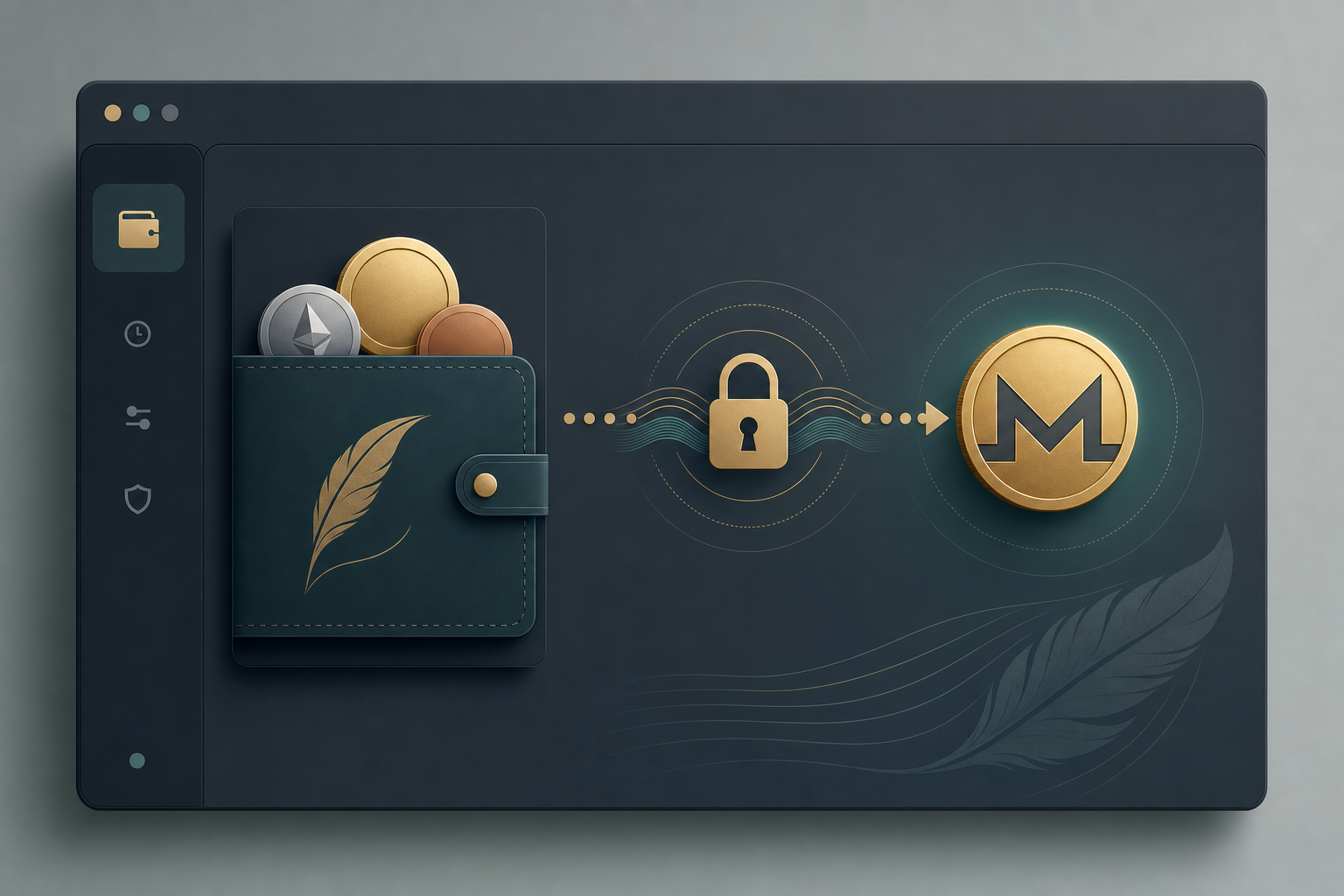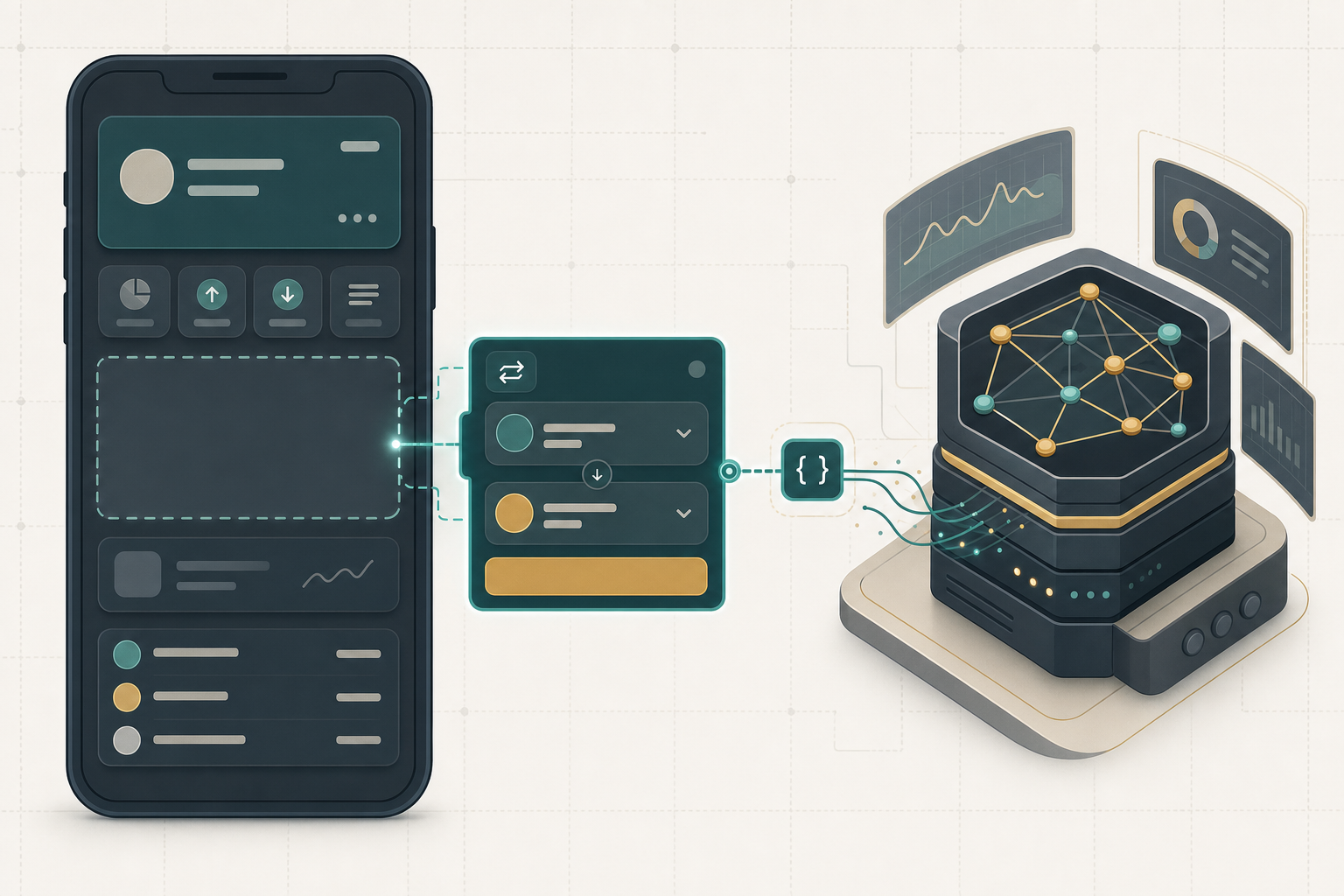
A crypto swap widget is an embedded UI-plus-API component that lets your wallet users exchange one coin for another without leaving your app. The widget renders inside your wallet; a backend API quotes the rate, generates a deposit address, and settles the swap. On GhostSwap the integration is no-KYC for your end-users — you pass zero identity requirements down to them — and non-custodial, so funds pass through and are never held by GhostSwap or your app.
TL;DR: You call GhostSwap's API to fetch a rate, create a swap, and get a deposit address; your app shows the widget, the user sends coins, and the API returns settlement status via webhook. No account, no KYC for end-users, 1,600+ coins.
A swap widget is a wallet feature that lets a user exchange coins in-app. It combines a small front-end (amount, from/to coins, receiving address) with a backend swap API that handles quoting, routing, and settlement.
What a swap widget is and why wallets embed one
A swap widget turns a single-asset or multi-asset wallet into a place where users can also convert between coins — BTC to XMR, SOL to ETH — without sending funds to an external exchange first. The wallet supplies the interface; a swap API supplies the liquidity and settlement.
Wallet developers embed one for two reasons. First, retention: a user who can swap in-app has no reason to leave for a centralised exchange. Second, revenue: each swap can carry an integrator fee, so the wallet earns per transaction instead of only on premium tiers.
The no-KYC angle matters for wallet builders specifically. If your swap provider requires end-user identity verification, that compliance burden lands on your users and, indirectly, on you. A no-KYC swap API keeps the integration to a receiving address and a deposit — no identity data flows through your app. GhostSwap is a no-KYC crypto exchange: no account, no email, no identity verification required to swap.
Step-by-step: integrate GhostSwap's API into your app
The integration is four API calls plus a widget render. See the GhostSwap API reference for endpoint details and authentication.
- Get an API key — Request an integrator key. This identifies your app for rate quoting and, if enabled, revenue-share attribution.
- Fetch a rate — Call the quote endpoint with
from,to, and amount. GhostSwap returns a floating-rate estimate priced from aggregated liquidity from leading crypto markets. Floating rate means the price is set when the user's funds arrive, not when they click — typically within the quoted spread. - Create the swap — Post the pair, the amount, and the user's receiving address. The API returns a unique deposit address for that swap. Funds pass through non-custodially — GhostSwap never holds them.
- Render the widget — Show the deposit address (and a QR code) in your wallet UI so the user can send from their in-app balance in one tap.
- Track settlement via webhook — Register a webhook URL. GhostSwap posts status updates (waiting, confirming, exchanging, done) so your app can update the UI without polling.
Median swap completion time is about 8 minutes, with a 95th-percentile of roughly 30 minutes when a chain is congested — surface that expectation in your widget so users aren't surprised by the slow case.
Revenue share: how wallet partners earn per swap
Wallet integrators can earn a share of the swap fee on each transaction routed through their app. Because attribution is keyed to your integrator API key, you don't need a separate tracking layer — the swaps your widget generates are counted automatically.
A few practical notes for developers:
- Revenue accrues per completed swap, not per quote or per abandoned flow.
- Higher-value swaps generate proportionally more, so wallets serving power users tend to see stronger per-swap returns.
- Because the flow is non-custodial and no-KYC for end-users, there's no onboarding funnel to leak conversions — the user swaps in the same session they open the widget.
For exact fee-share terms, request them alongside your API key — they aren't published as a fixed public number.
GhostSwap API vs SimpleSwap vs SideShift — feature comparison
All three offer programmatic swaps for integrators. The differences that matter to a wallet builder are end-user KYC, custody model, and coin coverage. Figures below are from each provider's own public materials, retrieved 2026-07-28.
| Feature | GhostSwap API | SimpleSwap | SideShift |
|---|---|---|---|
| End-user KYC | None required | None required for standard swaps | None required |
| Custody | Non-custodial pass-through | See provider terms | See provider terms |
| Coin support | 1,600+ coins | Publicly stated on provider site | Publicly stated on provider site |
| Rate type | Floating (aggregated liquidity) | Floating and fixed | Floating |
| Integrator revenue share | Yes, per completed swap | Affiliate programme | Affiliate/API programme |
| Webhook settlement updates | Yes | See API docs | See API docs |
Confirm each competitor's current terms against their own documentation before you commit — provider policies change. GhostSwap is not a registered financial service; verify the compliance posture that applies to your jurisdiction and your users independently.
Technical requirements: API key, swap flow, webhook support
To ship a working widget you need:
- An integrator API key — for authentication and revenue attribution.
- A quote-then-create flow — fetch a floating-rate estimate, then create the swap to get a deposit address. Don't cache quotes; re-fetch before each swap because the rate floats.
- A receiving address per swap — your app collects the user's destination address (and, for some chains, a memo or destination tag). Pass it into the create call.
- Webhook handling — a public HTTPS endpoint to receive status callbacks so your UI reflects settlement in near-real-time.
- Chain-specific edge handling — some assets require a memo or destination tag. If your widget supports those coins, collect the extra field or funds can land at the right node but the wrong account.
That's the whole surface. The API reference documents endpoints and parameters; a working test with a small BTC-to-XMR swap on the BTC to XMR pair is the fastest way to validate your integration end-to-end.
FAQ
Q: Do my users need to create an account or complete KYC to use the swap widget?
A: No. GhostSwap requires no account, no email, and no identity verification for swaps. Your users supply a receiving address and send funds; nothing else is collected from them through your app.
Q: Is the swap custodial — does GhostSwap or my app hold user funds?
A: No. Swaps are non-custodial pass-through. Funds route through the swap engine and settle to the user's receiving address; they are never held by GhostSwap or your wallet app.
Q: How many coins can I offer through the API?
A: 1,600+ coins across BTC, ETH, XMR, SOL and other altcoin networks are accessible via the API. You can expose the full list or restrict the widget to the pairs your wallet supports.
Q: Floating rate or fixed rate — which does the API return?
A: Floating-rate pricing from aggregated liquidity. The price is set when the user's funds arrive, typically within the quoted spread, rather than locked at click time. Re-fetch the quote before each swap.
Q: How long does a swap take, and how does my app know when it's done?
A: Median completion is about 8 minutes; the 95th percentile is roughly 30 minutes under chain congestion. Register a webhook and GhostSwap posts status updates through to settlement, so your UI can reflect progress without polling.
Get started
If you're building a wallet and want an in-app swap that adds no KYC burden to your users, start with the GhostSwap API reference and validate the flow with a BTC to XMR swap or a SOL to XMR swap.
Questions about the integration? The API reference is the canonical starting point.