How to Buy Bitcoin Anonymously in 2026: Complete No‑KYC Guide
If you want the quickest way to buy Bitcoin anonymously in 2026, the most practical method is to swap another cryptocurrency (like XMR, USDT, or ETH) for BTC through a non‑custodial, no‑KYC swap service. For example, you can privately exchange XMR to BTC in minutes without creating an account or uploading ID.
- Set up a private Bitcoin wallet where you control the keys.
- Obtain a privacy‑friendly coin (such as XMR) or other crypto you can spend.
- Use a non‑custodial, no‑KYC swap platform like GhostSwap to convert to BTC.
- Send your crypto, receive BTC directly to your wallet, and verify the transaction.
What You Need Before You Start
To buy Bitcoin anonymously, you need to prepare a few things in advance. This keeps your identity better separated from your BTC and avoids last‑minute mistakes.
1. A Non‑Custodial Bitcoin Wallet
Always receive anonymous Bitcoin into a wallet where you control the private keys. Avoid leaving BTC on centralized exchanges or custodial wallets, because they typically track your activity and can be compelled to share data.
Popular non‑custodial BTC wallets include:
- Electrum (desktop, open source)
- Sparrow Wallet (desktop, privacy‑focused)
- Samourai Wallet (Android, coin control, Whirlpool)
- BlueWallet (mobile, supports Lightning)
Check official download links on the project sites or trusted aggregators like Bitcoin.org to avoid malware impersonators.
2. A Source of Funds
Anonymous purchasing usually means you are not directly wiring your bank or card to a KYC exchange. Instead, you will typically use:
- Existing crypto (ETH, USDT, USDC, BNB, etc.)
- A privacy coin like Monero (XMR) or similar
- Cash for Bitcoin ATMs or P2P trades
If you start from another cryptocurrency and care about privacy, many users first move into XMR, then swap XMR to BTC privately. This reduces the on‑chain link between your original asset and your final Bitcoin.
3. Minimum Amounts & Fees
Most swap platforms and ATMs have minimum and maximum limits. Expect minimums in the range of $20–$50 equivalent, depending on the coin. Network fees (especially on Bitcoin or Ethereum) can also impact small amounts, so consider sending slightly more to account for miner fees.
4. Time Needed
Buying BTC anonymously can be nearly instant or take a few hours depending on the method:
- Non‑custodial swaps: 5–30 minutes, depending on network congestion.
- Bitcoin ATMs: 5–20 minutes, plus travel time.
- P2P trades: 15–60 minutes to find and complete a deal.
- Centralized exchanges: Hours or days due to KYC and banking delays.
Plan at least 30–60 minutes for your first anonymous swap so you can double‑check addresses and confirmations calmly.
Method 1: Using GhostSwap (No KYC — Recommended)
The cleanest way to buy Bitcoin anonymously in 2026 is crypto‑to‑crypto using a non‑custodial instant swap. GhostSwap lets you convert over 1,500 coins into BTC without creating an account, without KYC, and without GhostSwap ever holding your keys.
This method is ideal if you already hold crypto or can first acquire a privacy‑friendly coin elsewhere using cash.
Step 1: Go to GhostSwap.io
Open your browser and navigate to GhostSwap.io. You do not need to register or log in. The exchange widget appears on the homepage.
For a privacy‑optimized route, many users start with Monero then convert it into BTC using the dedicated BTC/XMR non‑custodial swap. XMR’s privacy features help break the traceability from your original funding source.
Step 2: Select BTC in the Exchange Widget
In the widget:
- Choose the coin you want to spend in the “You send” field (for example XMR, USDT, ETH).
- Choose BTC in the “You get” field.
- Enter the amount you want to convert or the amount of BTC you want to receive.
The interface will display an estimated rate, the expected amount of BTC, and the network fee. Rates update in real time based on market conditions and liquidity.
Step 3: Enter Your Bitcoin Wallet Address
Next, paste your personal Bitcoin wallet address. This should be from a non‑custodial wallet where you control the keys, not a centralized exchange deposit address.
Verify the first and last 5–6 characters of the address and confirm it is a valid BTC format (e.g., starting with bc1, 1, or 3). Sending to the wrong address is irreversible.
Some wallets generate new addresses for each deposit; using a fresh address for each anonymous purchase improves your on‑chain privacy.
Step 4: Send Your Crypto and Receive BTC
GhostSwap now shows you a deposit address for the coin you are spending (for example, an XMR address if you are swapping XMR to BTC). From your sending wallet:
- Copy the deposit address displayed in the widget.
- Send the exact amount of your source coin to that address.
- Wait for blockchain confirmations; GhostSwap automatically detects your payment.
As soon as the transaction is detected and the required confirmations are met, GhostSwap performs the swap and sends BTC directly to the Bitcoin address you provided. You will see progress indicators and, once complete, a transaction hash you can verify on a block explorer like Blockchair.
Pros of Using GhostSwap for Anonymous Bitcoin
- No KYC, no account: You do not upload ID, proof of residence, or documents.
- Non‑custodial design: You keep control of your wallets; GhostSwap only facilitates the swap.
- 1,500+ trading pairs: Swap almost any major coin into BTC, ETH, USDT, and many more.
- Speed: Most swaps complete within one or a few confirmations, often under 30 minutes.
- Privacy‑friendly routes: Use privacy coins like XMR as an intermediate step.
Cons of This Method
- Crypto‑to‑crypto only: You cannot directly send bank transfer or card unless you first buy a coin elsewhere or use GhostSwap’s “Buy crypto” feature where available.
- Network dependency: If Bitcoin or your source chain is congested, confirmations may take longer.
You can swap BTC, ETH, USDT and 1,500+ other coins on GhostSwap without KYC, making it one of the most straightforward paths to anonymous Bitcoin ownership if you already hold crypto.
Method 2: Using a Centralized Exchange
Centralized exchanges (CEXs) like Binance, Coinbase, or Kraken are common ways to buy Bitcoin with fiat. However, they are usually the opposite of anonymous.
How Centralized Exchanges Work
A CEX connects directly to banks and card networks. You typically:
- Create an account with your email and password.
- Complete full KYC with passport/ID, selfie, and sometimes proof of address.
- Deposit fiat via bank transfer, card, or payment processor.
- Buy BTC on the spot market, then withdraw to your personal wallet.
These platforms log your IP, device, deposit details, and trade history. Authorities can request this data, and some exchanges share it with analytics firms.
Why This Method Is Not Anonymous
- KYC and AML policies: Your identity is explicitly tied to your account.
- Bank trail: Your bank records show transfers to the exchange.
- On‑chain linkage: Your exchange withdrawal addresses may be flagged and clustered by analytics tools.
Centralized exchanges can be convenient for liquidity and large orders, but if your goal is anonymity, you should regard them as a last resort or a source of initial funds that you later “wash” through privacy‑enhancing steps and non‑custodial swaps.
Time & Friction
Setting up a new exchange account can take anywhere from 30 minutes to several days, depending on how quickly KYC is processed. Bank transfers may add additional delays. This is slower and more invasive than using a no‑KYC swap when you already have crypto.
Method 3: Other Ways to Buy Bitcoin Anonymously (P2P & ATMs)
If you are starting from cash or do not have any cryptocurrency yet, peer‑to‑peer trades and Bitcoin ATMs can bridge that gap. These methods can be more private than CEXs, but you should research the rules in your country and prioritize personal safety.
Option A: Peer‑to‑Peer (P2P) Trading
P2P trading means buying BTC directly from another person. This can be done online or in person. Some specialized platforms simply act as escrow while you and the counterparty arrange payment.
Typical P2P workflows:
- Find a seller advertising BTC for cash, bank transfer, gift cards, or other payments.
- Agree on a price, payment method, and amount.
- Use an escrow mechanism when possible so neither party can easily scam the other.
- Once payment is confirmed, the seller releases BTC to your wallet.
P2P can be private if you pay in cash or use methods that do not require strong identification. Still, certain payment channels and platforms may collect data.
Option B: Bitcoin ATMs
Bitcoin ATMs let you insert cash and receive BTC to your wallet. Thousands of machines operate worldwide, though availability and rules vary by jurisdiction. You can locate them on services like Coin ATM Radar.
Common steps at a BTC ATM:
- Choose “Buy Bitcoin.”
- Enter the amount of cash you will insert.
- Scan your wallet QR code (or in some cases, print a paper wallet).
- Insert banknotes and confirm the purchase.
- Receive BTC to your wallet address once processed.
Some ATMs allow small purchases without ID, while others require phone verification or KYC above a threshold. Check the on‑screen prompts before committing. Observe your surroundings to ensure physical safety and privacy.
Combining P2P or ATMs With GhostSwap for Better Privacy
Even if you buy BTC directly with cash, that first receiving address might get tied to your location or a specific ATM operator. For greater on‑chain privacy, you could:
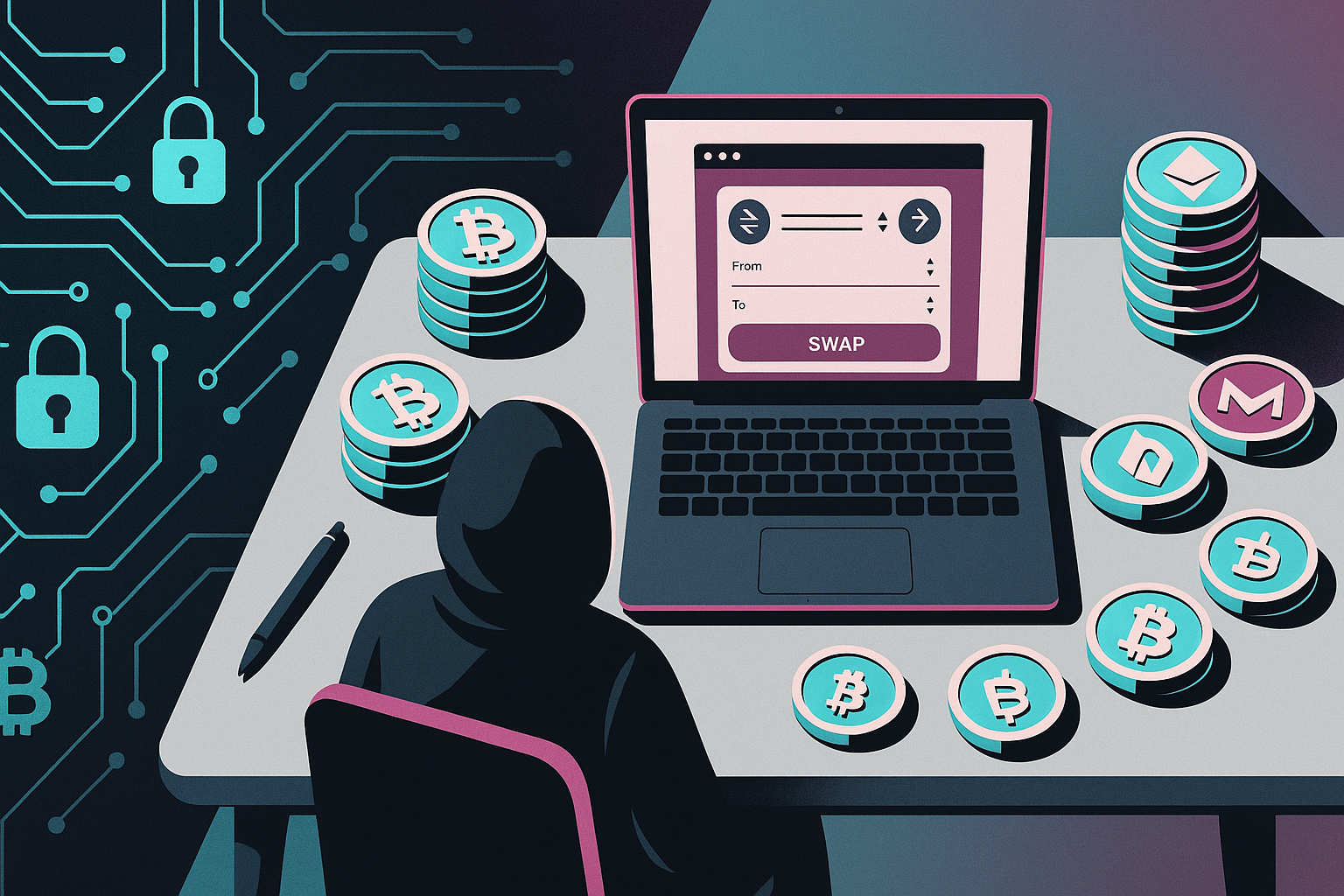
- Buy BTC with cash from an ATM or P2P seller into a fresh wallet.
- Swap that BTC to a privacy coin like XMR using a non‑custodial platform.
- Then convert XMR back to BTC to a new wallet address via a private swap like the GhostSwap BTC/XMR route.
This multi‑step process can help break deterministic transaction links that blockchain surveillance tools use.
Tips for Staying Safe When Buying Bitcoin Anonymously
Buying BTC anonymously is not just about skipping KYC. You also need to protect your operational security (OpSec) and avoid scams and technical mistakes.
Use Secure, Privacy‑Respecting Wallets
- Download wallets only from official websites or reputable sources, never from random ads.
- Write down your seed phrase on paper and store it in a secure location offline.
- Consider hardware wallets like Ledger or Trezor for larger holdings, purchased directly from the manufacturer.
- Use wallets that support coin control, multiple addresses, and optional Tor integration if privacy is paramount.
Improve Your Network Privacy
Even if you skip KYC, your IP address can still leak information about you.
- Use a reputable VPN that does not log your traffic.
- Consider routing your wallet and browser connections over Tor where technically supported.
- Avoid logging into personal accounts (email, social media) in the same session you use for private BTC operations.
Verify Addresses and Transactions
Crypto transactions are irreversible. To avoid mistakes:
- Double‑check every receiving address and consider sending a small test transaction first for large amounts.
- Use reputable block explorers like Blockstream.info or Blockchair to confirm that funds arrived.
- Beware clipboard‑hijacking malware that can silently replace wallet addresses.
Avoid Sharing Personal Details With Counterparties
When using P2P or ATMs:
- Prefer in‑person cash trades in public places if legally allowed and safe.
- Do not overshare identity details in chat or messaging apps.
- Beware of too‑good‑to‑be‑true offers or sellers who pressure you to act quickly.
Understand Your Local Regulations
Crypto laws differ widely. Some regions heavily regulate cash purchases and P2P trades. Make sure you understand:
- Whether buying BTC anonymously is legal in your jurisdiction.
- Any limits on cash transactions or reporting requirements.
- How tax rules apply to your Bitcoin acquisitions and sales.
Anonymity is not a shield from legal responsibilities; it simply protects your privacy from unnecessary exposure.
Ready to Trade Bitcoin (BTC)?
If you already hold crypto, the fastest way to move into BTC without sharing your identity is a non‑custodial swap. On GhostSwap, you can swap BTC, ETH, USDT and 1,500+ other assets with no account and no KYC. Start a private exchange from XMR to BTC or choose any other pair that fits your current holdings.
Frequently Asked Questions
Can I do this without ID?
Yes, it is still possible in 2026 to acquire Bitcoin without submitting ID, but you typically need to avoid traditional centralized exchanges. Methods that do not require ID include:
- Non‑custodial instant swaps like GhostSwap, when you already have crypto.
- Certain Bitcoin ATMs that allow small cash purchases below KYC thresholds.
- P2P cash trades arranged directly with individuals.
However, some jurisdictions are tightening regulations, so availability varies by country. Always check the current rules where you live.
What is the best method?
The “best” method depends on your starting point and goals:
- If you already hold crypto and want speed and privacy, a non‑custodial swap like GhostSwap is typically the most efficient.
- If you only have cash, a Bitcoin ATM or P2P cash trade can work, possibly followed by a privacy‑enhancing swap route.
- If you need large amounts and do not mind KYC, a centralized exchange may provide deeper liquidity but sacrifices anonymity.
For most users prioritizing anonymity and convenience, swapping an existing coin into BTC through a no‑KYC service is the most practical approach.
How long does it take?
Timeframes vary by method:
- Non‑custodial swaps (GhostSwap): Typically 5–30 minutes, depending on network congestion and required confirmations.
- Bitcoin ATMs: 5–20 minutes after inserting cash, plus any travel time.
- P2P trades: 15–60 minutes to find a counterparty, negotiate, and complete payment.
- Centralized exchanges: Same‑day to several days due to KYC checks and bank processing times.
Once you are familiar with the process, anonymous swaps can be as quick as a standard exchange trade, with far less friction.
Is it safe to use GhostSwap?
GhostSwap is designed as a non‑custodial, instant swap platform, which means it does not hold your long‑term balances or manage your private keys. You send only the specific amount of crypto you want to swap and receive BTC directly into your personal wallet.
As with any crypto tool, safety also depends on your own practices:
- Always double‑check deposit and receiving addresses.
- Use secure wallets and devices free from malware.
- Start with small test amounts if you are new to the process.
Non‑custodial swaps reduce counterparty risk compared to leaving assets on centralized exchanges, because there is no custodial account that can be frozen, hacked, or seized.