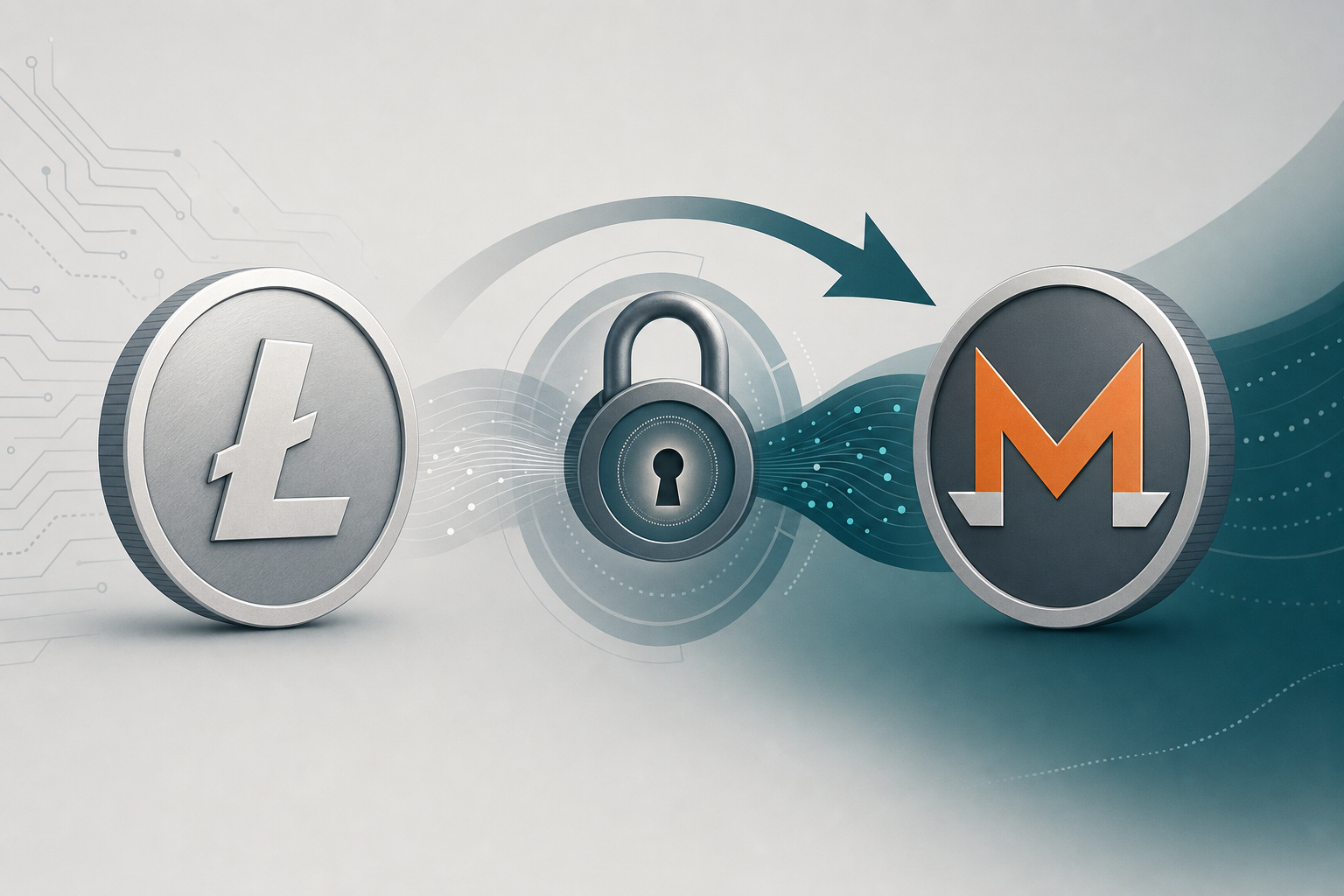
What Is KYC in Crypto? Complete Guide for 2026
Know Your Customer (KYC) in crypto is the process where an exchange or crypto service verifies your identity using documents like a passport, ID card, or proof of address before letting you trade, deposit, or withdraw. KYC is used to meet regulations on money laundering, terrorism financing, and tax reporting.
If you prefer to trade without sharing personal documents, non-custodial swap platforms like GhostSwap let you exchange coins directly from your wallet, with no KYC and no account.
What Is KYC in Crypto? Explained Simply
KYC in crypto is a set of checks that crypto platforms use to know who their customers are.
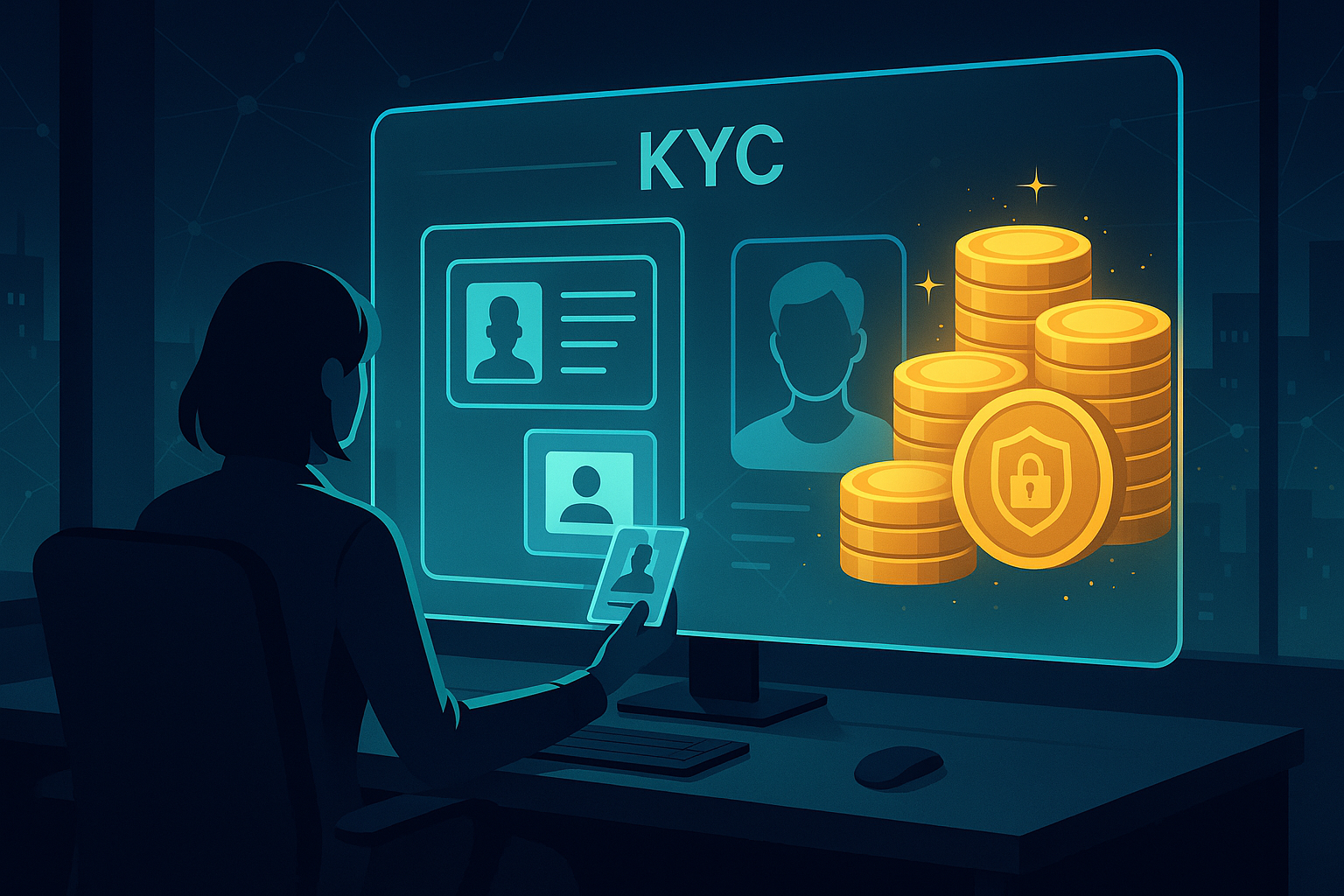
In practice, it means you must submit your personal information before using certain services. This usually includes your full name, date of birth, home address, and a government-issued ID.
Some platforms also ask for a selfie, a short video, or proof of where your funds come from. Only after they verify your identity will they let you trade above small limits or withdraw larger amounts.
Regulated centralized exchanges, fiat on-ramps, and some custodial wallets are required to perform KYC. In contrast, many DeFi protocols and non-custodial swap tools work without identity checks because they never hold your funds and act more like software than financial intermediaries.
How Does KYC in Crypto Work?
1. Data collection
The KYC process starts when you sign up on a centralized crypto exchange or similar service.
To comply with Anti-Money Laundering (AML) and Counter-Terrorist Financing (CTF) rules, the platform collects:
- Full legal name
- Date of birth
- Residential address
- Nationality
- Email and phone number
- Photo of a passport, national ID card, or driver’s license
- Sometimes, a selfie or video to match your face to the ID
This step is usually presented as “Level 1” or “Basic” verification in many centralized exchanges.
2. Document verification
Once you upload your documents, the platform either reviews them manually or uses third-party KYC providers.
These providers use tools like optical character recognition (OCR) and liveness detection to:
- Check if the ID is genuine and unaltered
- Confirm that the ID is not expired
- Match the selfie to the photo on the document
- Make sure the person is real and not a deepfake
Verification can take anywhere from a few minutes to a few days, depending on how busy the platform is and how strict the checks are.
3. Sanctions and risk screening
After basic verification, many platforms run your details through sanctions and watchlists.
They check:
- Global sanctions lists (for example, OFAC, EU, UN)
- Politically Exposed Person (PEP) databases
- Adverse media or law enforcement alerts
If there is a match, the account may be blocked or flagged for enhanced review. This is a core part of the wider AML/KYC framework regulators worldwide expect.
4. Ongoing monitoring
KYC is not always a one-time step.
Many exchanges apply ongoing monitoring, which can trigger:
- Requests for updated ID if a document expires
- Additional questions if you suddenly move large sums
- Source-of-funds checks (asking where your crypto or fiat came from)
If something looks suspicious, the platform may freeze withdrawals until the review is complete. This is where the convenience of centralized services often clashes with user expectations of crypto freedom.
5. Data storage and security
All the information collected in KYC must be stored securely, often for several years, depending on local laws.
This data can be shared with regulators or law enforcement upon request. Breaches at financial institutions show that holding large databases of IDs and personal details comes with real risks for users if security fails.
By contrast, non-custodial tools like GhostSwap’s instant swap interface do not hold user funds or identity data. You remain in control of your own wallets and keys, which significantly changes the regulatory and risk profile.
Why Does KYC in Crypto Matter?
Regulatory compliance and legal access
For centralized platforms, KYC is not optional.
Most jurisdictions require crypto businesses that hold customer funds to follow KYC/AML rules. Without it, they risk fines, license revocation, or being shut down. For users, this means that fully anonymous accounts on major exchanges have largely disappeared.
In some cases, regulators also pressure banks and payment processors to only work with KYC-compliant crypto services. So if you want to easily move fiat into or out of crypto on a large platform, you will almost always face KYC.
User protection and fraud prevention
Another reason KYC matters is fraud and scam prevention.
By tying accounts to real identities, exchanges can:
- Block known scammers or repeat offenders
- Investigate stolen funds more easily
- Work with law enforcement on serious crime cases
Regulators argue that this helps make crypto markets safer for ordinary users. Critics counter that motivated criminals can still find ways around KYC, while honest users lose privacy.
Privacy, sovereignty, and censorship concerns
KYC also matters because of what it means for personal freedom.
Handing over your full legal identity, biometric data, and financial history concentrates power in the hands of platforms and governments. This can lead to:
- Account censorship based on location, politics, or business type
- Surveillance of on-chain activity tied to real names
- Increased risk of identity theft if databases are hacked
For many early crypto users, this clashes with Bitcoin’s original goal of creating open, permissionless money. That is why non-custodial wallets, decentralized exchanges (DEXs), and instant no-KYC swap services continue to be popular.
Shaping the future of DeFi and Web3
As DeFi grows, regulators are debating whether and how to apply KYC to protocols and self-custodial tools.
Standards like “KYC’d wallets” or “verified addresses” are being discussed, which could lead to a split between fully permissionless ecosystems and semi-permissioned ones. How this debate evolves will affect which users and projects can access which parts of the crypto economy.
You can swap BTC, ETH, USDT and 1,500+ other coins on GhostSwap without KYC, directly from your own wallet.
What Is KYC in Crypto? Examples & Common Use Cases
Example 1: Opening an account on a centralized exchange
Imagine you sign up at a large centralized exchange to buy your first Bitcoin using a bank transfer.
Before you can deposit fiat or increase your withdrawal limits, the exchange prompts you to complete KYC. You upload your passport, a selfie, and a proof of address like a utility bill. After a short review, your account is verified and you can trade spot markets and maybe access margin or futures.
Example 2: Higher withdrawal limits & advanced features
Many platforms use tiered KYC levels.
A basic level might only require your name and country, allowing small crypto-only withdrawals. Higher tiers, with full document uploads and income information, unlock:
- Higher daily withdrawal limits
- Access to derivatives or leveraged products
- Fiat deposits and withdrawals to your bank
Each higher tier usually comes with more intensive checks and more personal data sharing.
Example 3: Fiat on-ramps and off-ramps
Payment processors and fiat gateways almost always require KYC.
If you want to buy USDT with a credit card, the third-party payment processor might request ID even if the crypto platform itself does not. Similarly, selling crypto for euros or dollars via bank transfer will typically involve a KYC-verified account at some point in the flow.
Example 4: OTC trading for large orders
Over-the-counter (OTC) trading desks handle large block trades for institutions and high-net-worth individuals.
Because of the size and visibility of these transactions, KYC is strict. Clients may be asked for detailed company documents, proof of beneficial ownership, and extensive source-of-funds documentation. Once approved, they can execute large trades with less slippage than on open order books.
Example 5: No-KYC swaps using non-custodial tools
On the other side of the spectrum are non-custodial swap platforms and DEXs.
With a tool like GhostSwap’s non-custodial swap interface, you connect your wallet, choose the asset you want to give and the one you want to receive, and complete the swap on-chain. No account, email, or ID upload is needed, because the platform does not take custody of your assets.
These no-KYC crypto swaps are popular among users who prioritize self-custody, privacy, and the ability to trade without waiting for approval or risking centralized account freezes.
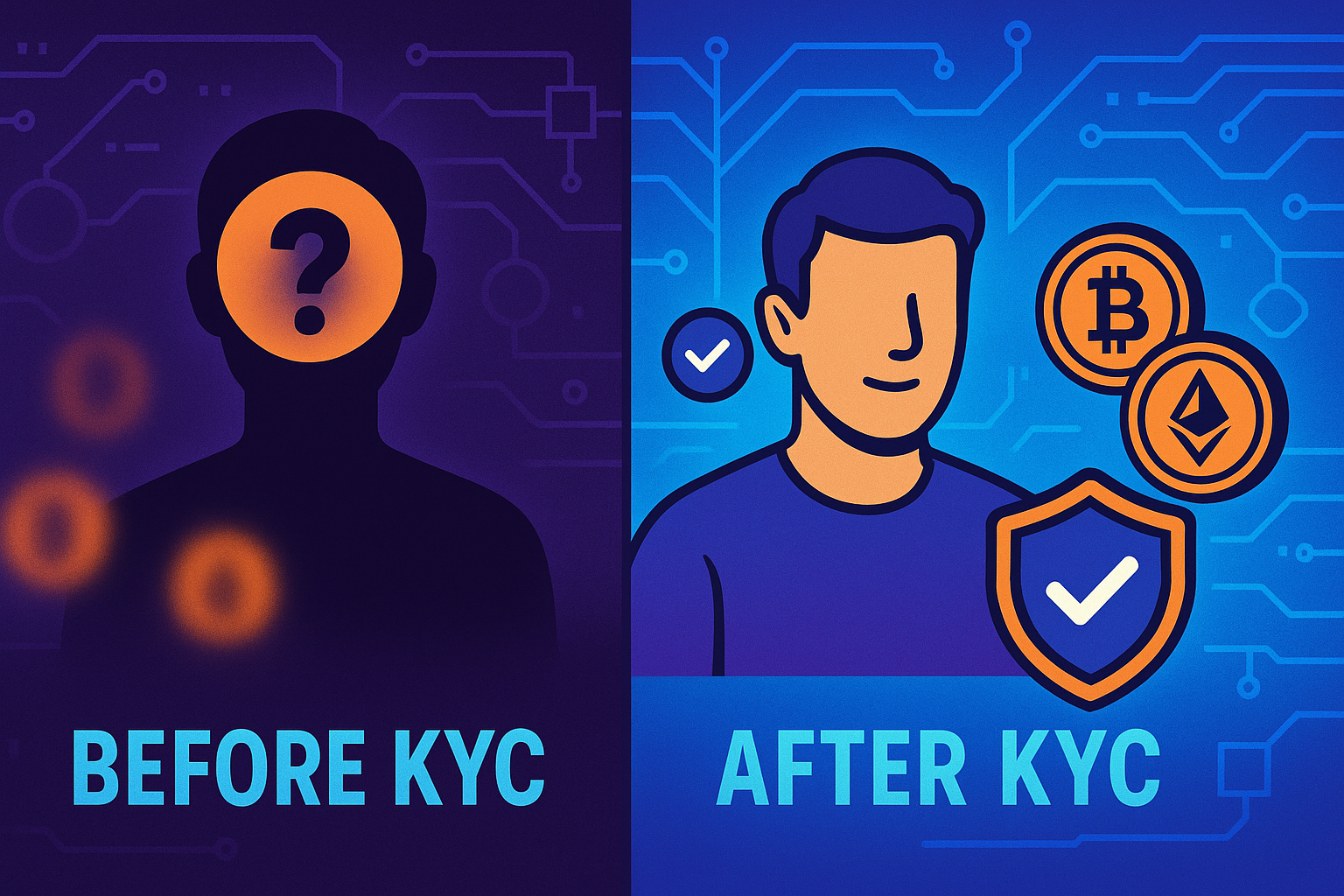
Pros and Cons of KYC in Crypto
Advantages of KYC in crypto
- Regulatory compliance: Enables centralized exchanges to operate legally in many jurisdictions and connect with banks and payment processors.
- Improved fraud detection: Makes it easier to identify and block known scammers or money launderers.
- Easier recovery in some cases: With identity records, support may sometimes help recover access if an account is hijacked.
- Access to more products: KYC can unlock derivatives, higher leverage, and fiat on/off ramps that regulators restrict to verified users.
Disadvantages of KYC in crypto
- Privacy loss: Users must share sensitive personal data that can link all future activity to their real-world identity.
- Data breach risk: Centralized storage of millions of IDs and documents creates a tempting target for hackers.
- Censorship and exclusion: Platforms can block entire regions or individuals, preventing them from accessing their funds or services.
- Friction and delays: Verification can be slow, with failed uploads, rejections, and long support queues.
- Not aligned with self-custody: The philosophy of open, permissionless crypto conflicts with “asking permission” via KYC.
Because of these trade-offs, many users choose a hybrid approach: they use KYC-compliant services when they need fiat rails or certain products, and rely on non-custodial, no-KYC tools for everyday swaps and portfolio management.
How KYC Relates to Trading on GhostSwap
KYC rules mainly target custodial services that take control of user funds. When you deposit coins into a centralized exchange, they sit in that platform’s wallets, and you rely on the exchange to manage withdrawals and security. That custodial role is what draws regulatory attention.
GhostSwap works differently. It is a non-custodial instant swap platform where you always trade from your own wallet. You do not create an account, and GhostSwap does not hold your crypto at any point in the process.
Because GhostSwap functions as a self-custodial swap interface, there is:
- No centralized user balance stored on the platform
- No account registration or login
- No identity document uploads or selfies
You choose the coin you want to send, the coin you want to receive, and provide the receiving address. Once your transaction is confirmed, the swap completes and funds go directly to your wallet. This model lets you swap crypto instantly while maintaining control over your keys and minimizing the collection of personal data.
For users who want to avoid traditional KYC workflows, GhostSwap can sit alongside other tools like hardware wallets, on-chain DEXs, and privacy-preserving networks to create a more sovereign trading stack.
Ready to Start Trading?
If you want to trade across a wide set of assets without going through a lengthy KYC process, you can use GhostSwap to move between BTC, ETH, stablecoins, and 1,500+ other pairs directly from your own wallet.
Pick the coins you want to swap, paste your address, and complete the transaction in minutes, with no centralized account to open and no identity documents required.
Frequently Asked Questions
Is KYC mandatory for all crypto users?
No, KYC is not mandatory for all crypto activity.
KYC is required by most centralized exchanges, custodial services, and fiat on-ramps that want to operate legally in many countries. However, you can still transact without KYC using self-custodial wallets, DEXs, and non-custodial swap services that do not hold your funds.
Can I buy or swap crypto without KYC?
Yes, it is still possible to buy or swap crypto without KYC, but options vary by region.
Peer-to-peer platforms, some Bitcoin ATMs, DEXs, and non-custodial swap tools allow trading with minimal or no identity checks, especially for crypto-to-crypto transactions. Services such as GhostSwap let you perform instant, no-KYC swaps between a large range of coins directly from your wallet.
Is KYC safe in crypto, and what are the risks?
KYC itself is a standard practice in finance, but its safety depends on how each platform stores and protects your data.
Risks include data breaches, identity theft, and unwanted data sharing with third parties or governments. To reduce these risks, only complete KYC on reputable platforms, enable strong account security, and avoid sending documents through informal channels like email or direct messages.
Does KYC prevent crypto scams and money laundering?
KYC helps make some types of fraud and large-scale money laundering more difficult, especially on centralized platforms.
However, it does not eliminate scams or illegal activity altogether. Scammers can still target users with phishing, social engineering, or exploit unregulated platforms. KYC is one tool among many in the broader AML framework, but it is not a perfect solution and comes with significant privacy trade-offs.
How is KYC different from AML in crypto?
KYC and AML are related but not the same thing.
KYC (Know Your Customer) focuses on identifying who the user is, while AML (Anti-Money Laundering) is the broader framework of laws, monitoring, and reporting that tries to detect and prevent illicit financial flows. KYC is one component of AML, along with transaction monitoring, suspicious activity reports, and sanctions screening.
Will DeFi and non-custodial swaps require KYC in the future?
Regulators are actively discussing how to apply KYC/AML rules to DeFi and non-custodial tools.
Possible future approaches include voluntary “verified” wallets, front-end access controls for certain jurisdictions, or new categories of regulated intermediaries. However, the technical nature of decentralized protocols and the global, open-source structure of Web3 make strict KYC on pure smart contracts difficult to enforce in a uniform way.
For now, many users combine regulated, KYC-based services for fiat access with non-custodial tools like GhostSwap for day-to-day crypto management and private exchange.
To explore how non-custodial, no-KYC trading works in practice, you can head directly to the GhostSwap non-custodial swap interface and try a small test transaction from your own wallet.