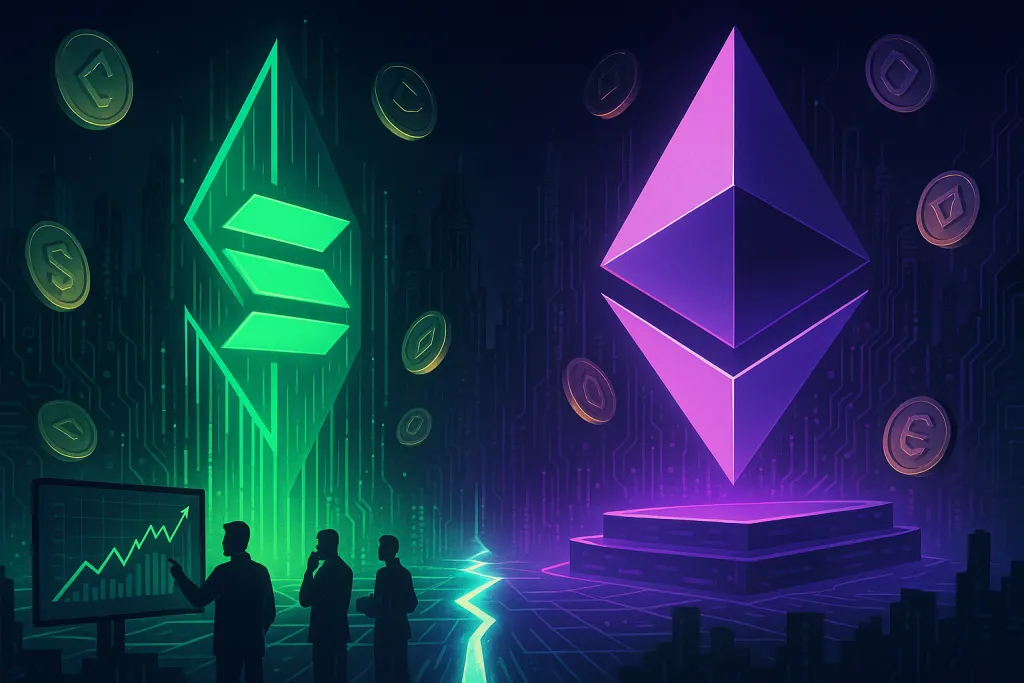
In 2026, Ethereum still dominates smart contracts and DeFi, while Solana offers faster, cheaper transactions and a growing ecosystem. Ethereum (ETH) is more battle-tested and decentralized, but Solana (SOL) delivers superior performance for high-throughput apps. For many investors and users, the most practical approach is to hold both and rebalance between them using non-custodial swap tools like GhostSwap’s SOL to ETH exchange.
| Feature | Solana (SOL) (SOL) | Ethereum (ETH) (ETH) |
|---|---|---|
| Current Price (2026-03-04) | $89.91 | $2,064.63 |
| Market Cap | $51.22B (Rank #7) | $249.17B (Rank #2) |
| Purpose / Use Case | High-performance smart contracts, DeFi, NFTs, payments | General-purpose smart contracts, DeFi, NFTs, Web3 backbone |
| Consensus Mechanism | Proof of Stake + Proof of History | Proof of Stake (Ethereum PoS) |
| Transaction Speed | Hundreds to thousands of TPS on mainnet, sub-second finality | Dozens of TPS on L1, higher via rollups; ~12s block time |
| Fees | Very low (often fractions of a cent) | Higher on L1, much lower on L2 (rollups) |
Quick Overview: Solana (SOL) vs Ethereum (ETH)
The Solana vs Ethereum debate centers on three things: performance, decentralization, and ecosystem maturity.
Solana focuses on raw speed and low fees. It uses an innovative Proof of History (PoH) combined with Proof of Stake (PoS) to process thousands of transactions per second with very cheap fees. This makes it attractive for high-frequency DeFi, on-chain games, and consumer apps that need real-time responsiveness.
Ethereum prioritizes decentralization, security, and composability. It transitioned to Proof of Stake and relies on a modular roadmap, where layer 2 rollups handle scaling. Ethereum has the most liquidity, the deepest DeFi stack, and the broadest developer community in Web3.
Practically, Solana is often better for fast, low-cost user experiences, while Ethereum remains the default settlement layer for serious DeFi, institutional activity, and cross-chain liquidity. Traders frequently move between them, using private, non-custodial routes to swap SOL to ETH instantly when market conditions change.
What Is Solana (SOL)?
Solana is a high-performance blockchain designed to support scalable, low-cost decentralized applications. Launched in 2020 by Solana Labs, it aims to be a single global state machine capable of handling thousands of transactions per second without relying on additional scaling layers. It focuses on speed and throughput while keeping fees extremely low, often less than a fraction of a cent.
Technically, Solana combines a unique Proof of History mechanism with Proof of Stake. Proof of History creates a verifiable cryptographic clock that orders transactions, allowing validators to process blocks in parallel and increase throughput. This architecture has positioned Solana as a leading network for on-chain trading, NFTs, gaming, and payments.
As of March 2026, SOL trades at $89.91 with a market cap of $51.22 billion, ranking #7 by market capitalization. It has a circulating supply of about 569.77 million SOL and no hard maximum supply. While Solana has faced network outages in the past, it continues to attract developers and users looking for fast, consumer-friendly Web3 experiences.
What Is Ethereum (ETH)?
Ethereum is the original smart contract platform and the backbone of much of the decentralized finance and Web3 ecosystem. Proposed by Vitalik Buterin and launched in 2015, Ethereum introduced programmable money via smart contracts, enabling applications such as decentralized exchanges, lending markets, NFTs, DAOs, and more.
Ethereum used Proof of Work for many years, then completed its transition to Proof of Stake with “the Merge.” It now uses a PoS consensus mechanism, where validators stake ETH to secure the network and earn rewards. Ethereum’s design has shifted toward a modular architecture, in which the main chain (layer 1) provides security and data availability, while layer 2 rollups handle most user transactions and scaling.
As of March 2026, ETH is priced at $2,064.63 with a market cap of $249.17 billion, ranking #2 in the crypto market. Circulating and total supply stand at approximately 120.69 million ETH, with no fixed maximum. Ethereum remains the most battle-tested smart contract platform, with the largest developer community and the deepest liquidity across DeFi and NFTs.
Solana (SOL) vs Ethereum (ETH): Technology
Consensus and Security Model
Ethereum uses pure Proof of Stake, where validators stake ETH and are randomly selected to propose and attest to blocks. Security is based on economic incentives and penalties: malicious validators risk having their stake slashed. This model, combined with broad validator distribution, supports Ethereum’s decentralization goals. You can review the protocol details on the official site at ethereum.org.
Solana uses a hybrid of Proof of History and Proof of Stake. Proof of History is not a consensus mechanism itself, but a cryptographic sequence that timestamps events, allowing validators to agree on the order of transactions more efficiently. Validators still stake SOL to participate in consensus and secure the network. While this architecture yields high throughput, critics argue that Solana is more resource-intensive and less decentralized than Ethereum.
Scalability and Throughput
Scalability is the heart of the Solana vs Ethereum comparison. Solana aims to scale on a single layer, squeezing maximum performance from modern hardware. In practice, it regularly processes hundreds to thousands of transactions per second on mainnet, with sub-second confirmation times and rapid finality.
Ethereum’s base layer handles a much lower TPS on its own, but the ecosystem is designed to scale via layer 2 solutions such as optimistic and zero-knowledge rollups. Networks like Arbitrum, Optimism, and zkSync batch many transactions off-chain, then post data back to Ethereum for security. This modular approach trades some raw speed on L1 for greater decentralization and resilience.
Fees and User Experience
Solana keeps fees very low by design. Even in busy periods, transaction costs are typically a fraction of a cent, which is attractive for high-frequency traders, NFT mints, and consumer apps where users are sensitive to costs.
Ethereum layer 1 gas fees can spike during network congestion, especially when popular DeFi or NFT projects launch. However, fees on Ethereum layer 2s have fallen significantly, allowing users to enjoy much cheaper transactions while still relying on Ethereum mainnet security. For many users, the choice is between ultra-cheap Solana L1 and slightly higher but still low fees on Ethereum L2.
Decentralization and Infrastructure Requirements
Running a full Solana validator requires relatively powerful hardware and considerable bandwidth. This raises concerns about centralization, because fewer individuals can afford to run full nodes. The team has been working on optimizations, but Solana’s design intentionally pushes hardware limits for performance.
Ethereum’s PoS validators can run on more modest hardware, and there is a large set of home stakers and independent node operators. According to public data from explorers and analytics tools like those referenced by CoinGecko, Ethereum’s node count and geographic distribution are higher, supporting its reputation as a more decentralized settlement layer.
Solana (SOL) vs Ethereum (ETH): Use Cases
DeFi and On-Chain Trading
Ethereum dominates DeFi in terms of total value locked (TVL), protocol diversity, and institutional participation. Major protocols such as Uniswap, Aave, and MakerDAO originated on Ethereum and often treat it as their primary deployment. This results in deep liquidity, strong network effects, and powerful composability.
Solana, however, has carved out a strong DeFi niche, especially for high-speed trading, orderbook-style exchanges, and new memecoin markets. Protocols on Solana leverage low-latency execution for experiences closer to centralized exchanges, but with non-custodial control. Many traders bridge liquidity or simply swap SOL for ETH and other assets privately to arbitrage opportunities across ecosystems.
NFTs and Digital Collectibles
Ethereum was the birthplace of ERC-721 and ERC-1155 NFTs and still hosts many blue-chip collections. High-value art, collectibles, and brand partnerships largely remain anchored on Ethereum because of its prestige and liquidity.
Solana’s NFT ecosystem has grown quickly thanks to very low minting and trading fees. This enables mass-market minting, gaming NFTs, and social collectibles where cost is a barrier on Ethereum layer 1. Solana NFTs are particularly attractive for creators and communities targeting smaller transactions and high user engagement.
Gaming and Consumer Applications
For real-time games, social apps, and microtransaction-heavy platforms, Solana’s low fees and fast confirmations are a clear advantage. Game studios and consumer app builders can deliver near-instant UX without requiring users to worry about gas spikes.
Ethereum addresses similar use cases through layer 2s and sidechains. Many games deploy to rollups or other EVM-compatible alternative chains while still tapping into Ethereum liquidity. For developers, this Ethereum-centric but multi-chain approach offers a large audience plus flexible performance options.
Enterprise and Institutional Adoption
Ethereum enjoys stronger institutional recognition. It has been the focus of enterprise consortia, research from major financial institutions, and regulated financial-product development. The long history and robust security track record are appealing to risk-averse players.
Solana is starting to attract institutional interest for specific verticals such as tokenized assets and high-speed market infrastructure, but it is still earlier in that curve compared with Ethereum.
Solana (SOL) vs Ethereum (ETH): Price Performance
Current Market Data (as of March 4, 2026)
- Solana (SOL): $89.91, market cap $51.22B (Rank #7), 24h volume $6.73B
- Ethereum (ETH): $2,064.63, market cap $249.17B (Rank #2), 24h volume $28.46B
Both assets are trading below their all-time highs. Solana’s ATH of $293.31 was reached on January 19, 2025, while Ethereum’s ATH of $4,946.05 came on August 24, 2025. This indicates that each has experienced a meaningful drawdown, consistent with broader crypto market cycles.
Recent Performance
Short-term momentum for both coins is positive. Over the past 24 hours, SOL is up 7.82% and ETH is up 5.79%. Over the past 7 days, SOL has gained 7.41%, slightly outpacing ETH’s 5.77% rise. These moves reflect renewed market interest, although they remain within a broader consolidation area.
On a 30-day basis, both assets are down, with SOL at -12.85% and ETH at -10.61%. Looking at the 1-year change, Solana has fallen -34.33% while Ethereum is down only -1.68%. This suggests Ethereum has been more resilient in the recent market environment, while Solana has shown higher volatility to both the upside and downside.
Supply and Tokenomics
Ethereum has a circulating and total supply of about 120.69 million ETH. Since the shift to Proof of Stake and EIP-1559 fee burning, Ethereum’s issuance has become more dynamic, and in some conditions net supply growth can slow significantly. You can verify up-to-date tokenomics on trackers such as CoinMarketCap’s Ethereum page.
Solana’s circulating supply is approximately 569.77 million SOL, with a total supply of 621.60 million SOL. It does not have a strict maximum supply cap, but inflation schedules and token unlocks are transparently documented. Investors should consider vesting schedules and staking rewards when evaluating long-term dilution.
You can swap SOL for BTC, ETH, USDT and 1,600+ other coins on GhostSwap without KYC.
Solana (SOL) vs Ethereum (ETH): Future Potential
Roadmaps and Upgrades
Ethereum’s future centers on scaling and data availability. Key milestones include wider adoption of danksharding concepts, further cost reductions on rollups, and continued improvements in validator efficiency and client diversity. The ultimate goal is to make Ethereum the most secure, censorship-resistant base layer for a multi-chain ecosystem.
Solana’s roadmap is focused on improving stability, client diversity, and performance refinements. Ongoing work aims to reduce outages, optimize validator software, and support more resilient infrastructure. The ecosystem is also investing in developer tooling, mobile-first experiences, and integrations with traditional finance rails.
Ecosystem Growth
Ethereum’s advantage lies in its network effects. Most new DeFi primitives, standards, and institutional pilots still start on Ethereum or EVM-compatible environments. As more assets are tokenized and more real-world infrastructure connects to blockchains, Ethereum stands to benefit from its reputation and modular design.
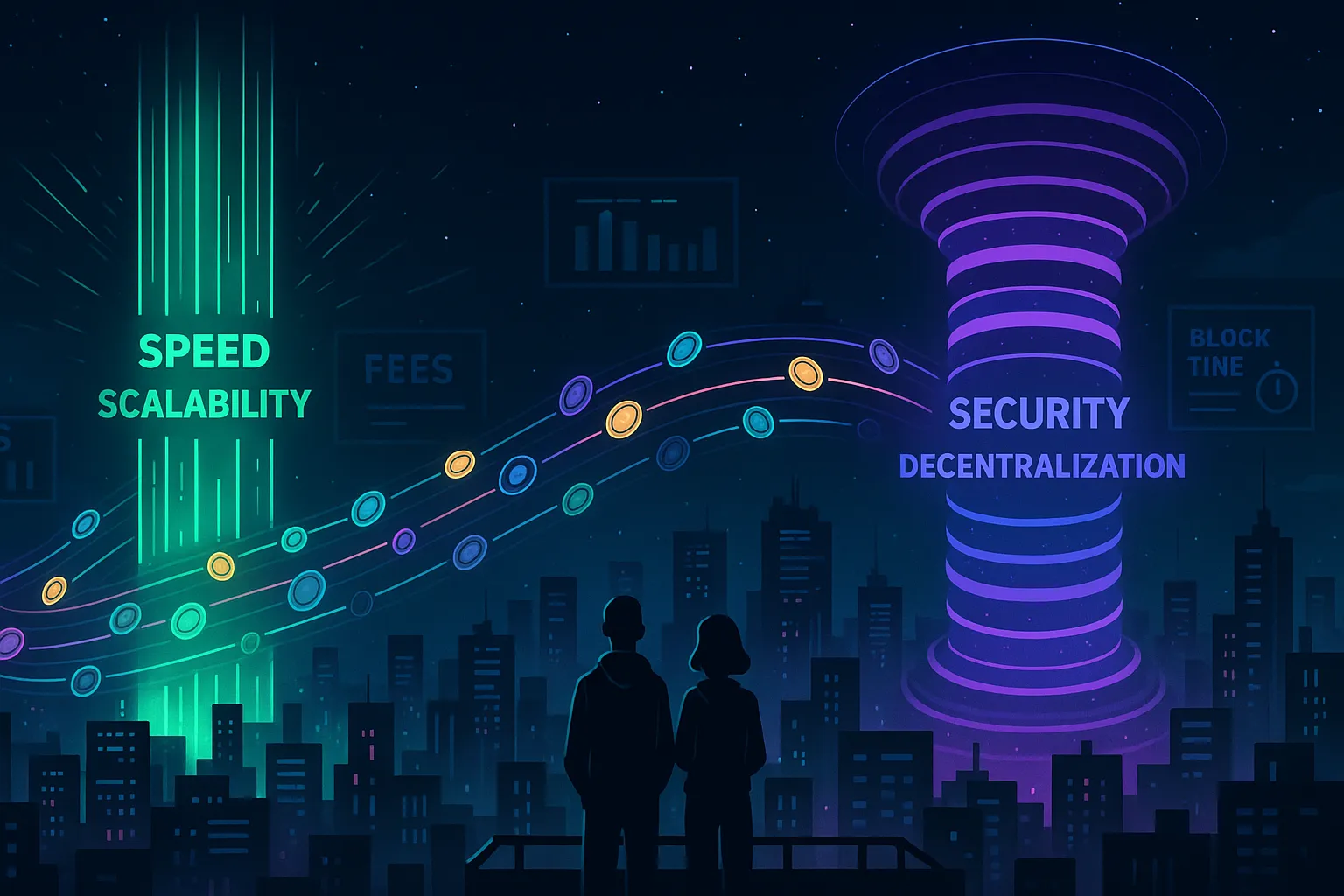
Solana’s growth is more “consumer-first,” focusing on on-chain orderbooks, high-speed DEXs, NFT markets, and games. If Web3 user counts grow by orders of magnitude, Solana’s scalability could make it a default network for everyday transactions, even while Ethereum remains the settlement and coordination layer.
Regulatory and Market Risks
Both Solana and Ethereum face regulatory uncertainties, especially around staking, token classification, and compliance for DeFi protocols. Ethereum’s age and decentralization may provide some relative resilience compared to newer networks, but no chain is immune to policy shocks.
Market-wise, Solana carries greater execution risk due to its younger ecosystem and more aggressive technical approach. Ethereum must successfully complete its scaling roadmap and maintain client diversity to avoid centralization pressures. Investors should weigh these risks alongside potential returns and always conduct independent research.
Which Should You Invest In?
Risk Profile and Time Horizon
Ethereum is generally considered a “blue chip” of crypto. Its large market cap, deep liquidity, and established ecosystem make it a core holding for many long-term investors. It may not offer the same explosive upside as smaller caps, but it has historically shown more resilience during market downturns.
Solana is higher beta. Its recent 1-year performance shows sharper swings, but it also has potential for strong upside in bullish markets if adoption accelerates. Investors with a higher risk tolerance and a belief in high-performance monolithic chains might allocate a larger share to SOL.
Portfolio Construction
For many, a blended approach makes sense: a core Ethereum position complemented by a tactical Solana allocation. The exact ratio depends on your risk tolerance, conviction, and investment horizon. Some may opt for a 70/30 or 60/40 ETH/SOL split, while more aggressive traders might tilt further toward SOL.
Because markets move quickly, being able to rebalance between SOL and ETH on a private, non-custodial platform is valuable. This is where tools like GhostSwap come in, letting you adjust exposure between the two ecosystems in minutes without sending funds to a centralized exchange.
How to Swap Solana (SOL) for Ethereum (ETH)
Step-by-Step: Swap SOL to ETH on GhostSwap
On GhostSwap, you can swap SOL to ETH instantly without KYC, account signups, or custody risk. You stay in control of your wallets and simply route assets through an on-chain swap.
- Prepare your wallets: Make sure you have a Solana-compatible wallet (for SOL) and an Ethereum wallet (for ETH), both with sufficient balances and a bit of extra SOL/ETH for network fees.
- Go to the SOL/ETH swap page: Visit the dedicated route at GhostSwap’s SOL → ETH exchange.
- Select the amount: Enter how much SOL you want to swap. The interface will show an estimated amount of ETH you will receive, along with the current rate and network fees.
- Enter your receiving address: Paste your Ethereum wallet address where you want to receive ETH. Double-check this address carefully.
- Send SOL to the provided address: GhostSwap will display a one-time deposit address on Solana. Send the exact amount of SOL there from your wallet.
- Wait for confirmation: Once the transaction confirms on Solana and the swap completes, your ETH will be sent to your Ethereum wallet automatically.
Because GhostSwap is non-custodial, you never create an account or deposit funds into a centralized wallet. You simply perform a one-off swap directly from your personal wallets. Interested in either asset? You can buy SOL or buy ETH instantly on a non-custodial exchange with no registration.
Ready to Swap SOL or ETH?
If you want to move from the Solana ecosystem into Ethereum or rebalance your portfolio the other way around, using a non-custodial swap keeps you in control of your keys. Platforms like GhostSwap let you swap crypto instantly between SOL and ETH with no KYC and support for 1,600+ trading pairs.
Frequently Asked Questions
Is Solana (SOL) better than Ethereum (ETH)?
Neither asset is universally “better”; they excel at different things. Solana offers very fast, low-cost transactions, which is ideal for trading, gaming, and consumer apps that need high throughput. Ethereum provides stronger decentralization, deeper liquidity, and the largest developer ecosystem, making it the preferred base layer for DeFi and institutional activity.
Your choice should depend on what you value most: speed and user experience (Solana), or security, decentralization, and ecosystem maturity (Ethereum). Many users interact with both chains and move assets between them as needed.
Can Solana (SOL) overtake Ethereum (ETH)?
It is possible, but far from guaranteed. For Solana to “overtake” Ethereum in market cap or influence, it would need to continue growing its developer base, maintain network reliability, and attract significant liquidity and institutional interest. Its technical advantages give it a shot in specific niches like real-time trading and mass-market apps.
However, Ethereum’s first-mover advantage, robust roadmap, and network effects are substantial. Even if Solana becomes the leading chain for certain use cases, Ethereum may remain the dominant settlement layer and value anchor in the broader crypto ecosystem.
Should I hold both SOL and ETH?
Many investors choose to hold both SOL and ETH as a way to diversify within the smart contract platform sector. Ethereum offers exposure to the most established Web3 ecosystem, while Solana adds high-performance growth potential. This combination can balance risk and upside within a crypto portfolio.
Rebalancing between the two over time allows you to lock in gains or increase exposure when you see better value on one side. Non-custodial platforms such as GhostSwap make these adjustments straightforward by providing a private exchange route between SOL and ETH without requiring accounts or KYC.
Where can I swap SOL to ETH?
You can swap SOL to ETH on various centralized and decentralized platforms. If you want to stay in control of your funds, a non-custodial swap service is often preferable. GhostSwap, for example, lets you perform a non-custodial swap between SOL and ETH directly from your wallet, without signups or identity checks.
Always verify that you are using the correct official URL, double-check destination addresses, and start with a small test transaction if you are using a new platform for the first time.