How to Make a Secure and Efficient RUNE to BTC Swap
Introduction
The crypto ecosystem has grown far beyond simple buy-and-hold strategies. Cross-chain swaps, especially a RUNE to BTC swap, are becoming a routine part of many traders’ strategies. Whether you are rotating out of THORChain’s native asset (RUNE) into the relative stability and liquidity of Bitcoin (BTC), or taking profits from DeFi activity, doing it safely and efficiently is crucial.
Today, you no longer need to create accounts on centralized exchanges, complete lengthy KYC, or wait hours for withdrawals just to move from one coin to another. With modern non-custodial protocols and interfaces, you can perform a rune to btc swap in a few clicks while keeping control of your keys.
This guide walks you through what a RUNE to BTC swap is, why it matters, the main benefits and risks, and a clear step-by-step process. It aims to help you swap with confidence while understanding what happens under the hood.
Why RUNE to BTC Swaps Matter
RUNE is the native token of THORChain, a cross-chain liquidity protocol that enables swaps between different blockchains without wrapping or centralized intermediaries. BTC is the original cryptocurrency, widely considered the digital equivalent of hard money and a core portfolio asset for many crypto users.
Moving from RUNE to BTC is relevant in several scenarios:
- Risk management
Shifting from a more volatile DeFi asset like RUNE into Bitcoin to reduce exposure during uncertain market conditions. - Profit taking
Locking in gains from RUNE after a price rally by converting those profits into BTC. - Portfolio rebalancing
Maintaining a target allocation between DeFi tokens and base-layer assets like Bitcoin. - Liquidity rotation
Moving capital from THORChain related activities into BTC for use elsewhere, such as Lightning payments or long term cold storage.
Since RUNE lives on a different chain from BTC, you need a cross-chain mechanism that can swap assets atomically and securely. That is where protocols like THORChain and user interfaces that connect to it become vital.
Key Benefits of a Modern RUNE to BTC Swap
Not all swaps are equal. There are major differences between swapping via a centralized exchange and using a decentralized, non-custodial solution.
1. Non-custodial control
In a non-custodial RUNE to BTC swap, you never relinquish ownership of your private keys to a third party. Your RUNE leaves your wallet directly, the protocol handles the swap, and the resulting BTC goes to the address you control. This dramatically reduces counterparty risk compared to parking funds on centralized exchanges for extended periods.
2. Fewer intermediaries
Traditional paths often look like this:
- Send RUNE to a centralized exchange
- Sell RUNE for USDT or another stablecoin
- Buy BTC with USDT
- Withdraw BTC to your wallet
Each hop introduces fees, delays, and a new risk surface. With a direct RUNE to BTC swap through a non-custodial interface, the path is simplified, sometimes down to a single atomic transaction.
3. Privacy advantages
Non-custodial swaps generally collect much less user data than centralized exchanges that require KYC. While the blockchain itself remains transparent, you avoid linking your identity to exchange accounts whenever possible. Using a reputable private exchange that enables non-custodial swap flows can help you maintain better operational privacy.
4. Potentially lower friction and time costs
Once your wallets are set up, swapping can be nearly instant at the interface level. You only wait for the underlying blockchains to confirm transactions. There is no need to wait for account approvals, internal transfer batching, or manual withdrawal checks.
Risks and Drawbacks of a RUNE to BTC Swap
Cross-chain swaps are powerful, but they are not risk free. You should understand what can go wrong before committing significant capital.
1. Price slippage
Swaps on liquidity pools are subject to slippage, which is the difference between the expected price at the time you initiate the swap and the price you actually get when it executes. Slippage increases when:
- The trade size is large relative to pool liquidity
- Market volatility is high
- There is low liquidity on either side of the pair
Use a platform that clearly shows estimated slippage and give yourself a buffer, especially in fast-moving markets.
2. Network and gas fees
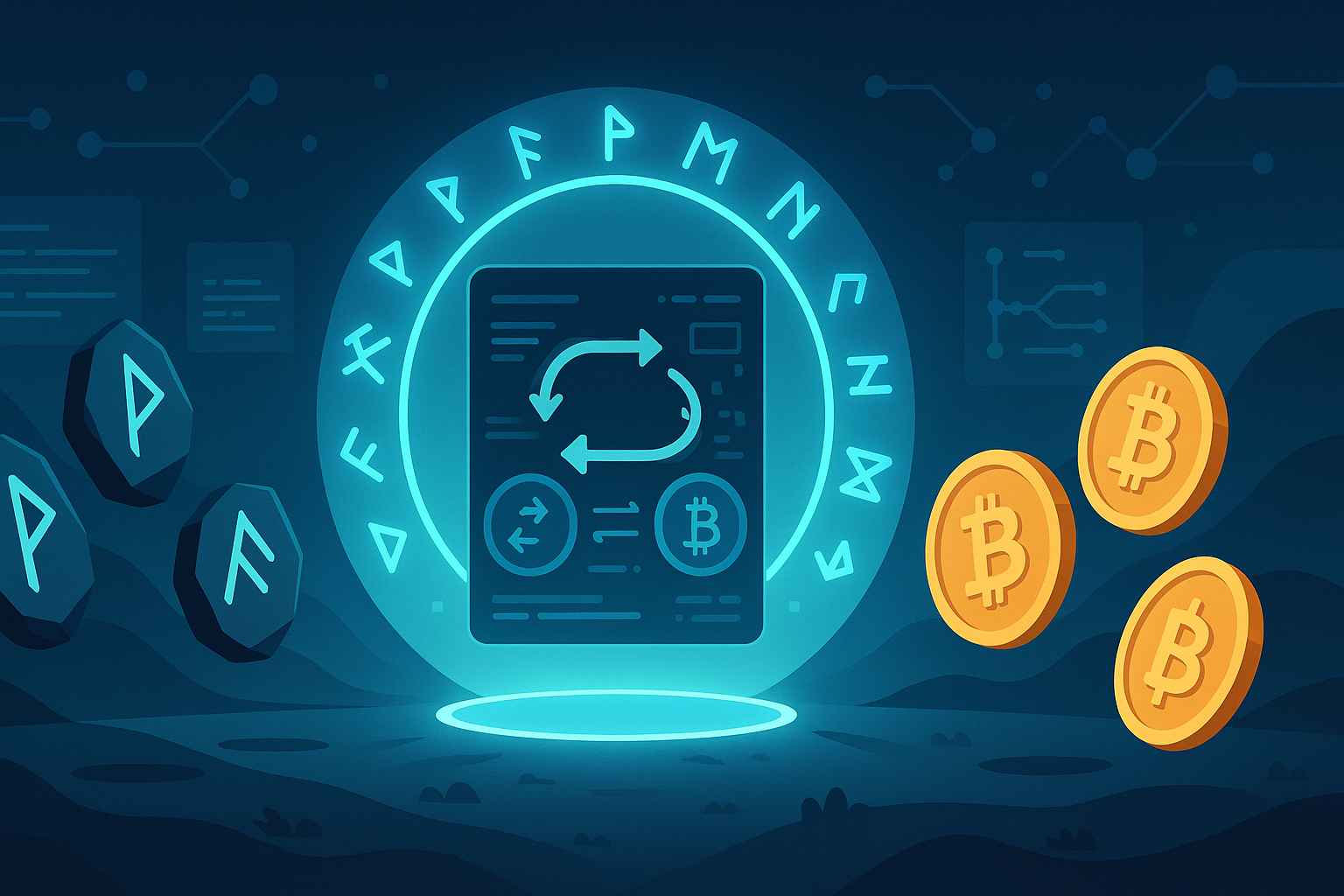
Each blockchain involved in the swap will charge transaction fees. For a RUNE to BTC swap, you may face:
- Fees to move RUNE from your wallet into the swap
- Protocol fees for the cross-chain operation
- Bitcoin network fees to send BTC to your destination address
Fees can spike during high network congestion, especially on Bitcoin. Always check fee estimates during the confirmation step before finalizing.
3. Smart contract or protocol risk
If the swap uses smart contracts or a cross-chain protocol like THORChain, there is technical risk. Bugs, malicious exploits, or network-specific issues can sometimes lead to disruption or loss. Mitigate this by using:
- Widely audited protocols
- Well-known interfaces with a security track record
- Conservative position sizing, especially for your first swaps
4. Human error
Many losses in crypto result from user mistakes, not protocol failures. Common errors include:
- Sending assets to the wrong address
- Choosing an incompatible network or format (for BTC, be careful with address types)
- Mis-typing Bitcoin destination addresses
- Misunderstanding minimum deposit or swap amounts
Double-check addresses, amounts, and network details before confirming.
Step-by-Step Guide: How to Perform a RUNE to BTC Swap
The exact steps can vary a bit depending on which non-custodial interface you use, but the overall workflow is similar. Below is a general process that applies to many cross-chain swap tools.
Step 1: Prepare your wallets
- RUNE wallet
Ensure you have a compatible wallet that holds your RUNE. This might be a native THORChain wallet or a multi-chain wallet that supports RUNE directly. - BTC wallet
Set up a secure Bitcoin wallet to receive your BTC. This could be a hardware wallet, a non-custodial mobile wallet, or a desktop client. Copy your BTC receiving address carefully.
It is good practice to test wallets beforehand with a small amount to make sure everything works as expected.
Step 2: Choose a non-custodial swap interface
Look for a service that supports direct RUNE to BTC swaps, works in a non-custodial way, and has transparent fees. An interface that allows you to swap crypto instantly between RUNE and BTC through THORChain or similar infrastructure will typically provide the smoothest experience.
Step 3: Select the RUNE to BTC market
Once on the interface:
- Select RUNE as the asset you are giving or sending.
- Select BTC as the asset you want to receive.
- Enter the amount of RUNE you intend to swap.
The interface should automatically calculate an estimated amount of BTC you will receive, factoring in pool pricing and fees.
Step 4: Review the quote and parameters
Before proceeding, carefully review:
- Expected BTC output based on the current rate
- Estimated slippage percentage
- Network fees on both sides (RUNE and BTC)
- Minimum received setting if available, which acts as protection against excessive price movement
If slippage looks high, you may consider splitting the swap into smaller chunks or waiting for better market conditions.
Step 5: Provide your BTC receiving address
Paste your Bitcoin address into the designated field, or connect a Bitcoin wallet if the interface supports that. Then:
- Verify the network is correct (mainnet, not testnet).
- Check the first and last few characters of the address two or three times.
- Optionally, scan a QR code rather than typing manually if your wallet supports it.
Step 6: Confirm the transaction from your RUNE wallet
When you initiate the swap, you will be prompted by your RUNE wallet to approve a transaction. Check:
- The amount of RUNE being sent
- The transaction fee on the RUNE side
- The contract or protocol address if shown, ensuring it matches documentation or prior usage
Approve only when everything looks correct.
Step 7: Wait for confirmations
The cross-chain swap will proceed once the RUNE transaction has the required confirmations. Then the protocol will handle the outbound BTC transaction. You will typically see a status indicator showing:
- Inbound transaction detected on the RUNE chain
- Swap in progress
- Outbound BTC transaction broadcast
- Settlement complete once the BTC transaction is confirmed
Depending on network conditions, this process can take from a few minutes to longer during heavy congestion. You can track Bitcoin confirmations using your wallet or a block explorer.
Practical Tips for Safer and More Efficient RUNE to BTC Swaps
1. Start with a small test amount
When using any new protocol or interface for the first time, begin with a small amount of RUNE. This lets you confirm the process works, your BTC address is correct, and you understand the fee structure before scaling up.
2. Monitor real-time network conditions
Before initiating your swap, check:
- Bitcoin network fee estimates on a reliable fee tracking site
- Any announcements about THORChain or the underlying cross-chain protocol, especially maintenance or partial outages
- General market volatility, as rapid price changes increase slippage risk
3. Be cautious with mobile connections
Using mobile data or unstable Wi-Fi during critical steps can cause delays or interface glitches. For larger swaps, a more stable internet connection and a fully updated browser or wallet app are preferable.
4. Secure your wallets and backup phrases
Your swap is only as safe as your wallet security. Follow these practices:
- Store seed phrases offline, not in screenshots or cloud notes
- Use hardware wallets for significant BTC holdings
- Enable additional security features such as passphrases or 2FA where applicable (for interfaces that support device-based or app-based authentication)
5. Document large swaps for records
For accounting, tax planning, or personal tracking, keep a simple record every time you execute a big RUNE to BTC swap:
- Date and time
- Amount of RUNE spent
- Amount of BTC received
- Transaction hashes on both chains
- Fees paid
This can make reporting and performance analysis much easier later.
Conclusion: Making RUNE to BTC Swaps Work for Your Strategy
A RUNE to BTC swap is more than just a trade between two tickers. It is a strategic move that can help you lock in profits, lower risk, or reallocate capital between DeFi and base-layer assets. By using a reputable, non-custodial swap interface that focuses on privacy and direct cross-chain swaps, you can streamline the process while maintaining control of your keys.
Always balance the benefits of speed and convenience with a clear understanding of the risks: slippage, fees, protocol security, and the potential for human error. If you start with small amounts, double-check every detail, and keep improving your security practices, RUNE to BTC swaps can become a reliable tool in your broader crypto strategy.
Ready to Swap?
Convert your crypto instantly on GhostSwap — no KYC, no sign-up required.
Popular swaps: BTC to XMR | BTC to ETH | XMR to BTC | ETH to XMR | BTC to SOL