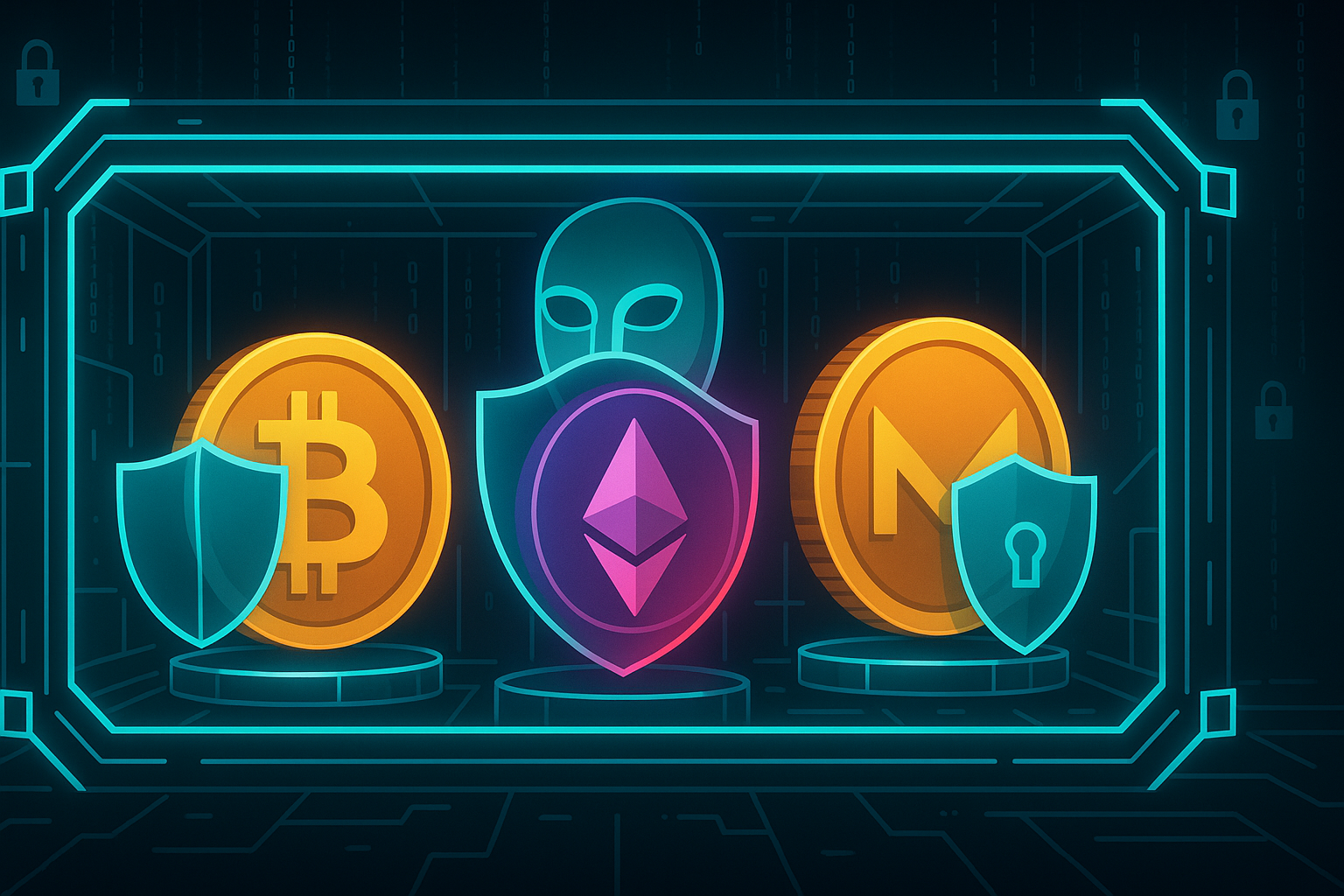
Privacy Coins List 2025: The Most Important Projects to Watch
As we head deeper into 2025, privacy in crypto is once again becoming a major conversation. Regulation, on-chain analytics, and the rise of surveillance technologies are making it harder to transact without leaving a permanent, traceable footprint. That is why interest in a strong, well-researched privacy coins list 2025 has never been higher.
In this guide, we will walk through the leading privacy coins, how they work, what risks they carry, and how you can use them responsibly. We will also look at practical tools such as non-custodial platforms that let you swap crypto instantly and privately without giving up control of your keys.
This article is not financial or legal advice. It is meant as an educational resource so you can better understand the privacy layer of the crypto ecosystem and decide what fits your own risk profile, values, and jurisdiction.
Why a Privacy Coins List 2025 Matters
Bitcoin and most major blockchains are transparent by design. Every transaction is recorded publicly and permanently. While addresses are pseudonymous, analytics tools, exchange KYC data, and off-chain information can often link addresses to real identities.
That transparency has benefits, such as auditability and traceability. But it also poses serious concerns:
- Financial surveillance by governments, corporations, or malicious actors
- Personal safety risks if your wallet size is exposed
- Business secrecy issues for companies that do not want competitors to see their flows
- Freedom of association and expression risks where donations or payments reveal political or social affiliations
Privacy coins attempt to solve this by using cryptography that obscures transaction details. A curated privacy coins list for 2025 matters because:
- The regulatory environment is shifting and some projects face delistings.
- Technical approaches vary widely, from ring signatures to zero-knowledge proofs.
- Liquidity and ecosystem support differ across chains.
- Security assumptions are not identical; some designs carry additional trade-offs.
Knowing which projects are active, well maintained, and widely used helps you make more informed decisions if you care about privacy in the long term.
Key Technologies Behind Privacy Coins
Before looking at the actual privacy coins list 2025, it helps to understand the main techniques these projects use.
1. Ring Signatures and Stealth Addresses
Ring signatures allow a transaction to be signed by one member of a group, but observers cannot know which member actually signed it. Combined with stealth addresses, this hides the sender and receiver among many possibilities on the chain.
Pros: Robust, battle-tested approach used by well-known projects.
Cons: Larger transaction sizes and some metadata leaks if implementations are not careful.
2. Zero-Knowledge Proofs (ZKPs)
Zero-knowledge proofs, particularly zk-SNARKs, allow someone to prove that a transaction is valid without revealing the sender, receiver, or amount. This is one of the most powerful tools in cryptography for privacy.
Pros: Strong privacy guarantees, compact proofs, and composability with other protocols.
Cons: Complex to implement, often requires trusted setup, and may be resource intensive.
3. CoinJoin and Transaction Mixing
CoinJoin and mixer-like protocols combine multiple users’ coins into a single transaction and then redistribute them, making it harder to track specific inputs to outputs. This is popular in Bitcoin and some token ecosystems.
Pros: Can be implemented on existing non-privacy chains.
Cons: Privacy often depends on the size and behavior of the participant set.
4. Layered Network Privacy (Dandelion, Tor, I2P)
Some privacy coins also focus on network-level privacy, obscuring IP addresses and routing paths. This protects users from being deanonymized by network observers even before a transaction hits the blockchain.
Leading Privacy Coins List 2025
Below is a high-level overview of key privacy-focused assets that are still relevant in 2025. Availability and legality can vary heavily by region, so always check your local rules before interacting with any of them.
Monero (XMR)
Core idea: Full-time privacy using ring signatures, RingCT (Ring Confidential Transactions), and stealth addresses.
- One of the longest-running and most battle-tested privacy coins.
- All transactions are private by default, no optional privacy mode.
- Active research and development community focusing on performance and privacy improvements.
Use cases:
- Everyday private payments
- Remittances where financial privacy is critical
- Donations to sensitive causes
Zcash (ZEC)
Core idea: Optional privacy with zk-SNARKs enabling fully shielded transactions.

- Supports both transparent and shielded addresses.
- Strong academic backing and leadership in zero-knowledge research.
- Users can choose between public and private transaction modes.
Use cases:
- Flexible privacy depending on regulatory or business requirements
- Experiments with ZK technology that may feed into other ecosystems
Firo (FIRO)
Core idea: Privacy-first chain that has used various protocols over time, currently focusing on Lelantus Spark-style constructions.
- Emphasis on on-chain privacy without compromising usability too much.
- Community focused on research and security audits.
Secret Network (SCRT) and Privacy Smart Contract Platforms
Core idea: Combining privacy with programmable smart contracts and DeFi.
- Encrypted smart contract execution to hide specific data fields.
- Focus on privacy-preserving applications such as private swaps, lending, or NFTs.
While not always classified as “classic” privacy coins, these platforms belong on any up-to-date privacy coins list 2025 because they enable privacy for applications and not just for simple transfers.
Beam and Grin (Mimblewimble-Based)
Core idea: Mimblewimble protocol for compact, privacy-preserving transactions with strong scalability characteristics.
- Amounts and addresses are hidden by default.
- Chain is more compact since old data can be pruned while keeping security.
Privacy Tokens on Smart Contract Chains
Besides standalone coins, there is a growing ecosystem of privacy tokens living on chains like Ethereum, Polygon, and others. These may rely on:
- Layer 2 solutions with ZK-rollups.
- Mixers and shielded pools.
- Cross-chain bridges into privacy layers like Secret, Aztec-style rollups, or other ZK systems.
These solutions are still evolving rapidly in 2025. Liquidity, UX, and regulatory clarity differ project to project, so treat each token with its own due diligence process.
Why Privacy Coins Matter in 2025
Beyond ideology, why should regular users care about privacy coins this year?
1. Financial Security and Personal Safety
If your salary, savings, or business balances are trivially visible, you become a more attractive target for theft, extortion, or social engineering. Privacy coins reduce the attack surface by concealing amounts and counterparties.
2. Business Confidentiality
Companies often do not want suppliers, customers, or competitors to see payment flows. Transparent chains can reveal:
- Key trading partners
- Pricing structures
- Inventory cycles and cash flow health
Using privacy layers for settlements helps preserve competitive advantage without abandoning blockchain benefits.
3. Freedom of Expression and Association
Donating to certain causes or communities can be politically sensitive. Having the option to contribute anonymously can protect individuals and organizations in high-risk jurisdictions.
4. Fungibility
Coins that can be traced to “tainted” history may be blacklisted or discounted. Privacy-enhancing technologies help maintain fungibility so that one unit of a currency is treated like any other.
Benefits of Using Privacy Coins
When used thoughtfully and legally, assets from a robust privacy coins list 2025 can provide several advantages.
- Stronger confidentiality: Protects both senders and receivers from on-chain surveillance.
- Enhanced negotiation power: Counterparties cannot easily see your overall holdings.
- Layered security: Even if an exchange, wallet, or dApp is compromised, full financial history is harder to map.
- Improved user choice: You decide when to be public and when to be private.
These benefits become even more relevant when combined with non-custodial tools that allow privacy-preserving swaps across chains without centralized order books logging your activity.
Risks and Drawbacks of Privacy Coins
Privacy coins are powerful, but they come with specific challenges in 2025 that every user should understand.
1. Regulatory and Compliance Pressure
- Some centralized exchanges have delisted or restricted privacy coins due to compliance concerns.
- Law enforcement agencies scrutinize anonymity tools, sometimes leading to broad policy reactions.
- Depending on your jurisdiction, obligations such as reporting or tax documentation may still apply even if transactions are private on-chain.
2. Liquidity and Market Access
- Delistings can reduce liquidity and increase volatility.
- Spreads may be wider compared to top transparent assets.
- On-ramps and off-ramps might be limited for certain coins.
3. Technical Complexity and User Error
- Some privacy tools require more advanced knowledge to use correctly.
- Mistakes, such as reusing addresses or leaking metadata, can weaken privacy.
- Backup procedures for private keys and wallets can be slightly different or more stringent.
4. Perception Risk
Privacy coins are often associated with illicit use in public discourse, even though many legitimate use cases exist. This perception can attract negative attention, even for users with entirely lawful intentions.
Step-by-Step Guide: How to Use Privacy Coins Responsibly in 2025
This step-by-step process assumes you are approaching privacy coins for legitimate, lawful purposes such as personal security and financial confidentiality.
Step 1: Clarify Your Goals and Constraints
- Are you trying to hide balances from public view, or just obfuscate counterparties?
- Are you running a business that requires compliance and audit trails?
- What are the laws and regulations in your country regarding privacy coins?
Understanding your objectives helps you choose the right coins and tools.
Step 2: Choose Your Assets from the Privacy Coins List 2025
From the projects discussed above, pick one or two that match your needs:
- Everyday transactions: Coins with broad wallet support and active communities like Monero.
- Optional privacy: Zcash, where you can move between transparent and shielded pools.
- DeFi and smart contracts: Networks or tokens that support private dApps and programmable privacy.
Step 3: Set Up a Secure Wallet
- Download official or well-audited wallets from legitimate sources.
- Write down and securely store your recovery phrase offline.
- Consider hardware wallets if supported by your chosen coin.
- Enable extra security features such as passphrases or multi-factor authentication where possible.
Step 4: Acquire Privacy Coins
There are several on-ramp paths, but availability depends on your jurisdiction:
- CEXs that still support specific privacy coins and comply with local regulations.
- Peer-to-peer marketplaces where KYC requirements vary.
- Non-custodial platforms that let you use a private exchange for non-custodial swaps from major assets into privacy-focused ones directly from your wallet.
Always ensure you are following local laws and tax rules when acquiring or disposing of privacy assets.
Step 5: Practice Good Privacy Hygiene
- Avoid reusing addresses where applicable.
- Separate identities: do not mix public, doxxed wallets with privacy wallets.
- Use network privacy tools such as Tor or VPNs if legal in your jurisdiction.
- Be mindful of off-chain metadata like IP addresses, exchange accounts, and chat histories.
Step 6: Record-Keeping for Compliance
Even when using privacy coins, you may personally want or be required to keep private records:
- Maintain your own logs of trades and transfers for accounting and tax purposes.
- Store this information securely and offline where feasible.
- Consult a professional if your situation is complex or if regulations are unclear.
Practical Tips for Using Privacy Coins in 2025
1. Diversify Your Privacy Stack
Do not rely on a single chain or tool. Combining on-chain privacy coins with private messaging, secure devices, and safe wallet practices provides better protection than any one tool alone.
2. Start with Small Amounts
When learning to use new privacy technologies, begin with minimal amounts to reduce risk if you make mistakes with addresses, fees, or network settings.
3. Watch Network Fees and Liquidity
Privacy technologies can increase transaction size and complexity, which sometimes translates into higher fees. Also monitor slippage if you are swapping into or out of less liquid assets.
4. Verify Open-Source Code and Audits
Whenever possible, favor projects that are open source, actively maintained, and have undergone independent security audits. Review community forums or developer updates to understand how quickly issues are addressed.
5. Stay Informed on Regulation
Regulatory positions on privacy coins and mixers can change quickly. Following reputable legal or compliance commentators, or occasionally consulting a professional, helps you avoid unintentional violations.
6. Prefer Non-Custodial Solutions
Custodial platforms can be pressured to share data or restrict access. Non-custodial tools that support non-custodial swap mechanisms keep you in control of your keys and typically reduce centralized data collection. This aligns well with the goals of users who care enough to build a diversified privacy coins list in 2025.
How Privacy Coins Fit into a Broader Crypto Strategy
Privacy coins should not necessarily replace all other assets, but they can be an important component of a balanced portfolio and operational setup.
- Store of value: Larger, more liquid coins may remain your primary long-term holdings.
- Spending wallet: Privacy coins can be your preferred asset for day-to-day spending or sensitive payments.
- Operational layer: Businesses may use privacy coins for internal settlements while maintaining compliant reporting.
Thinking in layers helps you avoid all-or-nothing decisions and adapt your strategy if regulations or technology evolve. For a fast, private option, you can swap BTC to XMR on a non-custodial platform with no account required. For a fast, private option, you can swap ETH to XMR on a non-custodial platform with no account required.
Conclusion: Building Your Own Privacy Coins List 2025
The landscape of privacy coins in 2025 is both promising and complex. On one hand, cutting-edge cryptography like zero-knowledge proofs is maturing rapidly and moving into real-world products. On the other hand, regulatory and liquidity challenges require users to be more thoughtful and informed than ever.
To build your own actionable privacy coins list 2025:
- Identify your personal or business need for financial privacy.
- Choose a small number of well-maintained, widely used projects that match those needs.
- Use secure wallets, good privacy hygiene, and strong record-keeping practices.
- Favor tools that let you maintain control of your keys, such as non-custodial platforms that support private swaps between major assets and privacy coins.
If you want to move between public and private assets without exposing your entire history to centralized order books, consider using a reputable non-custodial service designed for privacy-focused users, such as platforms that let you swap crypto instantly via a private, non-custodial exchange.
Privacy is not about hiding wrongdoing; it is about protecting legitimate rights to security, autonomy, and freedom of association. By educating yourself and using these tools responsibly, you can participate in the crypto economy on your own terms in 2025 and beyond.
Ready to Swap?
Convert your crypto instantly on GhostSwap — no KYC, no sign-up required.
Popular swaps: BTC to XMR | BTC to ETH | XMR to BTC | ETH to XMR | BTC to SOL