Cross–chain bridges have become a core part of Web3 infrastructure because they let tokens move between otherwise isolated blockchains. For users, these bridges unlock seamless transfers of assets and messages across chains, and for developers they enable chain‑agnostic experiences that abstract away technical complexity. Yet not all bridges are created equal — they vary widely in design and security, and privacy‑preserving coins like Monero (XMR) pose unique challenges.
In this guide we’ll unpack what a Monero bridge is, why you might need one, how cross‑chain bridging works, the challenges of bridging XMR, and the benefits and risks of using anonymous bridges. We’ll also show you how to move between Monero and other assets step‑by‑step and explain why GhostSwap’s Monero bridge is the easiest way to trade privately across chains. If you’re ready to swap right now, you can head directly to the Monero bridge on GhostSwap – no account or KYC required.
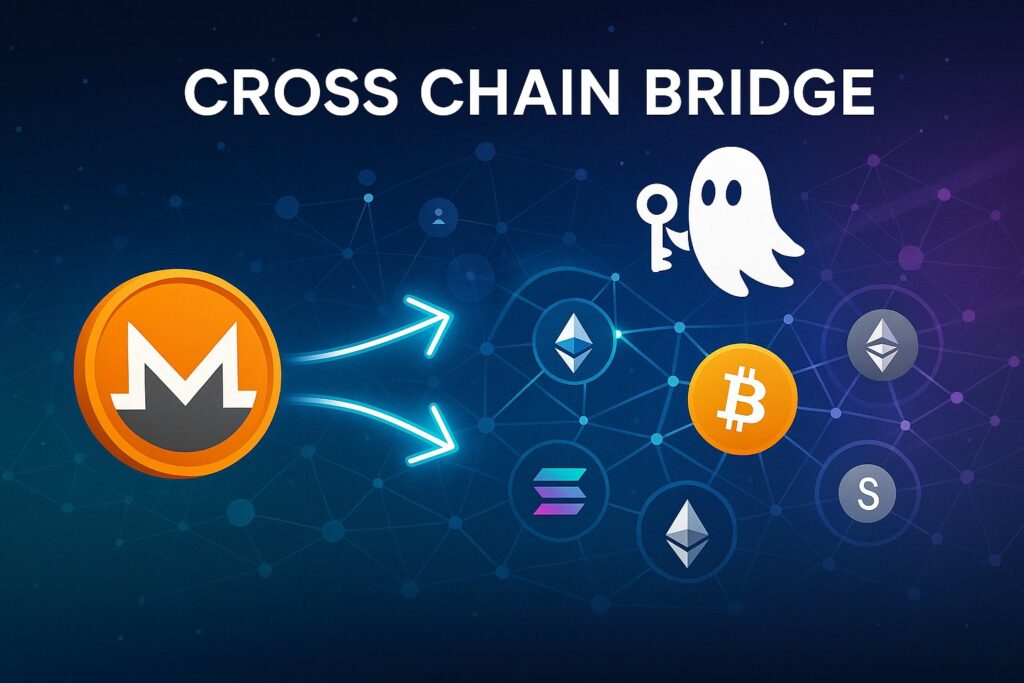
A cross‑chain bridge is a decentralized application that facilitates the transfer of assets from one blockchain to another. Some bridges are designed for simple transfers between a layer‑2 network and its base chain, while others provide general‑purpose routing between many chains. A Monero bridge connects the privacy‑focused Monero network to other blockchains so you can move XMR into or out of ecosystems like Bitcoin, Ethereum or stablecoins without going through a centralized exchange.
What Is a Monero Bridge?
Monero uses ring signatures and stealth addresses, which hide the sender, receiver and transaction amount. These features make XMR transactions private, but they also complicate interoperability – there is no built‑in way to send Monero to another chain, and typical cross‑chain protocols rely on transparent addresses or memos. A Monero bridge solves this by locking your XMR on the Monero chain and releasing an equivalent asset on another chain (or vice versa) using a secure multi‑chain protocol. When the bridge itself requires no account or login, you retain end‑to‑end privacy.
Why Use a Monero Bridge?
There are several reasons to move XMR across chains:
- Preserve privacy when converting XMR to other assets. Transacting on centralized exchanges exposes your identity through KYC requirements and on‑chain links. A no‑KYC bridge lets you enter or exit Monero without depositing to a third party.
- Access wider DeFi and liquidity. While Monero is ideal for privacy, it has limited DeFi opportunities. Bridging to Ethereum or another network opens access to lending, yield farming and NFTs while retaining your anonymity.
- Stablecoin on‑ramps/off‑ramps. You might want to park profits in USDT or USDC after an XMR rally. A modern Monero bridge can route to stablecoins with transparent fees under 0.5 %.
- Avoid regional restrictions. Decentralized bridges don’t block jurisdictions and often require no account or login, so users in restricted areas can still trade between Monero and other chains.
- Save time and fees. A bridge aggregates many liquidity routes. For example, Rubic’s Monero bridge taps more than 200 liquidity endpoints across 90+ networks, automatically finding the cheapest path with no hidden deposit or withdrawal fees.
How Do Cross‑Chain Bridges Work?
Different bridges use different architectures. THORChain, for example, employs validated nodes, vaults and liquidity pools secured by a threshold signature scheme (TSS). Each swap decomposes into two steps – the source asset is converted to the native token RUNE and then from RUNE to the target asset. This ensures continuous liquidity and decentralization without minting wrapped tokens. A sufficient quorum of nodes must sign transactions, meaning no single party controls the funds.
Bridging Monero is harder. Because Monero doesn’t have transparent addresses or a memo field, cross‑chain protocols can’t easily specify withdrawal addresses. THORChain’s proposed XMR integration requires encrypted memos and specialized mechanisms to delegate addresses, and so far only RUNE withdrawals are possible. A prior attempt was abandoned after discovering critical vulnerabilities, including misuse of tx_extra and difficulties in specifying secure withdrawal addresses. These challenges highlight why you should use bridges that are purpose‑built for privacy coins and have been audited.
Bridges also present general risks. Private key compromises and unaudited smart contracts are frequent attack vectors – cross‑chain bridges have suffered billions of dollars in hacks. Best practices include distributing keys among many nodes, using hardware security modules and ensuring code is audited. When evaluating a Monero bridge, consider its security architecture and whether it employs hash‑time‑locked contracts (HTLCs), multi‑signature vaults or other defenses.
Benefits and Risks of Anonymous Monero Bridges
Benefits:
- Privacy by design. Monero’s ring signatures and stealth addresses already hide your identity. A no‑KYC bridge preserves that anonymity end‑to‑end by avoiding centralized on‑ramps and account registration.
- Non‑custodial control. When you use a non‑custodial bridge, you hold your keys at all times. The bridge facilitates the swap but never has custody of your funds.
- Efficient execution. Bridges that aggregate multiple routes can save time and fees. Modern systems scan liquidity across chains to find the fastest, cheapest path.
- Multi‑chain flexibility. A good Monero bridge lets you move XMR to stablecoins, major chains (e.g., Ethereum, Bitcoin) or back to Monero whenever you need.
Risks:
- Smart contract vulnerabilities. Bugs or untested code in bridging contracts can lead to exploits and loss of funds.
- Key management failures. Bridges rely on multi‑signatures or threshold keys; compromised private keys have led to some of the largest bridge hacks.
- Complexity with privacy coins. Monero’s privacy tech complicates cross‑chain interoperability. Projects still in development may be experimental, so choose mature, audited solutions.
- Regulatory responsibilities. While you can swap anonymously, you’re still responsible for reporting taxes and complying with local laws.
How to Use a Monero Bridge (Step‑by‑Step)
The exact steps vary by platform, but the flow is typically similar. We’ll use GhostSwap as an example because it’s designed for privacy:
- Go to the Monero bridge on GhostSwap. There’s no account or login required — just open the GhostSwap XMR bridge.
- Select your swap route. Choose your input asset (e.g., BTC, ETH or a stablecoin) and the output asset (XMR or vice versa). GhostSwap scans multiple liquidity paths to find the best rate.
- Enter the amount and wallet addresses. Specify how much you want to swap. If you’re receiving XMR, paste your Monero address (which includes the integrated payment ID). If you’re sending XMR, paste your receiving address on the target chain.
- Confirm and send your funds. GhostSwap will display the estimated amount, fees and deposit address. Send your input asset to that address. You can monitor progress on a single screen.
- Receive your output asset. Once the transaction is confirmed and the bridge completes the swap, your XMR (or other asset) appears in your wallet. There’s no email, login or KYC to slow you down.
Why Choose GhostSwap’s Monero Bridge?
GhostSwap is built from the ground up for privacy. Here’s why it stands out versus other bridges:
- Zero KYC or account. You don’t need to create an account or submit ID. The platform doesn’t track you — no cookies, emails or fingerprinting.
- Cross‑chain power. GhostSwap supports more than 1,500 assets across 90+ networks and aggregates 200+ liquidity routes. This gives you more options and better rates than single‑route bridges.
- Non‑custodial and secure. Swaps are executed via hash‑time‑locked contracts (HTLCs) and multi‑signature vaults. End‑to‑end TLS and optional Tor proxies protect your traffic.
- Transparent fees. You see the fee before you swap and there are no surprise deposits or withdrawals.
- Public audit log. GhostSwap publishes its bridge transactions, so you can verify volumes and routes.
- Easy interface. Everything happens on one simple page — choose your tokens, enter addresses, and monitor the swap. You never leave the page and there’s no app to download.
Conclusion
Monero bridges open the door to a privacy‑friendly, multi‑chain future. They allow you to move XMR into the broader crypto ecosystem without touching centralized exchanges or exposing your identity. However, bridging XMR is technically challenging because of Monero’s privacy features. Choosing a trustworthy bridge is therefore essential — look for secure key management, audited contracts and a track record of reliability.
GhostSwap’s Monero bridge embodies these qualities. It’s non‑custodial, no‑KYC and supports hundreds of assets across dozens of networks. With transparent fees and strong security, GhostSwap makes it easy to enter and exit XMR while staying anonymous. If you’re ready to experience true cross‑chain privacy, try the GhostSwap Monero bridge now and keep your identity where it belongs — with you.