How to Buy Solana Without KYC: A Practical, Privacy‑Focused Guide
Introduction
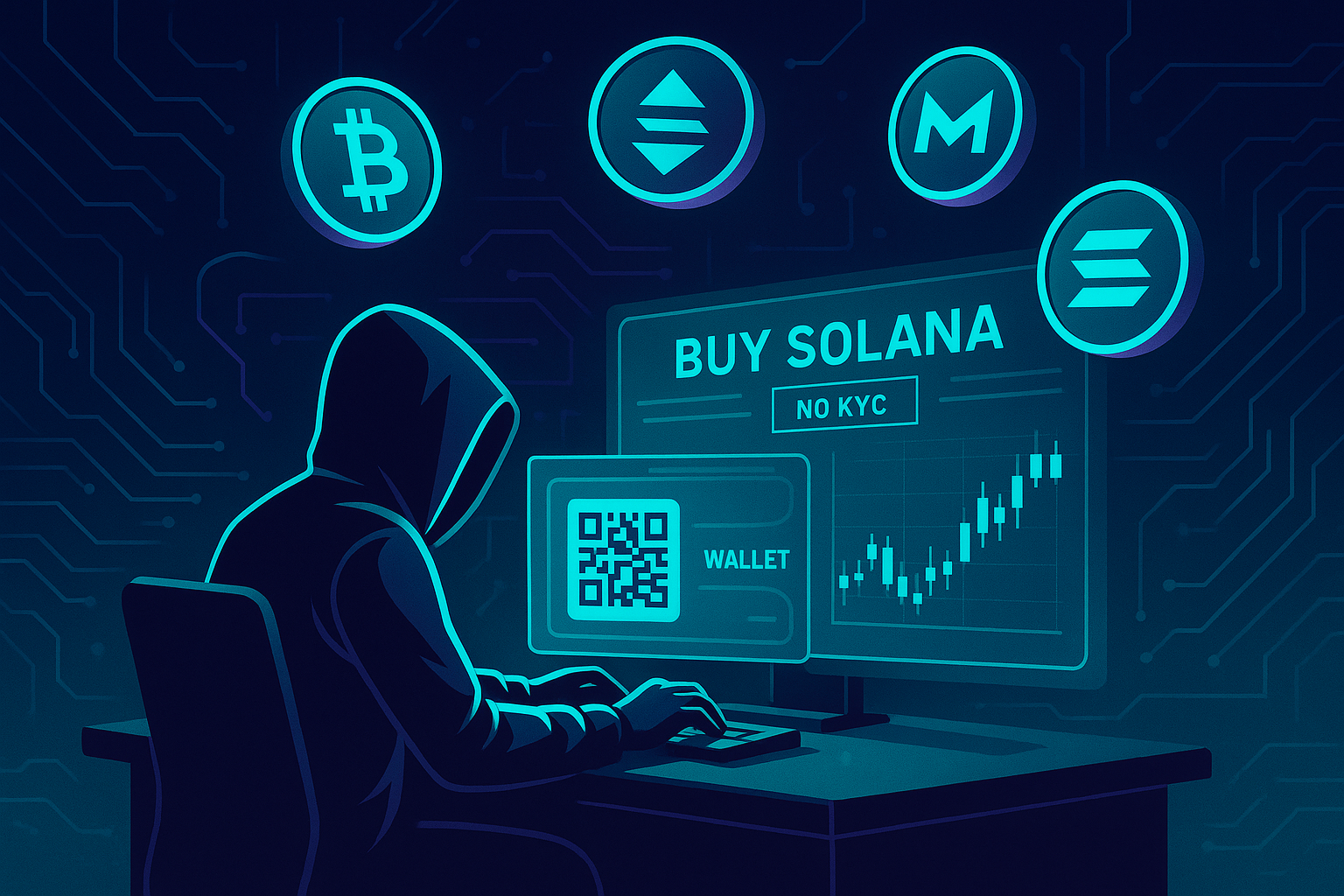
Solana (SOL) has become one of the most popular blockchains thanks to its speed, low fees, and rapidly growing ecosystem. Many crypto users want to get exposure to SOL without going through invasive Know Your Customer (KYC) checks that require uploading IDs, selfies, and personal documents.
The good news is that it is still possible to buy Solana without KYC using the right tools and strategies. However, doing this safely requires understanding both the benefits and the risks, as well as choosing platforms that respect your privacy while minimizing counterparty risk.
This guide walks you through how to buy Solana without KYC, which options are available today, what tradeoffs you should consider, and how to protect yourself from scams and poor execution.
Why Buying Solana Without KYC Matters
For many people, avoiding KYC is not about hiding illegal activity. Instead, it is about:
- Protecting sensitive personal information from data breaches
- Maintaining financial privacy in a world of increasing surveillance
- Reducing friction and delays when you just want to make a small or moderate purchase
- Having the freedom to transact globally without arbitrary restrictions
Centralized exchanges are under regulatory pressure to collect extensive user data. This data is often stored in centralized databases that are prime targets for hackers. When you submit your passport, national ID, or other documents, you are effectively trusting that exchange to store them securely for years.
By learning how to buy Solana without KYC, you gain more control over your identity and reduce the amount of personal data scattered across different platforms.
Key Concepts: KYC, Custodial, and Non‑Custodial
Before diving into the how‑to, it helps to understand a few key terms:
What Is KYC?
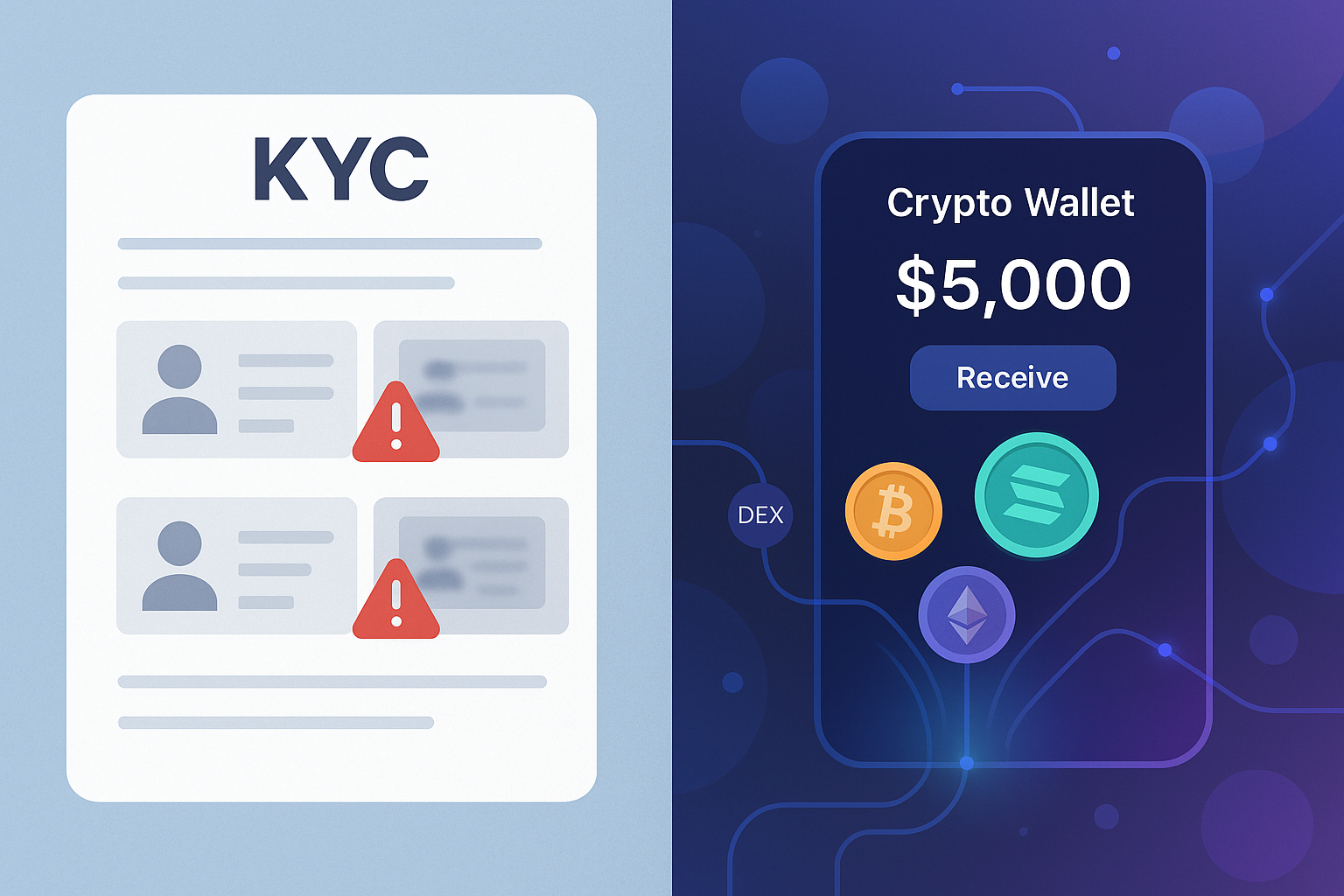
KYC (Know Your Customer) is a set of identity verification procedures that financial institutions perform to comply with anti‑money‑laundering (AML) regulations. It commonly includes:
- Full name, date of birth, and address
- Government ID (passport, driver’s license, national ID)
- Selfies or video verification
- Proof of address (utility bill, bank statement)
Once verified, your data is tied to your accounts and often shared with partners, payment processors, or regulators when requested.
Custodial vs Non‑Custodial
- Custodial platforms hold your funds for you. You log in with an email and password, but the platform controls the private keys. Centralized exchanges are usually custodial.
- Non‑custodial platforms never hold your funds. You connect a wallet that you control, such as Phantom, Solflare, or MetaMask, and every transaction is signed by you.
If your goal is to buy Solana without KYC, non‑custodial solutions are typically the most privacy‑friendly, because they do not require an account tied to your identity.
Benefits of Buying Solana Without KYC
1. Greater Privacy and Data Minimization
When you use non‑KYC methods, you avoid uploading:
- Scans or photos of your ID documents
- Selfies or biometric data
- Detailed personal information that can be linked to your wallet addresses
This reduces the risk of identity theft in the event of a data breach and limits how much third parties can track your financial life.
2. Faster Access to SOL
KYC verification can sometimes take hours or days, especially during peak demand:
- Manual review delays
- Document rejections due to small errors
- Country‑based restrictions
Non‑KYC methods often let you obtain SOL in minutes once you have funds in another crypto or a payment method that the service supports.
3. Fewer Geographic Restrictions
Many centralized exchanges block users from certain countries or states. Privacy‑respecting, non‑custodial services with private exchange and swap capabilities are often accessible from a broader range of locations, although you are still responsible for following your local laws.
4. Control Over Your Own Keys
Most non‑KYC routes rely on non‑custodial wallets. This aligns with a core crypto principle:
Not your keys, not your coins.
If you hold the keys, you ultimately control the SOL, regardless of what happens to any exchange or service provider.
Risks and Drawbacks of Buying Solana Without KYC
Avoiding KYC does not eliminate risk. In some cases, it can increase exposure if you are careless. Consider these potential downsides:
1. Counterparty and Scam Risk
Peer‑to‑peer (P2P) trades, OTC deals, or dubious sites can:
- Take your money and disappear
- Use chargebacks if you accept certain payment methods
- Provide fake or frozen funds
Three ways to mitigate this:
- Use well‑known non‑custodial swap services
- Avoid sending funds directly to strangers in untrusted channels
- Double‑check URLs and avoid clicking suspicious links
2. Limited Fiat On‑Ramp Options
Regulated fiat on‑ramps (where you buy crypto using bank transfers or cards) are increasingly required to perform KYC, especially in the US, EU, and many Asian jurisdictions. This means:
- You may need to start from existing crypto balances instead of fiat
- Non‑KYC card purchases often have lower limits or higher fees
3. Regulation and Tax Responsibilities
Buying Solana without KYC does not exempt you from local laws. You may still be required to:
- Report capital gains or income from crypto
- Declare holdings over certain thresholds
- Comply with any cross‑border transfer rules
Always research your jurisdiction or consult a qualified professional if you are unsure.
4. Less Customer Support
KYC platforms often have more robust support because they know exactly who their customers are. Privacy‑focused services and DEXs may offer:
- Limited or slower support
- Less recourse if you make a mistake with wallet addresses
When you go non‑custodial, you take on more responsibility for your own security and transactions.
How to Buy Solana Without KYC: Main Options
There is no single perfect method for everyone. The best approach depends on what you already have: bank access, cards, or other crypto.
Broadly, there are three categories of non‑KYC methods:
- Non‑custodial swap services (crypto‑to‑crypto)
- Decentralized exchanges (DEXs) on Solana
- P2P and informal OTC trades
1. Non‑Custodial Swap Services
Non‑custodial swap platforms let you swap one cryptocurrency for another directly to your own wallet. You do not create a custodial account and usually do not need to complete KYC for modest amounts.
Typical flow:
- Choose the crypto you have (for example, USDT, BTC, ETH)
- Choose SOL as the asset you want to receive
- Enter your Solana wallet address
- Send your crypto to the deposit address provided
- Receive SOL directly into your wallet after the swap is complete
Services like non‑custodial swap and instant crypto exchange platforms are built around this model, focusing on privacy, speed, and ease of use.
2. Decentralized Exchanges on Solana
DEXs are smart contract‑based marketplaces where you can trade directly from your wallet. On Solana, notable types include:
- Automated market maker (AMM) DEXs
- Order book DEXs and aggregators
To use a DEX to buy SOL without KYC, you typically:
- Already have SOL or SPL tokens to pay for gas and trading fees
- Swap another Solana‑based token (like USDC on Solana) for SOL
This is ideal once you are already on the Solana network. However, if you start from BTC or ETH, you usually need a bridge or swap service first.
3. P2P and OTC Trades
You can also obtain SOL from:
- Friends or colleagues who already have SOL
- Local crypto communities and meetups
- Online P2P marketplaces that allow non‑KYC for small deals
While these can be effective, they are also the riskiest and require high trust or strong escrow protections. Never send money to a stranger without a secure transaction structure.
Step‑by‑Step Guide: Buy Solana Without KYC Using a Non‑Custodial Swap
Below is a practical example of how to buy Solana without KYC using an instant, non‑custodial swap service. Specific interfaces vary between providers, but the flow is broadly similar.
Step 1: Set Up a Solana Wallet
You need a non‑custodial Solana wallet first. Popular options include:
- Phantom (browser extension and mobile)
- Solflare
- Backpack
Basic setup:
- Download the wallet from the official website or app store
- Create a new wallet and write down the recovery phrase on paper (never share it)
- Set a strong password on your device
- Back up the phrase in multiple secure offline locations
Locate your SOL receiving address inside the wallet. You will need this later.
Step 2: Acquire a Starting Crypto Asset
Non‑KYC swaps are usually crypto‑to‑crypto. That means you start with some other coin or token, for example:
- Bitcoin (BTC)
- Ethereum (ETH)
- USDT or USDC on a supported chain
If you do not already hold crypto, you may have to use a fiat on‑ramp, which often involves some KYC depending on your jurisdiction. Some services allow small card purchases with minimal verification, but limits and availability vary.
Step 3: Choose a Non‑Custodial Swap Platform
Look for a platform that supports:
- Swapping your existing asset into SOL
- Non‑custodial flows where you control your wallet
- Reasonable limits without requiring KYC for your intended amount
Compare:
- Fees and spreads
- Estimated completion time
- User reviews and reputation
Step 4: Configure the Swap
On the swap platform:
- Select the asset you are sending (for example, BTC)
- Select SOL as the asset you will receive
- Enter the amount you want to swap and check the estimated output
- Paste your Solana wallet address as the destination
Double‑check the address carefully. Sending to the wrong address is often irreversible.
Step 5: Send Your Funds
The swap service will give you a deposit address (or QR code) for the coin you are sending. From your existing wallet or exchange:
- Send the exact amount to the provided address
- Account for any network fees on your side if necessary
Once the transaction is confirmed on the source blockchain, the service will perform the swap and send SOL to your wallet.
Step 6: Verify Receipt of SOL
Open your Solana wallet and:
- Confirm that the SOL balance appears
- View the transaction details in a Solana block explorer if you want to verify the on‑chain record
You now own SOL in a non‑custodial wallet, obtained through a process that did not require KYC on the swap side.
Practical Tips for Staying Private and Safe
1. Use Fresh Wallet Addresses When Possible
If privacy is a high priority:
- Consider creating a dedicated wallet for purchases made via non‑KYC methods
- Avoid linking that wallet to on‑chain activity that clearly identifies you
Remember that blockchain transactions are public, even if your identity is not directly attached on‑chain.
2. Be Realistic About Amounts
Many non‑KYC platforms have:
- Soft limits beyond which KYC is requested
- Manual review for unusually large or suspicious transactions
Keep amounts reasonable and within published limits to avoid unexpected verification requests.
3. Check the URL and Security Certificates
Before using any site to buy SOL:
- Ensure the URL is correct and not a phishing clone
- Check for HTTPS and a valid certificate
- Avoid promotional links from random messages or unofficial channels
Bookmark the correct domain for future use.
4. Understand Fees and Rates
Instant swaps and privacy‑friendly services sometimes charge:
- Higher spreads than large centralized exchanges
- Network fees for both the sending and receiving chains
Always review:
- The estimated amount of SOL you will receive
- Any platform fees listed
If a rate looks too good to be true, verify that the service is reputable.
5. Keep Your Recovery Phrase Offline
Your Solana wallet’s seed phrase is the ultimate key to your funds. For security:
- Never store it in cloud notes, email, or screenshots
- Write it down and keep it in secure physical locations
- Do not type it into any website; only into the official wallet when restoring
Losing the phrase means losing access to your SOL, regardless of how you bought it.
Common Questions About Buying Solana Without KYC
Is buying SOL without KYC legal?
Legality depends on:
- Your country’s regulations on crypto trading and privacy
- Whether you are using the funds for lawful purposes
In many jurisdictions, simply buying and holding SOL via non‑KYC methods is not inherently illegal. However, you may still have reporting or tax obligations. Always research local rules.
Can I use a credit or debit card without KYC?
Some services may allow small card purchases with limited verification, but:
- Banks and card networks often have their own anti‑fraud and compliance checks
- Limits can be low, and extra checks may be triggered for larger transactions
For ongoing, higher‑volume purchases without KYC, crypto‑to‑crypto swaps are more reliable than card methods.
What if a platform suddenly asks for KYC?
Many services reserve the right to request KYC in cases such as:
- Large or unusual transactions
- Regulatory changes
- Suspicious activity flags by their compliance tools
To reduce this risk, stay within published limits and stick with platforms that clearly communicate their policies.
Conclusion: Privacy‑Conscious Ways to Accumulate SOL
You can buy Solana without KYC by combining:
- A secure, non‑custodial Solana wallet
- A starting crypto asset like BTC, ETH, or stablecoins
- A reputable non‑custodial swap service or DEX
This approach lets you retain control of your keys, minimize data exposure, and sidestep lengthy identity checks for modest purchases. At the same time, it requires you to be more proactive about security, wallet management, and understanding the fee structure.
If you value privacy and want an easy way to swap crypto instantly into Solana without KYC, non‑custodial swap services are one of the most practical tools currently available. Combine them with good wallet hygiene, realistic transaction sizes, and awareness of local regulations to make your SOL stacking both private and responsible.