Atomic Swap vs DEX vs CEX: Which Is Best for Your Crypto Trading?
Introduction
The debate of atomic swap vs DEX vs CEX is no longer just for hardcore crypto enthusiasts. As more people hold and trade digital assets, the way you swap coins can dramatically affect your privacy, security, speed, and even tax reporting. Choosing between centralized exchanges (CEXs), decentralized exchanges (DEXs), and atomic swap protocols is a key decision for anyone serious about crypto.
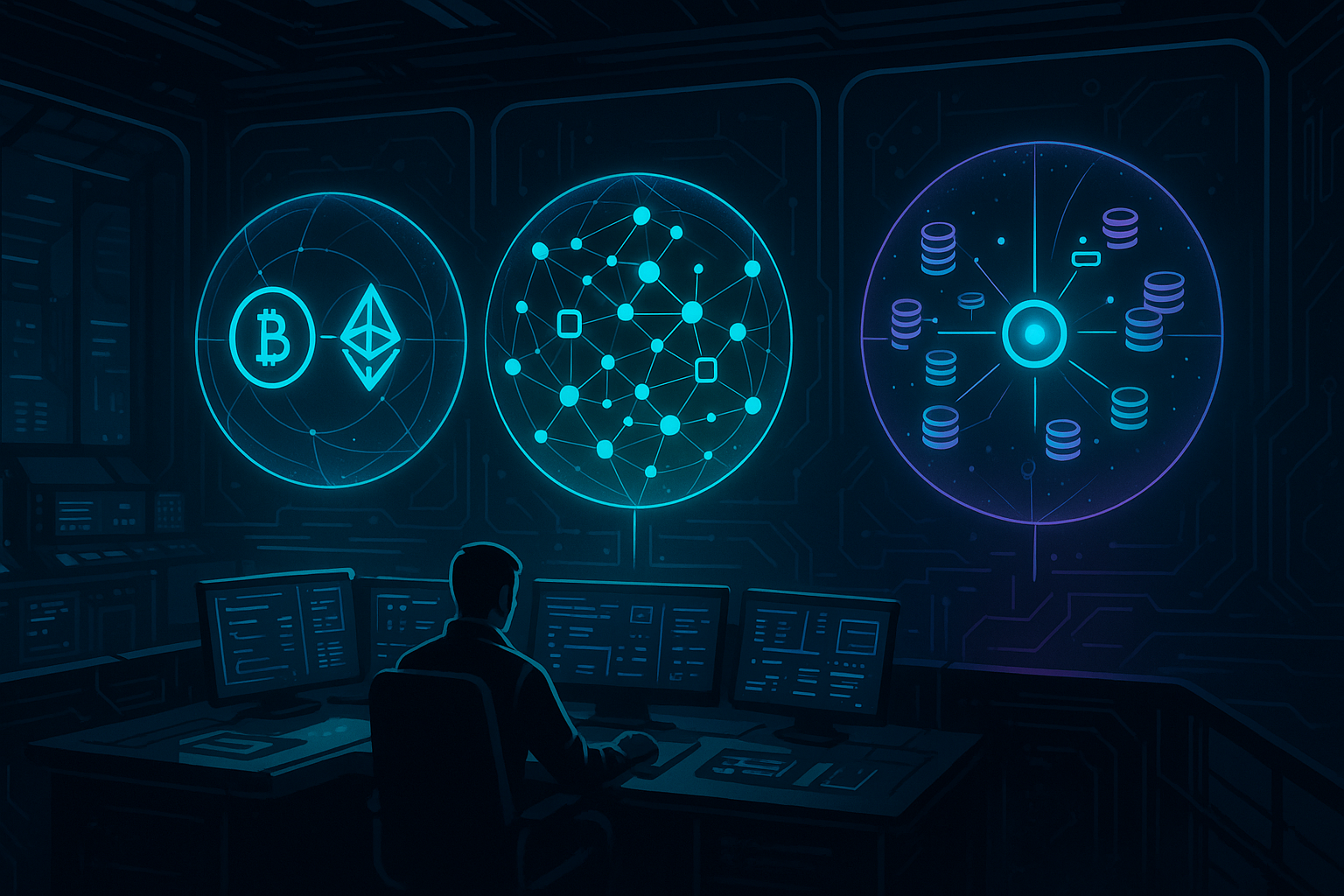
Each model solves a different problem. A CEX focuses on convenience and liquidity. A DEX emphasizes self-custody and permissionless access. Atomic swaps aim for direct, trustless, cross-chain exchange without an intermediary. Modern aggregators combine several of these approaches so users can swap crypto instantly without sacrificing too much on security or usability.
This guide compares atomic swap vs DEX vs CEX in detail so you can understand how they work, their pros and cons, and when to use each option in practice.
Why Atomic Swap vs DEX vs CEX Matters
At first glance, all three options do the same thing: they help you trade one asset for another. In reality, the underlying design changes what you are trusting, how much information you reveal, and how much control you keep over your funds.
- Security model: Do you trust code, an institution, or a third party custodian?
- Privacy: How much KYC data do you share, and who sees your transaction history?
- Control: Can your funds be frozen, limited, or censored?
- Costs: Who takes a fee and how often do you pay network gas?
- Access: Are some users or jurisdictions blocked?
Regulation is tightening, and large CEXs are under increasing pressure to monitor users. DEXs and atomic swaps offer alternatives that align more closely with the original vision of permissionless, peer-to-peer finance. Knowing the difference helps you choose the right tool for the right job instead of defaulting to whatever your friends use.
Quick Definitions: CEX, DEX, and Atomic Swaps
What Is a Centralized Exchange (CEX)?
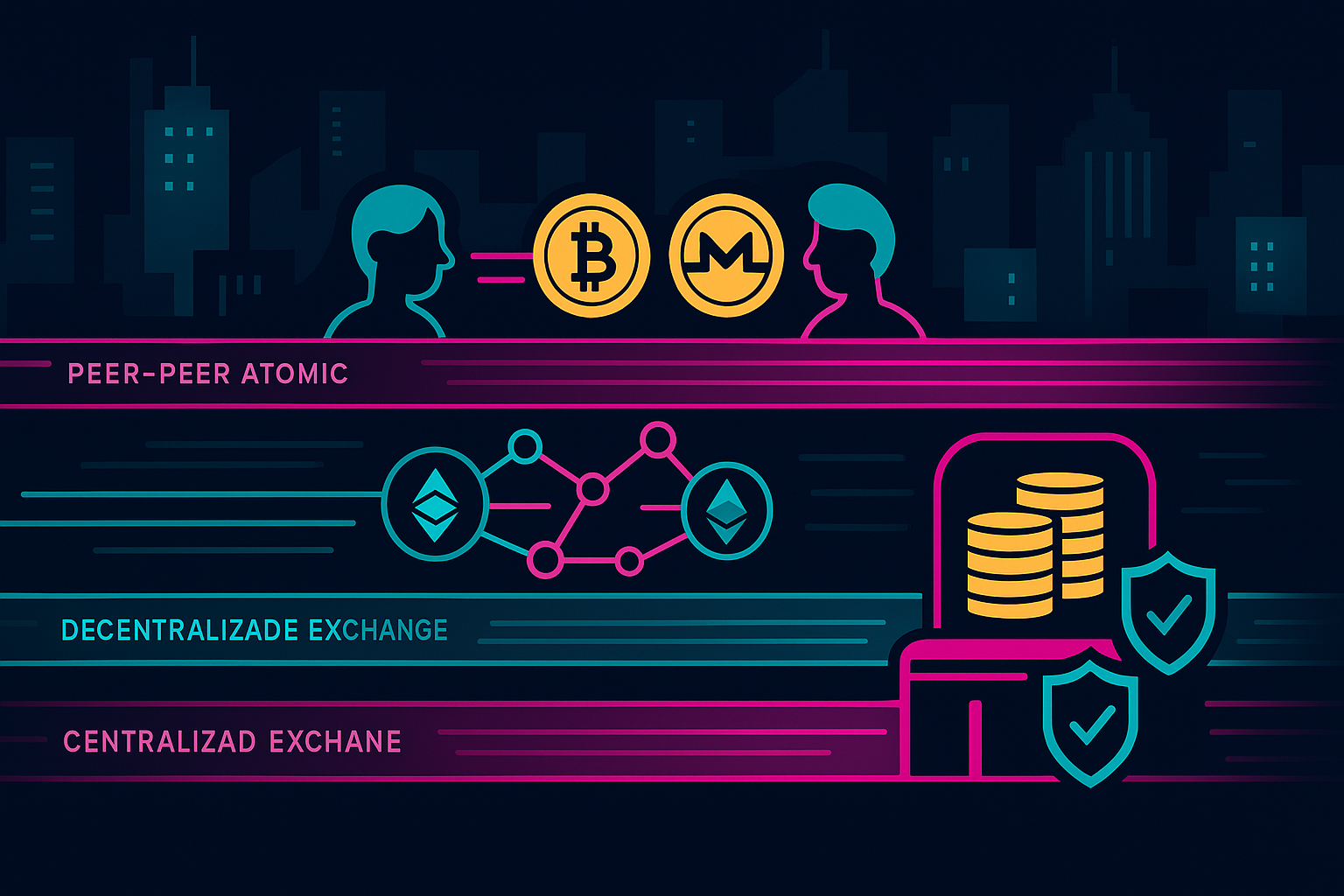
A CEX is a platform like Binance, Coinbase, or Kraken that holds custody of user funds and matches trades using an internal order book or liquidity system. You deposit crypto or fiat to your exchange account, then trade inside the exchange environment.
Key traits of a CEX:
- Custodial: the platform holds your private keys.
- Typically requires KYC / AML verification.
- Often offers high liquidity and many trading pairs.
- Provides customer support and sometimes insurance or protection funds.
What Is a Decentralized Exchange (DEX)?
A DEX is a non-custodial trading protocol that lets you trade directly from your wallet. Popular examples include Uniswap, PancakeSwap, Curve, and GMX. Trades are typically settled on-chain using smart contracts.
Key traits of a DEX:
- Non-custodial: you keep your private keys.
- Permissionless: usually no account or KYC required.
- On-chain settlement: swaps occur on the blockchain itself.
- Liquidity often provided by automated market makers (AMMs) or order books.
What Is an Atomic Swap?
An atomic swap is a protocol that enables two parties to exchange assets directly across blockchains without trusting each other or a central authority. The swap either completes fully or fails entirely, which is why it is called “atomic.”
Technical implementations often rely on Hash Time Locked Contracts (HTLCs) or similar primitives to ensure that if one side receives funds, the other side must too, or all funds are refunded after a specified time.
Key traits of atomic swaps:
- Peer-to-peer: no centralized custodian.
- Cross-chain: exchange assets on different blockchains directly.
- Trustless execution: enforced by cryptography and smart contracts or scripts, not by an intermediary.
- Usually more technical to use than a typical DEX or CEX interface.
Atomic Swap vs DEX vs CEX: Side-by-Side Comparison
| Feature | CEX | DEX | Atomic Swap |
|---|---|---|---|
| Custody | Custodial | Non-custodial | Non-custodial |
| Control of funds | Exchange controls keys | User controls keys | Each user controls their own keys |
| Typical KYC | Yes, often mandatory | Rarely, mostly no | Usually no; P2P |
| Privacy | Low to medium | Medium, on-chain but pseudonymous | Medium to high, depending on implementation |
| Cross-chain trading | Supported internally, off-chain accounting | Limited; usually within one ecosystem | Core feature; directly across chains |
| Ease of use | High, especially for beginners | Medium, requires wallet usage | Low to medium, often technical |
| Key risk | Custodial risk, regulatory risk | Smart contract risk, MEV/front-running | Implementation complexity, timeouts, UX |
Benefits of CEXs, DEXs, and Atomic Swaps
Benefits of Centralized Exchanges (CEXs)
- High liquidity: Large CEXs often have deep order books and narrow spreads, which is ideal for big trades.
- Fiat on/off ramps: Easy conversion between fiat and crypto through bank transfers, cards, or payment services.
- User-friendly interface: Mobile apps, charting tools, stop-loss orders, and customer support.
- Advanced products: Derivatives, margin trading, staking, and various yield products are commonly offered.
Benefits of Decentralized Exchanges (DEXs)
- Non-custodial: You always control your private keys, reducing custodial risk.
- Global and permissionless: Anyone with a supported wallet and internet connection can usually access DEXs.
- Wide token coverage: New or experimental tokens often list on DEXs first.
- Composability: DEXs integrate with other DeFi apps like lending pools, yield aggregators, and derivatives protocols.
Benefits of Atomic Swaps
- Trustless cross-chain swaps: Exchange assets across blockchains without using a centralized bridge or custodian.
- Inherent fairness: The “all or nothing” design minimizes scenarios where one party gets paid while the other does not.
- Improved privacy compared to CEXs: No account sign-up, and usually no KYC, although transactions are still visible on-chain.
- Alignment with crypto ethos: Atomic swaps embody peer-to-peer, non-custodial trading in a pure form.
Many modern tools combine aspects of each model. For example, an aggregator can route orders across multiple DEXs or protocols and offer non-custodial swap options that feel almost as simple as using a CEX, while still giving you control of your funds.
Risks and Drawbacks: Atomic Swap vs DEX vs CEX
Risks of Centralized Exchanges
- Custodial risk: If the exchange is hacked, frozen by regulators, or mismanages funds, your assets are at risk.
- Counterparty risk: You rely on the platform’s solvency and integrity.
- Regulatory and KYC risk: Your identity and trading activity are tied together and can be shared with authorities or partners.
- Withdrawal restrictions: Exchanges can limit withdrawals, delist assets, or block users by jurisdiction.
Risks of Decentralized Exchanges
- Smart contract vulnerabilities: Bugs in the protocol or contracts can lead to loss of funds.
- MEV and front-running: On-chain transactions can be reordered or sandwiched by MEV bots.
- Slippage and impermanent loss: Prices can move between transaction initiation and confirmation, and LPs face pricing risks.
- Network congestion and gas costs: High gas prices can make small swaps expensive or slow.
Risks of Atomic Swaps
- Technical complexity: Many user interfaces are not yet as polished as major DEXs or CEXs, increasing the chance of user error.
- Timeout and refund logic: HTLC-based systems rely on timing parameters. Misconfiguration or poor UX can lead to confusion or locked funds until timelocks expire.
- Limited asset support: Not all chains or tokens support the necessary scripting or contract features for atomic swaps.
- Liquidity and counterparties: Direct P2P atomic swap markets can be thin, although aggregators and protocols are improving this.
Step-by-Step Guide: How Each Method Works in Practice
1. Swapping on a CEX: Step-by-Step
- Create and verify an account: Sign up with email, complete KYC with government ID and possibly proof of address.
- Deposit funds: Transfer fiat or crypto into the exchange wallet.
- Place a trade: Use a market or limit order to trade, for example, BTC for ETH.
- Confirm trade execution: The CEX updates your account balances internally; no on-chain transaction is needed inside the platform.
- Withdraw to your wallet (optional): Withdraw ETH to your self-custodial wallet if you want full control.
2. Swapping on a DEX: Step-by-Step
- Set up a wallet: Use a non-custodial wallet like MetaMask, Rabby, or a hardware wallet.
- Fund the wallet: Send assets and sufficient native token for gas (for example ETH on Ethereum) to your wallet address.
- Connect to a DEX: Visit a DEX interface and connect your wallet.
- Configure the swap: Select the token you are selling and the token you want to receive; adjust slippage if needed.
- Approve token (if ERC-20): Grant the DEX smart contract permission to spend your token.
- Execute the swap: Confirm the transaction in your wallet and pay gas.
- Wait for confirmation: Once the transaction is mined, your new tokens are in your wallet.
3. Executing an Atomic Swap: High-Level Steps
The detailed mechanics depend on the implementation, but the general idea looks like this:
- Agree on terms: Two parties agree on which assets to swap, how much, and which blockchains are involved.
- Generate a secret and hash: One party generates a random secret and computes its hash. This hash is shared with the counterparty, but the secret is kept private.
- Create HTLC on chain A: The first party locks their coins in a contract that can be unlocked only with the secret or refunded after a timelock.
- Create HTLC on chain B: The second party does the same on their chain, using the same hash but different timelock parameters.
- Redeem and reveal: When one party redeems their funds using the secret, the secret becomes visible on-chain, allowing the other party to redeem from their HTLC.
- Fallback refunds if needed: If someone does not redeem in time, funds are refunded after the timelock expires.
User-friendly tools abstract these steps behind a UI, but understanding this flow helps explain why atomic swaps can be slower and more complex than a simple DEX swap yet offer strong guarantees.
Practical Tips: When to Use Atomic Swaps, DEXs, or CEXs
When a CEX Might Be Your Best Choice
- You need fiat rails: Buying crypto with a bank transfer or selling back to cash usually requires a regulated CEX.
- You want maximum liquidity: Large orders with minimal slippage are often easiest on a major centralized exchange.
- You need advanced trading tools: Complex order types, margin, and derivatives are more developed on CEXs.
When a DEX Is the Better Option
- You prefer self-custody: If “not your keys, not your coins” is your rule, a DEX fits your philosophy.
- You are interacting with DeFi: Lending, borrowing, liquidity provision, and yield strategies start with on-chain tokens.
- You want access to long-tail assets: Many niche or early-stage tokens appear on DEXs first.
When Atomic Swaps Shine
- You want cross-chain swaps without a bridge or CEX: Move value between independent chains in a trust-minimized way.
- You care strongly about minimizing third-party risk: Atomic swaps remove centralized custodians from the equation.
- You are comfortable with more advanced tools: If you are technical and security-focused, atomic swaps can be ideal for high-value transfers across chains.
Hybrid Approach: Using Aggregators and Non-Custodial Services
In reality, many users mix approaches. For example, you might buy crypto on a CEX, move it to a self-custodial wallet, then use a DEX or aggregator for cross-chain trades. Some services bundle these flows and focus on providing a fast, private exchange experience that lets you choose the right route without manually managing every step.
Practical tips for a hybrid strategy:
- Keep only short-term trading capital on CEXs; store long-term holdings in self-custody.
- Favor DEXs or atomic swap tools for cross-chain moves when you want to minimize custody risk.
- Use aggregators that check prices across multiple DEXs and protocols to reduce slippage and gas costs.
- Test each new tool with a small transaction before moving significant funds.
Conclusion: How to Decide Between Atomic Swap vs DEX vs CEX
There is no single winner in the atomic swap vs DEX vs CEX debate. Each approach optimizes for different trade-offs:
- CEX: Best for on/off ramps, high liquidity, and beginner-friendly trading, but requires trust and KYC.
- DEX: Ideal for non-custodial trading within a network, access to DeFi, and global permissionless participation.
- Atomic swaps: Strong choice for cross-chain, peer-to-peer, trust-minimized swaps when you prioritize control and counterparty risk reduction.
A practical strategy is to combine them: use centralized exchanges for fiat access, decentralized exchanges for on-chain activity, and atomic swap or aggregator tools when you need secure cross-chain movement. With careful selection, you can enjoy a flexible, resilient setup that aligns with your risk tolerance and privacy needs.
If you want a streamlined way to compare and combine these approaches in real scenarios, reviewing resources that break down atomic swap vs dex vs cex in the context of aggregators and bridges can help you design an even more efficient trading workflow.
Ready to Swap?
Convert your crypto instantly on GhostSwap — no KYC, no sign-up required.
Popular swaps: BTC to XMR | BTC to ETH | XMR to BTC | ETH to XMR | BTC to SOL