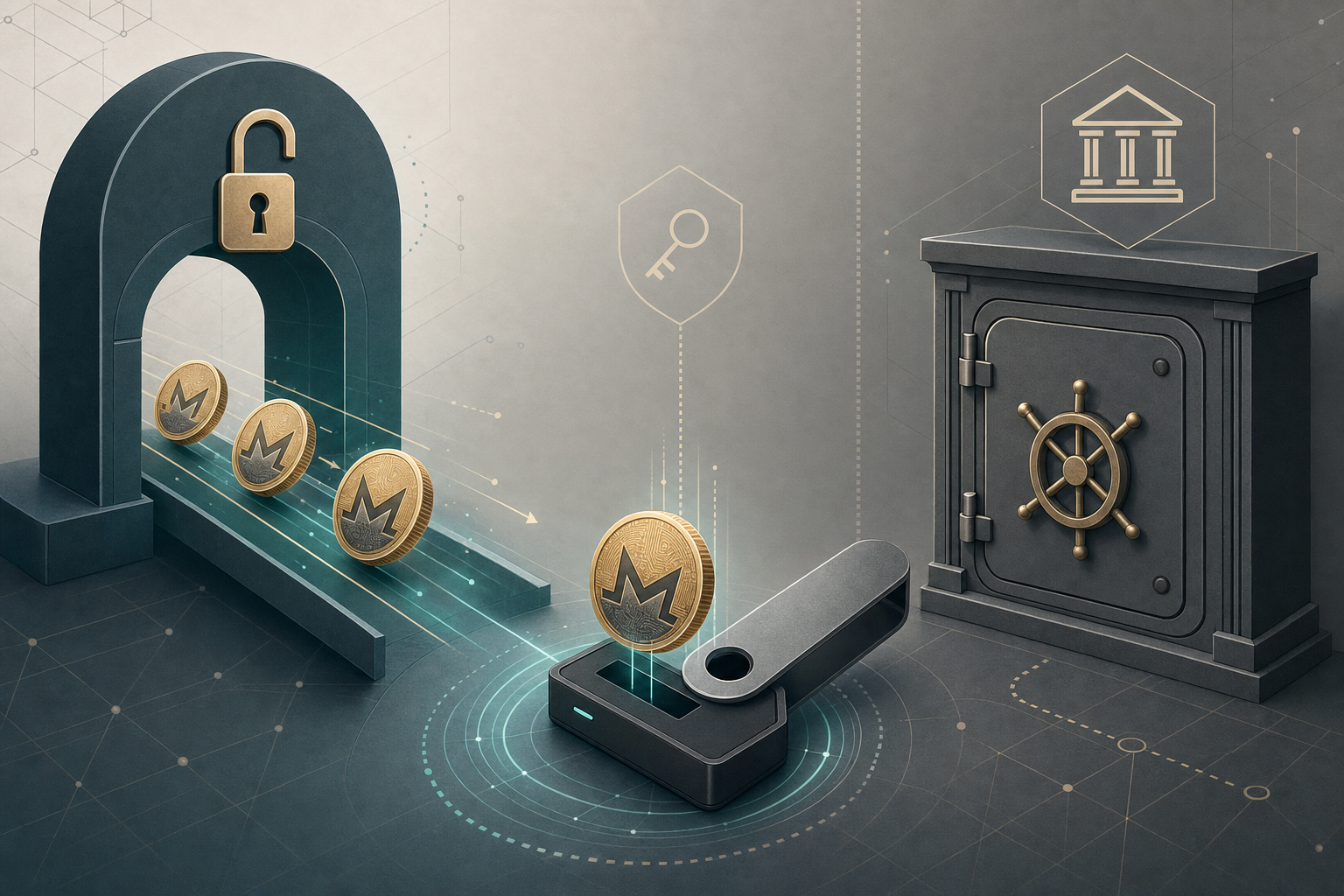
Buying Monero non-custodially means the coin lands directly in a wallet you control, and no third party ever holds it on your behalf. A non-custodial swap converts your input coin to XMR and pays out to a receiving address you supply — there is no account balance to withdraw from, because there is no account at all. The distinction matters because "no KYC" and "non-custodial" are not the same thing.
TL;DR: To buy Monero non-custodial and no-KYC, use a crypto-to-crypto swap that pays out straight to your own XMR wallet. You send BTC, ETH, or USDT; the service converts it and sends XMR to the address you gave. GhostSwap does this with no account, no email, and no KYC for swaps — funds pass through and are never held.
Non-custodial means a service never takes possession of your funds. Your coin passes through the swap and settles into a wallet whose keys only you hold. Custodial means the funds sit in the service's account until you withdraw them.
What non-custodial means, and why GhostSwap never holds your funds
Non-custodial means the service never controls your coins. On GhostSwap, funds pass through and are never held — you supply a receiving address, the swap converts your input coin to Monero, and the XMR settles directly into your wallet. There is no balance page, no withdrawal step, and no account, because the model has no place to store your coins.
This is the technical heart of the difference. A custodial exchange gives you a deposit address that belongs to the exchange. Your coins land in the exchange's wallet and become an IOU on its internal ledger. You then request a withdrawal, which the exchange processes on its own schedule.
GhostSwap requires no account, no email, and no identity verification to swap. You provide two things: the address that receives your Monero, and a refund address in case a swap can't complete. That is the full extent of the data a swap needs.
Step-by-step: buy XMR non-custodially via GhostSwap
The process is five steps and needs no login. Median completion time is about 8 minutes, with a 95th-percentile time near 30 minutes depending on chain congestion.
- Pick your pair — choose the coin you're paying with (BTC, ETH, USDT, and 1,600+ pairs across 200+ assets) and set XMR as the output.
- Enter your Monero address — paste the receiving address from a wallet you control (Feather, Monerujo, Cake, or a hardware setup). This is where the XMR settles.
- Add a refund address — supply an address on the input coin's network so funds return to you if the swap can't complete.
- Send your input coin — transfer the exact amount to the one-time deposit address shown. Pay an adequate network fee so it confirms inside the quote window.
- Receive XMR — once your deposit confirms, the swap converts at the floating rate and sends Monero to your address. No withdrawal request, because nothing was ever held.
Because pricing is floating-rate from aggregated liquidity from leading crypto markets, the rate you get reflects the market at the moment your funds arrive, not the moment you clicked — typically within the quoted spread.
When you're ready, the live swap widget sets up an XMR payout in a couple of minutes, or start from a specific pair like BTC to XMR.
Non-custodial XMR swap vs custodial exchange: how they compare
The difference between a non-custodial swap and a custodial account isn't cosmetic — it changes who holds your coins and what data you hand over. The table below compares GhostSwap with three named no-KYC swap services on the two axes that decide this: custody and account requirements.
| Feature | GhostSwap | StealthEX | SimpleSwap | FixedFloat |
|---|---|---|---|---|
| Account required | None | None claimed | None claimed | None claimed |
| Custody model | Non-custodial pass-through | See provider terms | See provider terms | See provider terms |
| Pairs | 1,600+ | See provider site | See provider site | See provider site |
| XMR payout to your own wallet | Yes | See provider site | See provider site | See provider site |
The honest read: several services advertise no-KYC swaps. What you should verify for each is whether you ever create an account, and whether the deposit address belongs to you-via-your-wallet or to the service. If a deposit address needs a login, that's custody with a nicer word.
Which wallets receive Monero non-custodially
Monero lands in any wallet where you hold the keys. Popular open-source choices include Feather (desktop), Monerujo (Android), and Cake Wallet (mobile). Hardware wallets that support XMR let you keep the keys offline while still receiving swap output to a public address.
The rule is simple: the receiving address must come from a wallet you control, not from another exchange. If you paste an exchange deposit address as your Monero output, you've handed custody straight back to a third party — the exact thing non-custodial buying avoids.
Feather and Monerujo are reference-grade open-source wallets maintained by the Monero community. Both generate a receiving address you can paste directly into the swap's output field.
Common mistakes: exchange deposit address vs self-custody wallet
The most consequential error is pasting a custodial exchange's deposit address as your XMR output. That routes your freshly-bought Monero into a third party's account, undoing the point of a non-custodial swap. Always use an address from a wallet whose seed phrase you hold.
Two more to avoid:
- Underpaying the network fee on your deposit. The swap waits for on-chain confirmations before converting. Too low a fee can leave your deposit unconfirmed past the quote window.
- Skipping the refund address. Without it, a swap that can't complete has nowhere to return your funds automatically.
How GhostSwap handles the swap differently
GhostSwap's model has no account layer to hold anything. Your input coin arrives at a one-time deposit address, converts at the floating rate, and the Monero pays out to your wallet — funds pass through and are never held. There is no balance, no withdrawal queue, and no identity verification for swaps.
That's the practical meaning of non-custodial: the service can't freeze a balance it never holds, because the coins only exist in your wallet and in transit. GhostSwap is not a registered financial service; it's a crypto-to-crypto swap that pays out to addresses you control.
FAQ
Q: How do I buy Monero without giving custody to an exchange?
A: Use a crypto-to-crypto swap that pays out directly to your own XMR wallet. You send an input coin like BTC or USDT, the service converts it, and the Monero settles into the receiving address you supplied. On GhostSwap this needs no account and no KYC for swaps.
Q: Do I need an account or ID to buy Monero this way?
A: No. GhostSwap requires no account, no email, and no identity verification to swap. You supply a receiving address for the XMR and a refund address on the input network — that's all a swap needs.
Q: What does non-custodial actually mean for my Monero?
A: It means the service never holds your coins. Funds pass through the swap and settle in a wallet you control. There's no account balance and no withdrawal step, because there's nothing stored on your behalf.
Q: How long does a non-custodial XMR swap take?
A: Median completion time is about 8 minutes, and the 95th-percentile time is near 30 minutes, depending on how congested the input and output chains are when your deposit confirms.
Q: Which wallet should I send the Monero to?
A: Any wallet where you hold the keys — Feather, Monerujo, Cake, or a hardware wallet that supports XMR. Never paste another exchange's deposit address, or you hand custody back to a third party.
Buy Monero on your own terms
If you want the XMR to land in your wallet and nowhere else, start from the live swap widget or set up a BTC to XMR swap directly. New to self-custody Monero? Read how to buy crypto first.