How to Swap USDT to BTC Instantly in 2026 (No KYC, Step‑by‑Step Guide)
The fastest way to swap USDT to BTC in 2026 is to use a non-custodial instant swap service that does not require registration or KYC. On GhostSwap, you simply choose USDT and BTC, paste your Bitcoin address, send Tether to the deposit address, and receive BTC directly in your wallet within minutes.
- Connect or open your USDT and BTC wallets.
- On a non-custodial swap site, select USDT as the coin you send and BTC as the coin you receive.
- Enter your Bitcoin address and confirm the rate and fees.
- Send USDT to the provided address and wait for BTC to arrive in your wallet.
For a fast, private swap with no account signup, you can use GhostSwap’s dedicated USDT to BTC exchange route and complete the whole process in just a few minutes.
What You Need Before You Start
Before you swap USDT to BTC, make sure you have the basics ready. This avoids failed transactions, delays, or funds going to the wrong place.
1. A wallet that supports USDT and BTC
You need at least one wallet for each coin:
- USDT wallet: Tether exists on multiple blockchains, including Ethereum (ERC‑20), Tron (TRC‑20), BNB Smart Chain (BEP‑20), and more. Confirm which network your USDT is on in your wallet or on a block explorer such as Etherscan for ERC‑20 or Tronscan for TRC‑20.
- BTC wallet: Any standard Bitcoin wallet will work, such as a hardware wallet (Ledger, Trezor), a self-custody mobile wallet (BlueWallet, Phoenix, Sparrow), or a desktop wallet.
Non-custodial wallets where you hold your own keys are generally safer than leaving funds on an exchange. If you do not have one, consider setting this up before swapping.
2. Enough USDT to cover the swap and fees
Instant swap services and exchanges usually have minimum amounts. They vary but are often in the range of $20–$50 equivalent for a smooth experience, especially on networks with higher gas costs like Ethereum.
Also account for:
- Network fees: You need a small amount of the native token for gas on the chain where your USDT lives (for example, ETH for ERC‑20 USDT, TRX for TRC‑20 USDT).
- Service fees and spread: Instant swap platforms and centralized exchanges include a fee and/or spread between buy and sell prices.
3. Time needed for the swap
How long it takes to swap USDT to BTC depends on the method you choose:
- Instant non-custodial swap: Usually 5–30 minutes, depending on blockchain congestion and confirmations.
- Centralized exchange: From 30 minutes up to several days if you still need to pass KYC or wait on bank transfers or withdrawal reviews.
- P2P / OTC / DEX routes: Anywhere from minutes to hours, depending on liquidity and counterparties.
For most people who already have USDT in a self-custodial wallet, a non-custodial swap will be the most straightforward way to convert to Bitcoin quickly.
Method 1: Using GhostSwap (No KYC — Recommended)
GhostSwap is a non-custodial, instant crypto-to-crypto swap platform with 1,500+ trading pairs and no KYC requirements. You never deposit into a custodial account. Instead, you send USDT from your wallet directly to a swap address, and BTC is sent out to your own BTC wallet.
Step 1: Go to GhostSwap.io
Open your browser and go to GhostSwap.io. You can use it from desktop or mobile without creating an account.
For the exact route you need, you can go directly to the USDT to BTC swap page where the pair is pre-selected.
Step 2: Select USDT in the exchange widget
In the swap widget:
- Choose Tether (USDT) in the “You send” field.
- Choose Bitcoin (BTC) in the “You get” field.
- Select the correct USDT network (for example, ERC‑20, TRC‑20, BEP‑20). This must match the network of the USDT in your wallet.
Enter the amount of USDT you want to swap. The widget will automatically show an estimated amount of BTC you will receive, including the service’s spread and fees.
Step 3: Enter your Bitcoin wallet address
Next, paste your personal BTC receiving address in the “Recipient address” field. Double-check:
- The address belongs to your own Bitcoin wallet.
- You are on the correct blockchain (regular Bitcoin, not wrapped BTC on another chain).
- There are no extra spaces or typos. It is best to paste from your wallet app instead of typing manually.
Some wallets offer multiple address formats (Legacy, SegWit, Taproot). All are generally compatible with major services, but native SegWit or Taproot addresses can reduce future transaction fees for you.
Review the order details: estimated BTC output, fee, and minimum/maximum amount. Confirm if everything looks correct.
Step 4: Send your crypto and receive BTC
After confirming, GhostSwap will generate a unique deposit address for your USDT. This is the address where you need to send your Tether from your own wallet:
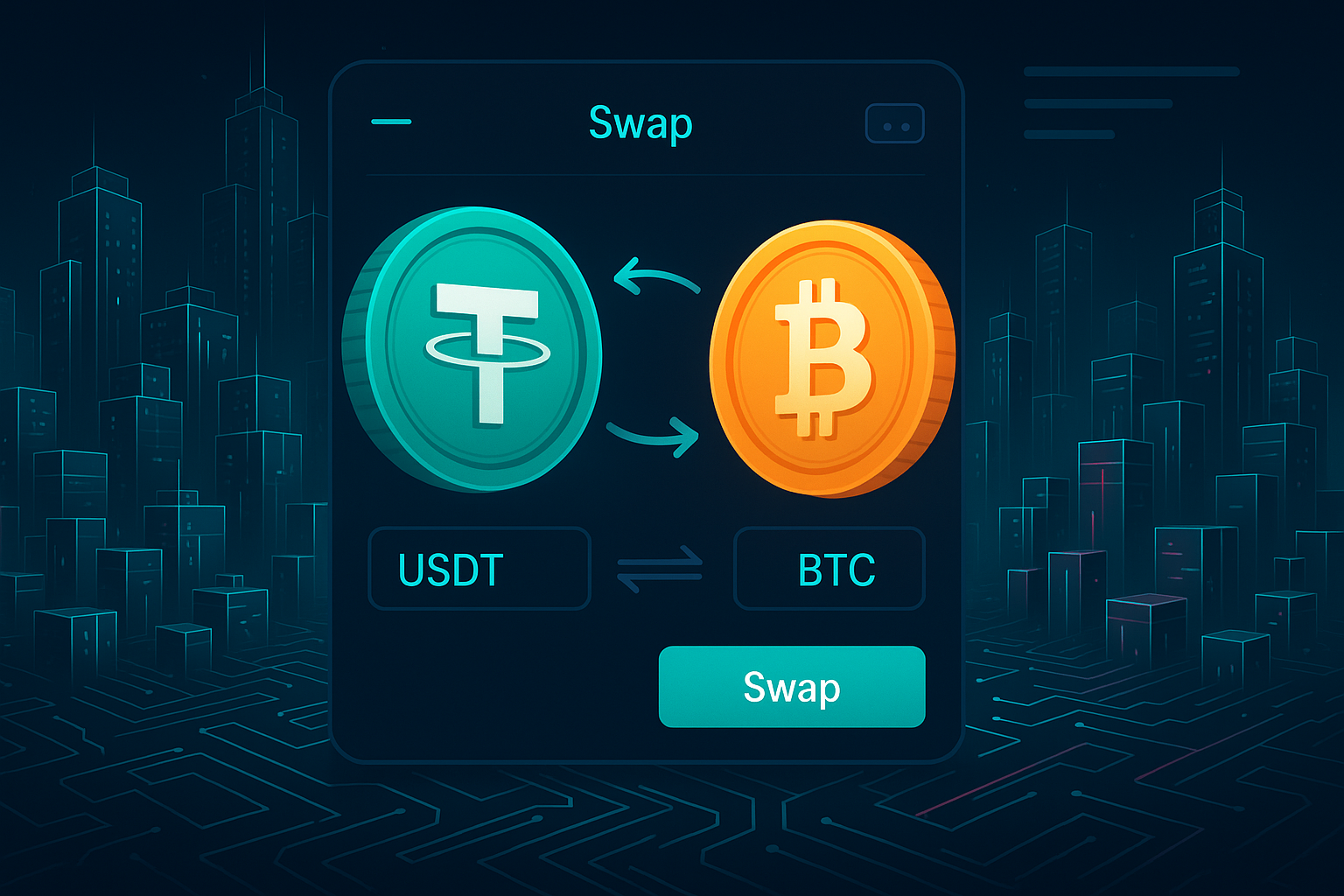
- Copy the USDT deposit address shown on the screen.
- In your USDT wallet, start a transfer and paste the address.
- Make sure you select the same network that GhostSwap expects (for example, do not send TRC‑20 USDT to an ERC‑20 address).
- Send the exact amount (or slightly more if recommended to cover small network differences).
Once your USDT transaction has the required blockchain confirmations, GhostSwap’s engine automatically executes the swap and sends BTC to your recipient address. You can monitor the progress with the provided status link.
You do not need to stay on the page, but it is a good idea to keep your order ID until BTC arrives in your wallet.
Pros and cons of using GhostSwap
Pros
- No KYC: You can swap USDT to BTC without uploading ID documents or linking a bank account.
- Non-custodial: You keep control of your wallets. Funds are never held in a long-term exchange account.
- Fast execution: Swaps typically finalize within minutes once your USDT transaction confirms.
- 1,500+ trading pairs: Beyond BTC, you can route your USDT into many other assets in one place.
- Simple UI: Suitable for beginners who do not want the complexity of an order book exchange.
Cons
- Crypto-to-crypto only: It is not designed for cashing out to bank accounts directly, although you can use on-ramp/off-ramp partners if you need fiat.
- No advanced trading tools: There is no order book, margin trading, or complex orders. It is focused on simple swaps.
You can swap USDT for BTC, ETH, USDT and 1,500+ other coins on GhostSwap without KYC.
Method 2: Using a Centralized Exchange
Another way to swap USDT to BTC is to use a centralized cryptocurrency exchange (CEX). This is the traditional route many traders still use, especially those who already have verified exchange accounts.
How centralized exchanges work for USDT to BTC
The general process looks like this:
- Create an account: Sign up with your email and password on a major exchange.
- Complete KYC: Provide your full name, address, photo ID, and possibly a selfie or proof of residence. This step is mandatory on regulated platforms and can take minutes to days depending on checks.
- Deposit USDT: Get your USDT deposit address from the exchange and send USDT from your wallet. Check that the network matches the one supported by the exchange for that token.
- Trade USDT for BTC: Use a USDT/BTC trading pair in the spot market to place a market or limit order.
- Withdraw BTC: Once you have BTC, request a withdrawal to your self-custodial Bitcoin wallet.
This method offers deeper liquidity and sometimes slightly tighter spreads, especially for large volume trades. However, it comes with extra friction and privacy trade-offs.
Drawbacks of the CEX route
- KYC and privacy: You must share personal documents and go through identity checks.
- Custodial risk: Your funds sit in the exchange’s wallets while you trade, which introduces counterparty and hacking risk.
- Time cost: Initial KYC can add hours or days, and withdrawals can be delayed by reviews or maintenance.
- Extra fees: You may pay deposit fees, trading fees, and BTC withdrawal fees that are separate from network fees.
If you only want to convert USDT to BTC without engaging in full-time trading, an instant non-custodial swap is usually simpler and faster than going through a centralized exchange onboarding process.
Method 3: Using P2P, DEX, or Local Bitcoin ATMs
Besides instant swaps and centralized exchanges, there are other ways to convert Tether into Bitcoin, each with its own trade-offs in terms of speed, privacy, and complexity.
P2P marketplaces
P2P (peer-to-peer) platforms let you trade directly with another person who is buying or selling BTC for USDT.
Typical flow:
- You post or accept an offer to sell USDT in exchange for BTC.
- The platform often uses an escrow system to lock in funds while the trade completes.
- After both sides confirm, BTC is released to your wallet.
Benefits include flexible payment methods and competitive pricing, but you must be cautious of scams and only use platforms with strong escrow and reputation systems. It can also take longer than an automated swap.
Decentralized exchanges and cross-chain bridges
Decentralized exchanges (DEXs) allow you to trade directly from your wallet via smart contracts. For example, if your USDT is on Ethereum, you can swap USDT for a wrapped version of BTC (like WBTC) on a DEX. However, converting that wrapped BTC into native Bitcoin often requires a bridge or separate service.
Challenges include:
- Smart contract risk and more complex interfaces for beginners.
- High gas fees on some networks, such as Ethereum during periods of congestion.
- Multiple steps to go from USDT on one chain to native BTC on the Bitcoin network.
This route is more suitable for advanced users who are comfortable managing multiple chains and tools rather than someone who just wants a straightforward USDT to BTC swap.
Bitcoin ATMs and OTC desks
Some Bitcoin ATMs and over-the-counter (OTC) desks may let you pay with stablecoins, but most ATMs primarily handle cash-to-BTC or card-to-BTC transactions. Where USDT is accepted, you typically:
- Scan a QR code to send USDT to the operator.
- Provide a BTC address or generate one via a paper wallet at the ATM.
- Receive BTC after your payment confirms.
Fees at ATMs are often significantly higher than online options, and availability depends on your location. OTC desks can be useful for very large trades, but they are not practical for everyday retail users swapping moderate amounts.
Tips for Staying Safe
Whether you use GhostSwap, a centralized exchange, or any other method, take basic precautions to protect your funds and privacy when you swap USDT to BTC.
Verify URLs and services
- Type the URL manually or use trusted bookmarks rather than clicking random ads or links.
- Check for HTTPS and certificate details in your browser.
- Beware of lookalike domains imitating well-known services.
Double-check wallet addresses
- Always copy and paste addresses from your wallet app.
- Verify the first and last 4–6 characters before confirming a transaction.
- Watch out for clipboard malware that could silently replace addresses.
Use secure, reputable wallets
- Prefer hardware wallets or reputable open-source software wallets for storing BTC long term.
- Write down your seed phrase on paper and keep it offline, never in cloud storage or screenshots.
- Enable additional security features such as passphrases or 2FA where applicable.
Understand network and token details
- Confirm which blockchain your USDT is on by checking in your wallet or on a price tracker such as CoinGecko’s Tether page or CoinMarketCap.
- Never send tokens to an incompatible chain or address format.
- Leave some native gas token (ETH, TRX, BNB, etc.) in your wallet so you can pay network fees.
Keep your environment secure
- Update your operating system, browser, and wallet software regularly.
- Avoid performing sensitive transactions on public Wi‑Fi; use a VPN if necessary.
- Be wary of unsolicited messages, “support” contacts, or airdrop links asking you to connect wallets.
Ready to Trade Tether (USDT)?
If you want a fast, private way to convert Tether into Bitcoin without signups or KYC, a non-custodial swap is often the best balance of speed and security. With GhostSwap, you can swap crypto instantly between USDT and BTC directly from your own wallet.
Ready to Get Started?
To summarize, you have three main options if you want to swap USDT to BTC in 2026: a non-custodial instant swap like GhostSwap, a traditional centralized exchange, or alternative routes such as P2P and DEX tools.
For most users who already hold Tether in a self-custody wallet and want to receive Bitcoin quickly and privately, GhostSwap hits the sweet spot. It lets you perform a non-custodial swap from USDT to BTC in just a few clicks, with no signup, no KYC, and direct payouts to your own BTC address.
Visit GhostSwap now to try a private exchange from USDT to BTC and see how simple instant crypto swaps can be.
Frequently Asked Questions
Can I swap USDT to BTC without ID?
Yes. You can swap USDT to BTC without ID by using a non-custodial instant swap service like GhostSwap. These platforms do not require account creation, KYC, or linking a bank card for pure crypto-to-crypto swaps.
You just provide the amount, your BTC address, and send USDT from your wallet. As long as you stay within their risk and AML thresholds, there is no need to upload documents.
What is the best method to convert USDT into Bitcoin?
The “best” method depends on your priorities:
- Speed + privacy: Non-custodial instant swaps are ideal, because they avoid lengthy verification and keep you in control of your wallets.
- Deep liquidity for large trades: Centralized exchanges or OTC desks may provide better pricing for very large orders, at the cost of KYC and custody.
- Advanced DeFi strategies: Power users might use DEXs and bridges, but this is more complex and not necessary for a simple USDT to BTC conversion.
For most everyday users, a straightforward non-custodial swap strikes the best balance of convenience, security, and privacy.
How long does it take to swap USDT to BTC?
On instant swap platforms, the main time factor is blockchain confirmations:
- Your USDT transaction typically confirms within a few minutes, depending on network congestion.
- After that, the service executes the trade and sends BTC, which then needs its own confirmations before it is fully spendable in your wallet.
In normal conditions, the full process often completes in 5–30 minutes. Centralized exchanges can take longer due to KYC onboarding, internal batch processing, and withdrawal reviews.
Is it safe to use GhostSwap?
GhostSwap is non-custodial, which means it never takes long-term custody of your coins. You keep your USDT and BTC in your own wallets except for the brief time your USDT is in transit during the swap.
As with any crypto service, your safety also depends on your own practices: verifying the correct URL, double-checking addresses, and using secure wallets. Always start with a modest test amount if you are using a service for the first time, and ensure you understand each step before sending large sums.