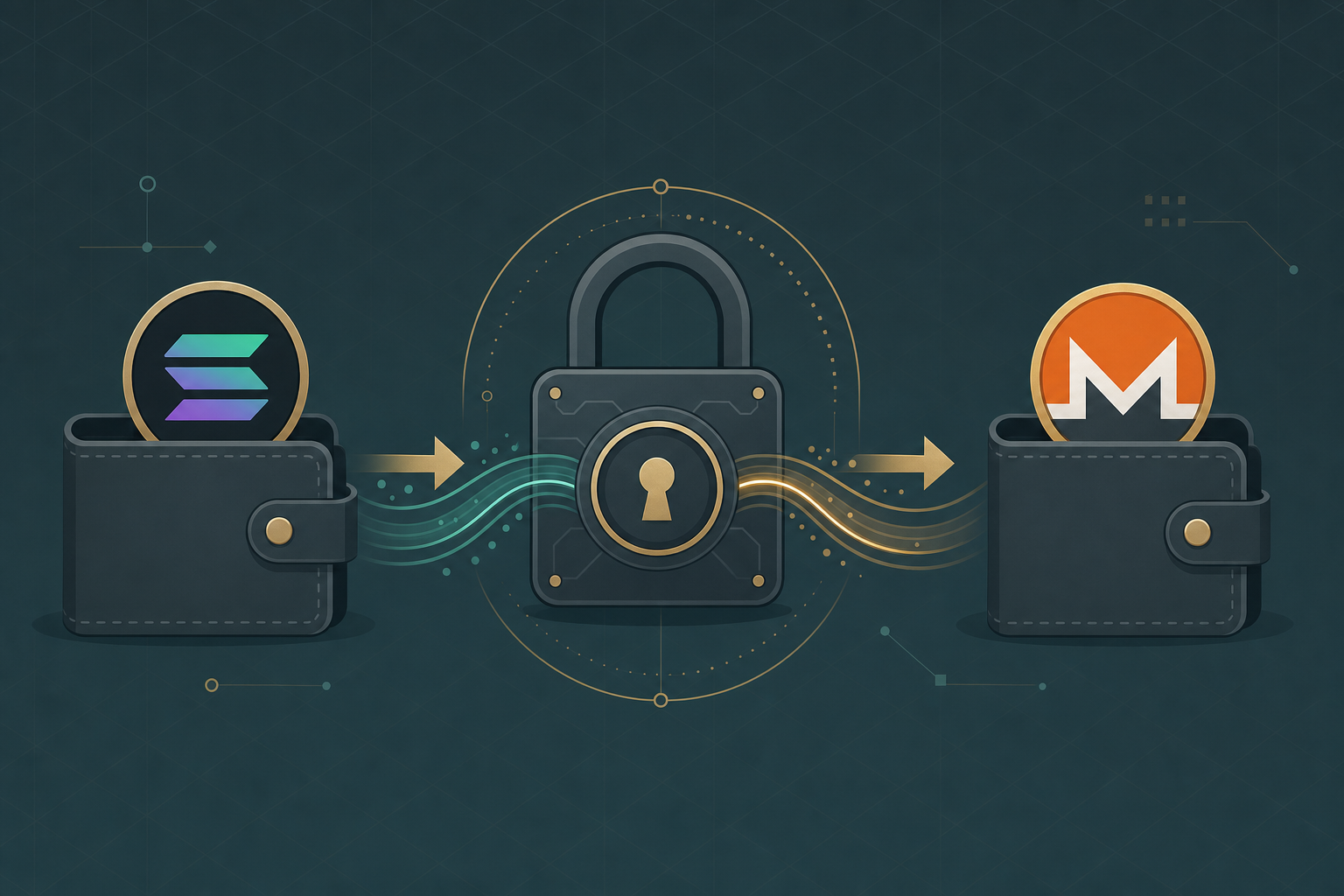
Swapping SOL from Phantom to a privacy coin is a cross-chain conversion: you send Solana from your wallet, and a swap service converts it to a coin on a different network — such as Monero (XMR), Zcash (ZEC), or Dash (DASH). On GhostSwap this happens without an account, without an email, and without identity verification. You supply a receiving address on the privacy coin's network, send your SOL, and the swap routes through a non-custodial engine — funds pass through and are never held by GhostSwap.
TL;DR: Send SOL from Phantom to the address GhostSwap generates, enter your XMR (or ZEC/DASH) receiving address, and receive the privacy coin — no account, no KYC. Swaps typically finish in about 8 minutes.
A no-KYC crypto swap is a crypto-to-crypto exchange that converts one coin to another without requiring you to create an account or verify your identity. Unlike a centralised exchange trade, a non-custodial swap holds no balance for you — coins move straight from the sending wallet to your receiving address.
Why swap SOL to a privacy coin
A privacy coin uses network-level techniques to obscure transaction details that are public on transparent chains like Solana. Monero, for example, uses ring signatures and stealth addresses so amounts and addresses are not openly linkable on-chain. Moving value from SOL into XMR, ZEC, or DASH is a common reason people run a cross-chain swap.
The practical draw of doing it through a non-custodial swap is the account model. GhostSwap requires no sign-up, no email, and no identity verification to swap. You provide a receiving address and, optionally, a SOL refund address; nothing else. Funds are non-custodial — they pass through and are never held by GhostSwap.
GhostSwap supports 1,600+ pairs across roughly 200 assets, including XMR, ZEC, and DASH, so SOL-to-privacy-coin routes are part of the standard offering. Pricing is floating-rate, drawn from aggregated liquidity from leading crypto markets.
Step-by-step: send SOL from Phantom, receive XMR
Here is the full flow, start to finish. It is the same five steps whether you receive Monero, Zcash, or Dash.
- Pick the pair. On the GhostSwap swap widget, set the send asset to SOL and the receive asset to XMR (or ZEC / DASH). GhostSwap returns a live floating-rate estimate.
- Enter your receiving address. Paste the Monero address from your XMR wallet — Cake Wallet, Feather, or Monerujo all work. Monero addresses are long; check every character, because a wrong address cannot be reversed.
- (Recommended) Add a SOL refund address. If a swap cannot complete, GhostSwap returns your SOL here. Skip it and you will have to contact support for a manual refund.
- Send SOL from Phantom. GhostSwap shows a Solana deposit address. In Phantom, choose Send, select SOL, paste that deposit address, and confirm. Send the amount the quote is based on.
- Receive your privacy coin. Once your SOL deposit confirms on Solana, GhostSwap executes the conversion and sends the privacy coin to your receiving address.
You can start a SOL-to-Monero swap directly on the SOL to XMR pair page. Median completion is about 8 minutes; roughly 95% of swaps finish within 30 minutes, though heavy network congestion can extend that.
Which privacy coins can you receive
GhostSwap supports several privacy-focused assets as receive coins. The three most common destinations from SOL are:
- Monero (XMR) — uses ring signatures and stealth addresses at the protocol level. The default choice for most people running this swap.
- Zcash (ZEC) — supports shielded transactions using zk-SNARKs. Note that ZEC also supports transparent addresses, so the privacy depends on the address type you use.
- Dash (DASH) — offers an optional coin-mixing feature (PrivateSend) layered on a transparent base chain.
All three are receivable across GhostSwap's 1,600+ pairs. Floating-rate pricing applies to each, drawn from aggregated liquidity from leading crypto markets.
GhostSwap vs SimpleSwap vs SideShift for Phantom users
All three are no-KYC, non-custodial swap services you can send SOL to from Phantom. Here is how they line up on the structural features that matter for a wallet-to-swap flow. Competitor rows are sourced from each provider's own site, retrieved 2026-07-10.
| Feature | GhostSwap | SimpleSwap | SideShift |
|---|---|---|---|
| Account / KYC to swap | None required | None required | None required |
| Custody model | Non-custodial pass-through | Non-custodial | Non-custodial |
| Supported assets | 200+ (1,600+ pairs) | see SimpleSwap | see SideShift |
| Pricing | Floating-rate | Floating + fixed options | Floating + fixed options |
| Median completion | ~8 minutes | Varies | Varies |
The honest note on pricing: GhostSwap is floating-rate. That means the privacy-coin amount you receive is set by the market rate at the moment your SOL deposit is detected on-chain — not the moment you clicked. During normal conditions the spread between estimate and execution is small, but if SOL moves sharply in the minutes before your deposit confirms, the received amount shifts with it.
Common issues: minimums and Phantom address formats
A few things trip people up on this route:
- Minimum swap amounts. Each pair has a minimum. If your SOL amount is below it, the swap form will tell you before you send. Send at least the stated minimum.
- Sending the right asset. In Phantom, send native SOL to the SOL deposit address. Do not send an SPL token (like USDC on Solana) to a SOL address — it will not be picked up as the expected deposit.
- Address accuracy. Copy your Monero (or ZEC/DASH) receiving address directly from your wallet. Manual typing invites errors, and privacy-coin sends are irreversible.
- Refund path. If you skipped the SOL refund address and a swap stalls, you will need to contact support to recover funds. Add the refund address up front to avoid this.
Why non-custodial matters from a software wallet
When you swap from a software wallet like Phantom, your SOL leaves your self-custody the moment you send it. On a non-custodial swap, that value does not sit in an exchange account waiting on a withdrawal approval — it passes through the swap engine and out to your receiving address. GhostSwap never holds your funds.
That also shapes the account model. Because there is no balance to secure, there is no account: no sign-up, no email, no identity verification to swap. You control the sending wallet and the receiving address; GhostSwap handles the conversion in between.
FAQ
Q: Can I swap SOL to Monero directly from Phantom?
A: You send SOL from Phantom to the deposit address GhostSwap generates, then receive XMR at your Monero address. Phantom sends the SOL; GhostSwap performs the cross-chain conversion. No account or KYC is required to swap.
Q: Do I need an account or ID to swap SOL to a privacy coin?
A: No. GhostSwap requires no account, no email, and no identity verification to swap. You supply a receiving address and, optionally, a SOL refund address. Funds pass through non-custodially and are never held by GhostSwap.
Q: How long does a SOL to XMR swap take?
A: Median completion is about 8 minutes, and roughly 95% of swaps finish within 30 minutes. Solana confirmation speed and network congestion affect the total time.
Q: Why is my received amount different from the quote?
A: GhostSwap uses floating-rate pricing. The final amount is set by the market rate when your SOL deposit is detected on-chain, not when you clicked. If SOL's price moves before your deposit confirms, the received amount moves with it.
Start your swap
You can begin a SOL-to-Monero conversion on the SOL to XMR pair page, or set any pair you like on the GhostSwap swap widget. New to crypto swaps? The how to buy crypto guide walks through the basics first.