LDO to ETH Swap: Complete Guide to Exchanging Lido DAO for Ether
Introduction
Lido DAO (LDO) and Ether (ETH) sit at the center of today’s liquid staking and DeFi ecosystem. As staking dynamics, yields, and market conditions change, many users look for an efficient, low-friction way to perform an LDO to ETH swap. Whether you are rotating profits, rebalancing your portfolio, or exiting a governance position, choosing the right method to exchange LDO for ETH can have a significant impact on your costs, privacy, and overall risk.
In this guide, you will learn what motivates LDO holders to move into ETH, the key benefits and risks of different swap methods, and a practical, step-by-step process for completing an LDO to ETH trade safely. We will also highlight how non-custodial services such as
private LDO to ETH swap platforms can help you reduce counterparty risk while keeping control of your wallet.
By the end, you will understand the main options available, how to compare them, and how to avoid the most common mistakes when swapping LDO to ETH, whether you are a DeFi power user or just starting with Ethereum tokens.
Why LDO to ETH Swaps Matter
LDO is the governance token of Lido, one of the largest liquid staking protocols for Ethereum. ETH, on the other hand, is the foundational asset of the Ethereum network, used for gas fees, staking, and as collateral throughout DeFi. Moving between these two assets is not just another trade. It often reflects a strategic shift in how you participate in the Ethereum ecosystem.
Common Reasons to Swap LDO to ETH
- Locking in gains: If LDO has appreciated relative to ETH, you may want to realize profits and rotate into a more “base layer” asset.
- Increased need for gas or collateral: Active DeFi users, NFT traders, and stakers often need more ETH to transact, pay gas fees, or supply collateral.
- Risk management: LDO carries protocol and governance risk. Swapping to ETH can reduce exposure to a single protocol token.
- Portfolio rebalancing: You might have guidelines for what percentage of your portfolio should be in governance tokens vs. major assets like ETH.
- Changing view on Lido governance: If your outlook on Lido’s future changes, you might reduce LDO exposure while staying invested in Ethereum via ETH or staked ETH derivatives.
For both sophisticated and casual users, knowing how to execute an LDO to ETH swap efficiently can improve returns, reduce friction, and support a more disciplined investment strategy.
Key Benefits of Swapping LDO to ETH
1. Increased Liquidity and Market Depth
ETH is one of the most liquid assets in all of crypto, with deep order books on centralized exchanges and enormous liquidity on decentralized exchanges (DEXs). Compared to LDO, ETH usually has:
- Tighter spreads
- Lower slippage on large trades
- More trading pairs across platforms
If you often move capital between different chains or protocols, holding more ETH can make it easier and cheaper to reposition.
2. Lower Volatility Relative to Governance Tokens
All crypto assets are volatile, but governance tokens such as LDO tend to experience sharper price swings than large caps like ETH. Swapping LDO to ETH can:
- Reduce single-protocol exposure
- Smooth portfolio performance over time
- Help you stick to risk management rules
3. Utility as Gas, Collateral, and Staked Asset
ETH has direct utility:
- Gas fees: Every transaction on Ethereum requires ETH.
- Collateral: Many DeFi protocols require ETH as collateral to borrow or yield farm.
- Staking: ETH can be staked directly or via liquid staking providers to earn rewards.
Swapping part of your LDO to ETH ensures you have enough ETH to pay fees, experiment with new protocols, and actively participate in the network.
4. Better Alignment with Ethereum’s Long-Term Growth
Some investors prefer to anchor their holdings around core infrastructure assets like ETH rather than governance tokens. Converting LDO to ETH can be part of a long-term thesis focused on Ethereum’s role as a settlement and execution layer, while still allowing you to re-enter LDO if your outlook changes.
Risks and Drawbacks of an LDO to ETH Swap
1. Market and Timing Risk
Any token swap exposes you to price risk. After swapping LDO to ETH:
- LDO could outperform ETH, leaving you with an opportunity cost.
- Short-term volatility may move against you if your timing is poor.
No method can remove market risk. You can only manage it through position sizing, diversification, and clear strategy.
2. Trading Fees and Slippage
Depending on the platform and liquidity, you may pay:
- Trading fees or spreads
- Gas costs on Ethereum
- Potential slippage if the trade size is large relative to pool or order-book depth
Comparing routes and estimating total cost before execution helps you avoid overpaying for your LDO to ETH swap.
3. Custodial and Counterparty Risk
If you use centralized exchanges, you entrust your assets to a third party. This introduces:
- Exchange solvency risk
- Withdrawal delays or restrictions
- Account freezes, KYC, and potential data leaks
Non-custodial services that let you connect your own wallet and trade directly from it help mitigate these counterparty risks.
4. Privacy Considerations
Exchanging LDO for ETH on KYC-heavy platforms can leave a detailed trail of your activity tied to your identity. On-chain DEX trades are pseudonymous but still fully transparent. Anyone can analyze your wallet history. If privacy matters to you, using a non-custodial swap with a focus on anonymity can reduce how easily your activity can be tracked or correlated.
5. Smart Contract and Technical Risk
When you trade on-chain through smart contracts:
- Bugs or vulnerabilities could, in extreme cases, lead to loss of funds.
- You rely on contract logic for pricing and settlement.
To manage this, favor well-known platforms, audited contracts, and services with a track record of secure operation.
Ways to Perform an LDO to ETH Swap
You have three primary paths to convert LDO to ETH, each with trade-offs in cost, convenience, and control.
1. Centralized Exchanges (CEXs)
Many major CEXs list LDO and ETH with direct pairs or via intermediate assets like USDT or USDC.
Pros:
- Simple user interface
- High liquidity and generally low slippage
- Additional tools like limit orders and stop orders
Cons:
- Custodial: funds must be deposited with the exchange
- KYC and regulatory requirements
- Withdrawal fees and potential delays
- Privacy trade-offs since activity may be tied to your identity
2. Decentralized Exchanges (DEXs)
DEXs such as Uniswap or Curve let you trade LDO for ETH from your own wallet, using smart contracts and liquidity pools.
Pros:
- Non-custodial: you maintain wallet control
- No centralized account or KYC required
- On-chain transparency, composable with other DeFi protocols
Cons:
- Network gas fees, especially on mainnet
- Price impact on large trades if pool liquidity is limited
- Potential for front-running and MEV exposure
3. Non-Custodial Swap Services
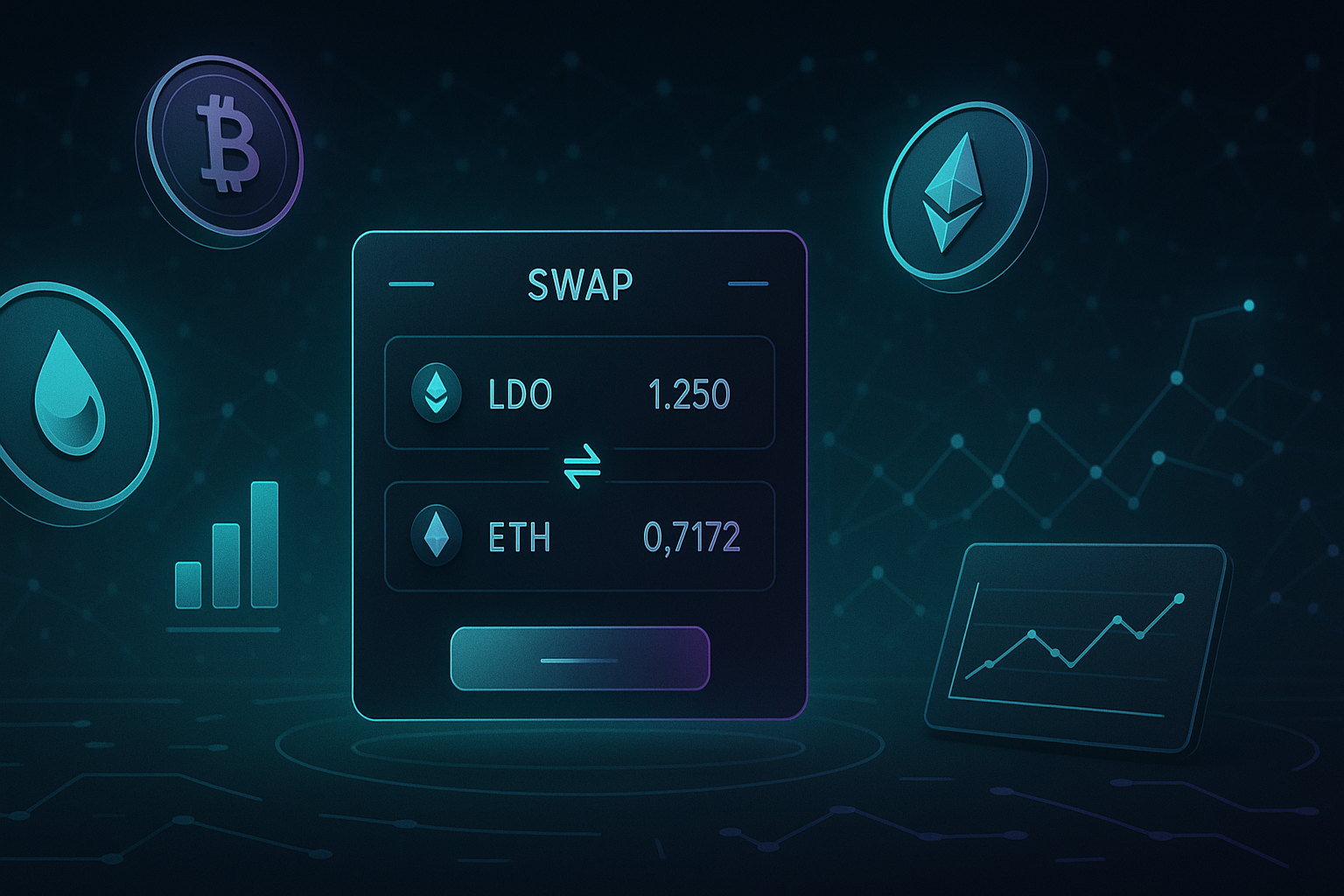
A third option is to use an instant, non-custodial swap service that connects your wallet and finds a route to exchange LDO for ETH without you depositing assets into an exchange account. These services often aggregate prices across liquidity sources, focusing on a quick and simple experience.
For users who value both privacy and control, a swap crypto instantly tool can offer a streamlined way to convert LDO to ETH in one flow, usually with a clear estimate of what you will receive and the fee involved.
Step-by-Step Guide: How to Swap LDO to ETH Safely
Step 1: Decide on Your Strategy
Before you begin, answer these questions:
- How much LDO do you want to convert to ETH?
- Is this a full exit or a partial rebalance?
- What is your main priority: low fees, speed, privacy, or convenience?
- Are you willing to use KYC platforms, or do you prefer non-custodial options?
Your answers will inform whether you pick a CEX, DEX, or private instant swap service.
Step 2: Prepare Your Wallet and Security
- Ensure you have a secure wallet (hardware wallet preferred for significant amounts).
- Verify that your LDO resides on the correct network (typically Ethereum mainnet).
- Maintain enough ETH in the same wallet to cover gas fees if trading on-chain.
- Back up your seed phrase and never share it with anyone.
Step 3: Compare Available Routes
To optimize your LDO to ETH swap, compare:
- Price and slippage: What is the expected ETH you will receive?
- Fees: Trading fee, service fee, and estimated gas cost if applicable.
- Execution method: Instant swap, limit order, or multi-hop DEX trade.
- Counterparty risk: Custodial vs. non-custodial, audited contracts, and reputation.
Instant swap platforms that connect directly to your wallet can be a good middle ground between ease of use and self-custody, especially if they clearly display the expected output and total cost.
Step 4: Connect Your Wallet or Transfer Funds
The exact process depends on the type of platform you choose:
- CEX: Deposit LDO from your wallet to your exchange address, wait for confirmations, then trade LDO to ETH on the spot market.
- DEX: Connect your wallet, approve LDO for spending in the smart contract if required, then execute the swap directly.
- Non-custodial swap service: Connect your wallet and specify that you want to convert LDO to ETH, usually in a single interface that handles routing behind the scenes.
Step 5: Configure Slippage and Review Details
Before hitting confirm:
- Check the quoted rate and minimum amount of ETH you will receive.
- Set a sensible slippage tolerance, especially in volatile markets.
- Review network fees and transaction speed options.
- Ensure you are on the legitimate website or dApp, not a phishing clone.
Step 6: Execute the Swap
Once everything looks correct:
- Confirm the transaction in your wallet.
- Monitor the transaction on a block explorer to ensure it is mined.
- Afterconfirmation, verify that your ETH balance has increased and your LDO balance has decreased as expected.
Step 7: Post-Swap Security and Record-Keeping
- Consider moving large balances to a long-term, secure storage wallet.
- Update your portfolio tracking tools.
- Keep records of the transaction for tax and accounting purposes, including timestamps, amounts, and prices.
Practical Tips for an Efficient LDO to ETH Swap
1. Optimize for Gas Fees
Ethereum gas costs can significantly affect your net outcome, especially for smaller trades. To save on gas:
- Use off-peak times when network demand is lower.
- Check current gas prices on monitoring sites before executing.
- Avoid unnecessarily high priority fees unless you urgently need confirmation.
2. Avoid Using Your Main Wallet Everywhere
For privacy and security, it can help to:
- Use separate wallets for trading activity and long-term storage.
- Limit how many platforms you connect your main wallet to.
- Revoke DEX approvals periodically to reduce potential attack surface.
3. Split Large Swaps into Smaller Parts
If you are swapping a large amount of LDO:
- Consider splitting the swap into several smaller trades to reduce slippage.
- Test with a small amount first to confirm the route and process behave as expected.
- Monitor price movements between each chunk to avoid unexpected volatility.
4. Prioritize Non-Custodial and Private Options When Possible
If you want to stay in control of your keys and reduce data exposure, non-custodial services that support a private exchange model are preferable. They often:
- Let you remain anonymous or pseudonymous
- Do not require account creation or KYC for basic swaps
- Execute trades directly from and to your own wallet
5. Always Double-Check Token Contracts
Fake or malicious tokens can appear with similar tickers. When dealing with LDO and ETH:
- Confirm the official LDO contract address from trusted sources like the Lido website or leading explorers.
- Be cautious of custom token addresses given to you in private messages or unofficial channels.
Conclusion: Making Your LDO to ETH Swap Work for You
Swapping LDO to ETH is more than a simple trade. It is a strategic choice about how you participate in Ethereum, balance risk, and position for the future. By understanding the motivations behind the swap, the advantages of holding ETH, and the trade-offs between CEXs, DEXs, and instant non-custodial services, you can choose the method that best fits your goals and risk tolerance.
Before executing any LDO to ETH swap, take a moment to define your objective, compare routes, and consider how much privacy, control, and flexibility you need. If you prefer to retain full custody and avoid complex order books, using a focused tool for a
non-custodial LDO to ETH swap can provide a streamlined, wallet-to-wallet experience with clear pricing and minimal friction.
By combining sound risk management, attention to fees, and thoughtful platform selection, you can convert LDO to ETH in a way that supports both your near-term trading needs and long-term investment strategy in the Ethereum ecosystem.
Ready to Swap?
Convert your crypto instantly on GhostSwap — no KYC, no sign-up required.
Popular swaps: BTC to XMR | BTC to ETH | XMR to BTC | ETH to XMR | BTC to SOL