Quick answer: to buy Ethereum without KYC, swap a coin you already hold (USDT, BTC, LTC, SOL or XMR) to ETH on a no-account swap service such as GhostSwap. Paste your Ethereum address, send the deposit, and the ETH is paid straight to your own wallet. No sign-up, no wallet connection and no ID upload.
- Install an Ethereum wallet you control (for example MetaMask, Rabby or a hardware wallet) and copy your ETH address.
- Pick the coin you send in the box below and ETH as the coin you receive.
- Paste your ETH address; the quote shows the rate, network fee and the minimum and maximum.
- Send the deposit to the one-time address and receive ETH in your wallet.


By clicking Confirm exchange, you agree to the Privacy Policy & Terms of Service.
Ways to buy Ethereum without KYC, compared
| Method | ID / KYC | Pay with | Speed | Good to know |
|---|---|---|---|---|
| No-account swap (GhostSwap) | None | USDT, BTC, LTC, SOL, XMR and 1,600+ other coins | Minutes after your deposit confirms | Works from any chain; no wallet connection, you just paste an address |
| DEX (Uniswap and similar) | None | Tokens already on Ethereum or a layer 2 | Seconds to minutes | You need ETH for gas first, and funds on the same chain |
| P2P marketplace | Varies by platform | Cash, bank transfer, payment apps | 10–60 minutes | Counterparty risk; escrow matters |
| Crypto ATM | Often required above low limits | Cash | About 30–60 minutes | High fees |
| Card purchase | Yes, by the card provider | Debit or credit card | 15–60 minutes | Not anonymous; see card buying without KYC |
Popular routes: USDT (TRC20) to ETH, BTC to ETH, LTC to ETH, SOL to ETH and XMR to ETH.
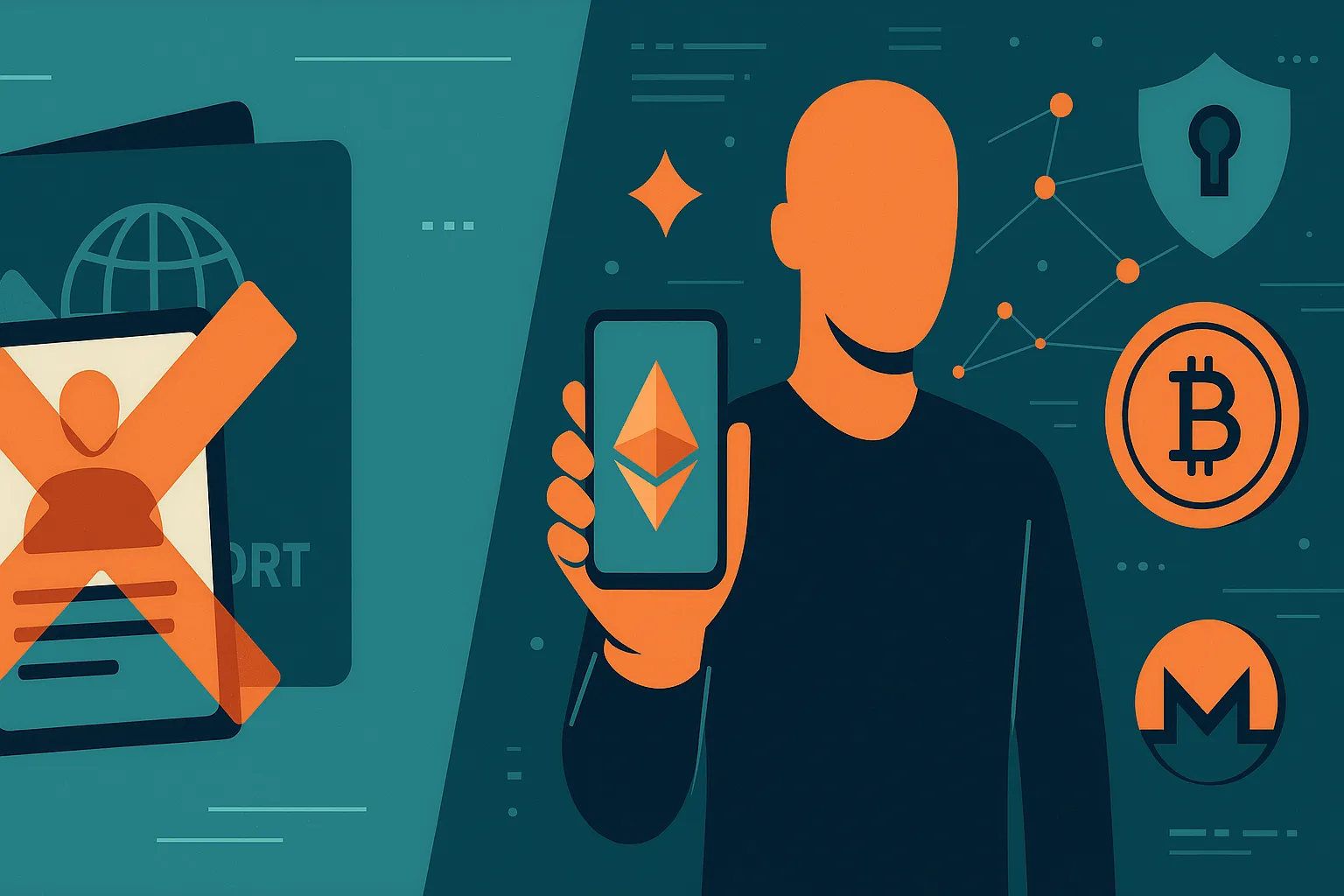
Buying Ethereum has become much easier over the years, but it has also become more invasive. Most major centralized exchanges now require full identity verification, including ID uploads, selfies, and proof of address. For privacy-conscious users, that raises a natural question: can you buy Ethereum without KYC in a safe and responsible way?
The short answer is yes, it is still possible to get ETH without going through traditional Know Your Customer (KYC) checks. However, it requires understanding which tools are available, how they work, and what legal and security considerations apply in your jurisdiction.
This guide explains why people look for non KYC options, the main benefits and risks, and a practical, step-by-step framework you can follow to buy Ethereum without submitting your ID, while keeping safety in mind.
Why Buying Ethereum Without KYC Matters
1. Financial privacy
KYC rules require you to link your real-world identity to your exchange accounts and transactions. Once that data is collected, it can be:
- Shared with third parties such as analytics firms and regulators
- Exposed in data breaches
- Used to build detailed profiles of your financial behavior
Some users believe they have a right to transact without being constantly tracked or profiled, especially when dealing with relatively small amounts of cryptocurrency. For them, non KYC methods are a way to preserve basic financial privacy.
2. Data security and breach risk
Centralized exchanges have become a prime target for hackers, not just for the crypto they hold, but also for the large volumes of sensitive user data they store. When you upload your passport, driver’s license, or utility bill to a KYC platform, you have to trust:
- That the platform is storing and encrypting your data securely
- That employees and contractors will not misuse your documents
- That the platform will notify you in case of a breach
Some users prefer to reduce their exposure entirely by avoiding platforms that require personal identity documents.
3. Access and convenience
For people in certain countries, accessing global exchanges with full KYC can be difficult or impossible. Common issues include:
- Lack of accepted ID documents
- Residence in restricted or sanctioned jurisdictions
- Long KYC approval times or repeated re-verifications
Non KYC methods, when legally allowed, can offer a more straightforward way to get small amounts of ETH quickly, especially if you only need to fund a new wallet or test a DeFi protocol.
Key Benefits of Buying Ethereum Without KYC
1. Stronger privacy by default
The main advantage is that your ETH purchase is not directly linked to a full identity dossier on a centralized exchange. You might still leave some footprints (for example, network metadata or blockchain analysis), but you avoid uploading official documents.
This can:
- Limit how much personal information is tied to a specific wallet
- Reduce your exposure in case of data leaks
- Make it harder to connect your everyday identity to every transaction you make
2. Faster onboarding and fewer friction points
Without KYC, you often skip:
- Document upload and review
- Manual checks and rejections
- Waiting for days to get approved
Many non-custodial swap tools and privacy-focused platforms let you swap crypto instantly with minimal steps. For users who already hold some crypto and simply want to convert it to ETH, this can be significantly faster.
3. Non-custodial control of your funds
Non KYC setups often go hand in hand with non-custodial tools, which means:
- You control your private keys and seed phrases
- There is no centralized entity holding your funds on your behalf
- Counterparty risk from exchange insolvency or withdrawal freezes is reduced
From a self-sovereign finance perspective, this aligns better with the original ethos of cryptocurrencies.
Risks and Drawbacks of Buying Ethereum Without KYC
Buying ETH without KYC is not automatically safer. In some respects, it can be riskier. It is essential to understand the trade-offs.
1. Legal and regulatory considerations
Regulations vary widely by country. In many jurisdictions, buying small amounts of cryptocurrency without KYC is allowed, especially when done through regulated intermediaries that apply other forms of controls.
However:
- Some regions have strict rules about anonymous transactions
- Certain methods (such as cash trades with strangers) can raise legal risks if misused
- Tax obligations still apply regardless of KYC status
You are responsible for understanding and complying with the laws in your location. Non KYC does not mean non taxable or outside legal frameworks.
2. Higher scam and fraud exposure
Methods that do not require KYC sometimes attract scammers, particularly:
- P2P trades with untrusted individuals
- Telegram / Discord OTC groups
- Imposter websites and phony non-custodial services
Without regulated intermediaries and strong oversight, you must rely much more on your own due diligence.
3. Liquidity and pricing limits
Non KYC services and methods often impose:
- Lower transaction limits per trade or per day
- Higher fees or worse exchange rates compared to high-volume centralized exchanges
- Geographical restrictions even if they do not require formal KYC
If you are trying to acquire very large amounts of ETH, non KYC options might be impractical, costlier, or entirely unavailable.
4. No recovery mechanisms
Using non-custodial wallets and permissionless swap tools is powerful, but it comes with responsibility:
- Lose your seed phrase, and you lose access to your funds
- Send funds to the wrong address, and the transaction is generally irreversible
- There is no support desk that can reset your password with a selfie or ID
If you choose to avoid KYC, you need strong operational security habits.
Main Ways to Buy Ethereum Without KYC
Before we walk through a step-by-step guide, it helps to understand the primary categories of tools and methods you might use.
1. Non-custodial swap platforms
Non-custodial swap services let you exchange one cryptocurrency for another directly into your own wallet. They usually:
- Do not hold long-term custody of funds
- Require only an address and a deposit to execute a swap
- Let you use ETH-compatible wallets like MetaMask, hardware wallets, or mobile wallets
Many of these services can be used as a private exchange layer between different coins and Ethereum. They are particularly useful if you already hold crypto elsewhere and want to convert it to ETH without going through a centralized KYC exchange again.
2. Decentralized exchanges (DEXs)
DEXs like Uniswap and others operate as smart contracts on the blockchain. To use them:
- You connect a wallet such as MetaMask
- You approve token spending
- You swap tokens directly on-chain
DEXs are generally non KYC by design, though frontends may sometimes impose regional restrictions. You still need a way to get your initial crypto onto the blockchain, which may involve a separate on-ramp or P2P method.
3. Peer-to-peer (P2P) marketplaces
P2P platforms connect buyers and sellers directly. You can often:
- Pay with local bank transfers, cash, or other methods
- Use escrow provided by the platform
- Trade small amounts with minimal KYC, depending on the platform and local rules
Some P2P platforms now require partial KYC above certain limits. Always read the latest terms and limitations before relying on them.
4. Crypto ATMs
In many cities, Bitcoin and sometimes Ethereum ATMs allow you to:
- Insert cash
- Scan your wallet QR code
- Receive ETH directly to your address
Limits and requirements vary. Some ATMs allow small, low-value purchases without full KYC but may use phone verification or similar checks.
Step-by-Step Guide: How to Buy Ethereum Without KYC
This example workflow focuses on a practical, relatively user-friendly route: using a non-custodial wallet plus a non KYC swap service. It assumes you either already have some crypto or can acquire a starter amount via cash or P2P.
Step 1: Choose and set up a non-custodial wallet
Pick a reputable Ethereum-compatible wallet. Options include:
- Browser wallets like MetaMask
- Hardware wallets such as Ledger or Trezor
- Mobile wallets from well-established providers
Setup checklist:
- Download from the official website or trusted app store
- Create a new wallet and securely write down your seed phrase offline
- Enable extra security features such as PINs, biometrics, or passphrases if supported
- Back up the seed phrase in at least two secure physical locations
Step 2: Acquire initial crypto without KYC (if you do not have any)
To interact with Ethereum or a swap service, you need some crypto as a starting point. If you do not already hold any, consider:
- Crypto ATMs: Check listings in your city and verify machine limits and ID requirements.
- P2P marketplaces: Use platforms with escrow, reputation systems, and clear dispute procedures.
- Local cash trades: Only if you trust the counterparty and it is safe and legal to do so in your area.
You might start with BTC, stablecoins, or other major assets that are easily swappable to ETH.
Step 3: Select a trusted non-custodial swap service
Choose a non-custodial swap platform that:
- Supports your starting cryptocurrency and Ethereum
- Executes swaps directly into your wallet
- Does not require traditional KYC for the amounts you plan to trade
- Has a solid track record, transparent fees, and clear documentation
Many of these services effectively function like a non-custodial bridge, letting you move value between assets while staying in control of your keys.
Step 4: Paste your Ethereum address
Copy the receiving address from your wallet and paste it into the swap. GhostSwap never asks you to connect a wallet or sign anything: you only send a deposit from your own wallet.
Always double check that the address is correct. Consider sending a small test amount first, especially with larger swaps.
Step 5: Configure the swap and confirm details
Before you initiate the transaction, verify:
- Input asset: The coin or token you are sending
- Output asset: ETH or an Ethereum-compatible token
- Estimated rate and fees: Understand the final amount and network fees
If the service offers a preview of the transaction or on-chain route, review it for any red flags.
Step 6: Send your funds and wait for confirmation
Once everything looks correct:
- Send your input crypto to the deposit address provided by the swap service
- Monitor the transaction status on your wallet or via a block explorer
- Wait for the swap to complete and for ETH to arrive in your wallet
Non-custodial services usually complete the swap after a set number of blockchain confirmations on the input asset.
Step 7: Secure and manage your ETH
After the swap:
- Verify your new ETH balance in your wallet
- Consider moving larger amounts to a hardware wallet for additional security
- Record any details you need for tax reporting such as dates, values, and transaction IDs
From this point on, you can use your ETH in DeFi protocols, NFTs, on-chain governance, or simply hold it as a long-term asset.
Practical Tips for Buying Ethereum Without KYC Safely
1. Start with small test amounts
When using a new platform or method for the first time:
- Begin with the minimum viable amount to test the full flow
- Confirm that deposits, swaps, and withdrawals work as expected
- Scale up only after multiple successful transactions
2. Research the service’s reputation
Before trusting any non-custodial swap or P2P marketplace:
- Search for independent reviews and user feedback
- Check how long the service has been operational
- Look at whether they provide clear help documentation and status pages
If a platform claims to be a completely anonymous, no-limits solution with guaranteed profits, treat it with skepticism.
3. Protect your network and device
Even the most privacy-friendly service cannot protect you if your laptop or phone is compromised. Basic hygiene includes:
- Keeping your operating system and browser up to date
- Using a reputable password manager
- Enabling two-factor authentication for related accounts
- Avoiding public Wi Fi for sensitive transactions when possible
4. Understand fee structures and limits
Non KYC methods sometimes come with:
- Higher spreads between buy and sell prices
- Additional network fees for deposits and withdrawals
- Soft or hard limits per transaction or per day
Plan your trades to minimize repeated small fees. In some cases, a single well sized swap can be more economical than multiple tiny ones.
5. Monitor regulatory changes
Crypto regulations evolve quickly. A platform that allowed certain non KYC transactions last year might change its policies. Check regularly for:
- Updated terms of service
- Regional restrictions or geofencing
- New verification thresholds for higher limits
Adjust your approach to stay within the rules of your jurisdiction.
Conclusion: Is Buying Ethereum Without KYC Right for You?
Buying Ethereum without KYC is possible, but it is not a one size fits all solution. It makes the most sense for users who:
- Value financial privacy and control over their data
- Are willing to learn how non-custodial tools and wallets work
- Understand local regulations and their own tax obligations
- Can manage the extra responsibility that comes with self-custody
If that sounds like you, using a combination of a secure wallet, P2P or cash methods for initial funding, and a reliable non-custodial swapping route can provide a structured path to buy Ethereum without KYC. As with any financial decision, take time to research, start small, and prioritize security at every step. For a fast, private option, you can convert ETH to XMR on a non-custodial platform with no account required.
By approaching non KYC Ethereum purchases thoughtfully, you can preserve more of your privacy without compromising on safety or usability.

Buy Ethereum without KYC: FAQ
Can I buy Ethereum without ID?
Yes. Swap a coin you already hold to ETH on a no-account service such as GhostSwap, or buy peer to peer. Card purchases and most centralized exchanges ask for ID.
Do I need to connect my wallet to swap to ETH?
No. On GhostSwap you paste your ETH address and send the deposit from your own wallet. There is no wallet connection and no approval or signature to give.
What is the cheapest way to get ETH without KYC?
Send a coin with low network fees, such as USDT on TRON, LTC or SOL, and receive ETH. Compare the amount you receive after all fees, which the exchange box shows before you send.
Can I get ETH on Arbitrum or Base without KYC?
Yes. GhostSwap lists ETH on Arbitrum, Base and Optimism as separate coins next to ETH on Ethereum, so you can receive ETH directly on those networks. Pick the right network in the coin list and paste an address from that network.
Is buying Ethereum without KYC legal?
In most countries it is legal for you to swap or buy ETH without KYC; the rules apply to businesses and differ by country. Report taxable gains where required.
Ready to swap?
Convert your crypto instantly on GhostSwap, an anonymous crypto exchange, no KYC, no sign-up required.
Popular swaps: BTC to XMR BTC to ETH ETH to BTC USDT (TRC20) to ETH ETH to USDT (TRC20)