How to Do a BTC to LINK Swap Safely and Efficiently
Introduction
Bitcoin and Chainlink are two of the most widely recognized crypto assets in the market. Bitcoin (BTC) is the first and largest cryptocurrency, while Chainlink (LINK) powers one of the leading oracle networks that connects real-world data to smart contracts. As more traders and DeFi users diversify their portfolios, knowing how to execute a smooth btc to link swap has become increasingly important.
Whether you are moving profits from Bitcoin into altcoins, funding a DeFi strategy that requires LINK, or simply rebalancing your holdings, the way you perform this swap can significantly affect cost, privacy, and security. Using a streamlined btc to link swap service can help you avoid unnecessary complexity and save on time and fees.
This guide explains why BTC to LINK swaps matter, the key benefits and risks, and a clear step-by-step process you can follow. It also includes practical tips for keeping your funds safe while getting the most out of your trades.
Why a BTC to LINK Swap Matters
On the surface, swapping BTC for LINK is just another crypto trade. In practice, it can serve several strategic purposes in both trading and long-term investing.
1. Portfolio diversification
Many long-term holders start with Bitcoin as their base asset, then gradually diversify into high-conviction projects that solve different problems. Chainlink is a key infrastructure project for decentralized finance and smart contracts, so moving a portion of BTC into LINK can reduce reliance on a single asset.
2. Access to DeFi and on-chain opportunities
LINK is used in many DeFi protocols as collateral, rewards, or for participation in staking and oracle-related activities. If you want to:
- Provide liquidity in pools that involve LINK
- Participate in yield strategies that pay or require LINK
- Support oracle-based applications on various blockchains
you will first need to convert BTC into LINK, preferably in a way that limits friction and preserves as much value as possible.
3. Tactical trading opportunities
Traders often rotate between BTC and altcoins based on market cycles. If you expect Chainlink to outperform Bitcoin during a certain period, a timely btc to link swap allows you to position accordingly. Later, you might rotate back to BTC if conditions change.
Key Benefits of Swapping BTC to LINK
Swapping BTC for LINK is not just about changing one token for another. How you perform the swap influences cost, speed, and risk. Using a specialized non-custodial swap service or an efficient exchange can bring several benefits.
1. Speed and convenience
Traditional centralized exchanges sometimes require multiple steps:
- Deposit BTC to the exchange
- Wait for confirmations
- Place a market or limit order
- Withdraw LINK to your own wallet
Each step adds time, potential fees, and counterparty risk. In contrast, a dedicated instant swap tool lets you input a BTC address and a LINK address and then handles the conversion in the background. This is especially helpful during high-volatility periods when every minute counts.
2. Maintaining custody of your funds
With a non-custodial swap, you retain control of your private keys throughout the process. You do not need to park funds inside an exchange account which can be an attractive target for hackers. The swap provider only orchestrates the trade while you move funds directly from your wallet to the designated address and receive LINK back into your own wallet.
3. Privacy advantages
Some users prefer not to link extensive personal data with their everyday swaps. While you should always comply with local regulations, using a private exchange for instant swaps can offer a more streamlined process than full KYC onboarding at a major centralized platform. For many small to medium-sized trades, this can be faster and less intrusive.
4. Potentially lower friction and fees
Multiple deposits and withdrawals across different platforms add up in blockchain transaction fees and spread. A direct swap service consolidates steps, which can:
- Reduce the number of on-chain transactions needed
- Limit exposure to unfavorable order book slippage
- Save time that you would otherwise spend navigating multiple interfaces
Risks and Drawbacks to Consider
Every crypto transaction carries some risk. Being aware of the trade-offs will help you choose the safest and most cost-effective way to perform your btc to link swap.
1. Market volatility and slippage
BTC and LINK are both highly volatile. Prices can move quickly between the time you initiate the swap and when it completes. This may result in:

- Receiving fewer LINK tokens than you expected
- Missing out on a better rate that was available moments earlier
Some swap platforms provide rate estimates, fixed-rate quotes for a short window, or slippage controls. Understand how your chosen service handles pricing before sending funds.
2. Counterparty and platform risk
Even with non-custodial tools, you rely on a service provider to perform the conversion. Risks include:
- Service downtime or delays
- Technical issues that slow or complicate the swap
- Unclear or unfavorable terms and fees
Use reputable platforms, read their documentation or FAQs, and start with smaller test amounts when using a new service.
3. Network congestion and transaction fees
Both Bitcoin and the networks on which LINK operates can become congested. When this happens:
- Transaction confirmation times increase
- Network fees rise, cutting into the value you receive
Check current fee levels, and if necessary, adjust the timing of your swap to avoid spikes in costs.
4. Human errors: addresses and amounts
The most common issues in crypto swaps are simple mistakes:
- Sending BTC to an incorrect address
- Mixing up BTC and LINK networks
- Using unsupported address formats
- Entering the wrong amount
These errors are often irreversible. Always double-check addresses, amounts, and network details before confirming any transaction.
Step-by-Step Guide: How to Perform a BTC to LINK Swap
Below is a general workflow you can follow using an instant swap service or similar non-custodial platform. The exact screens will differ depending on the provider, but the process is usually quite similar.
Step 1: Prepare your wallets
- BTC wallet: Ensure you have Bitcoin in a wallet you control (hardware wallet, mobile wallet, or desktop wallet). Confirm that your wallet can send BTC without restrictions.
-
LINK wallet: Decide where you want to receive LINK. Chainlink typically exists as a token on major smart contract networks (commonly ERC-20 on Ethereum, as well as other chains). Make sure your chosen wallet:
- Supports LINK on the desired network
- Provides you with the correct LINK-compatible address
Step 2: Choose a reliable swap service
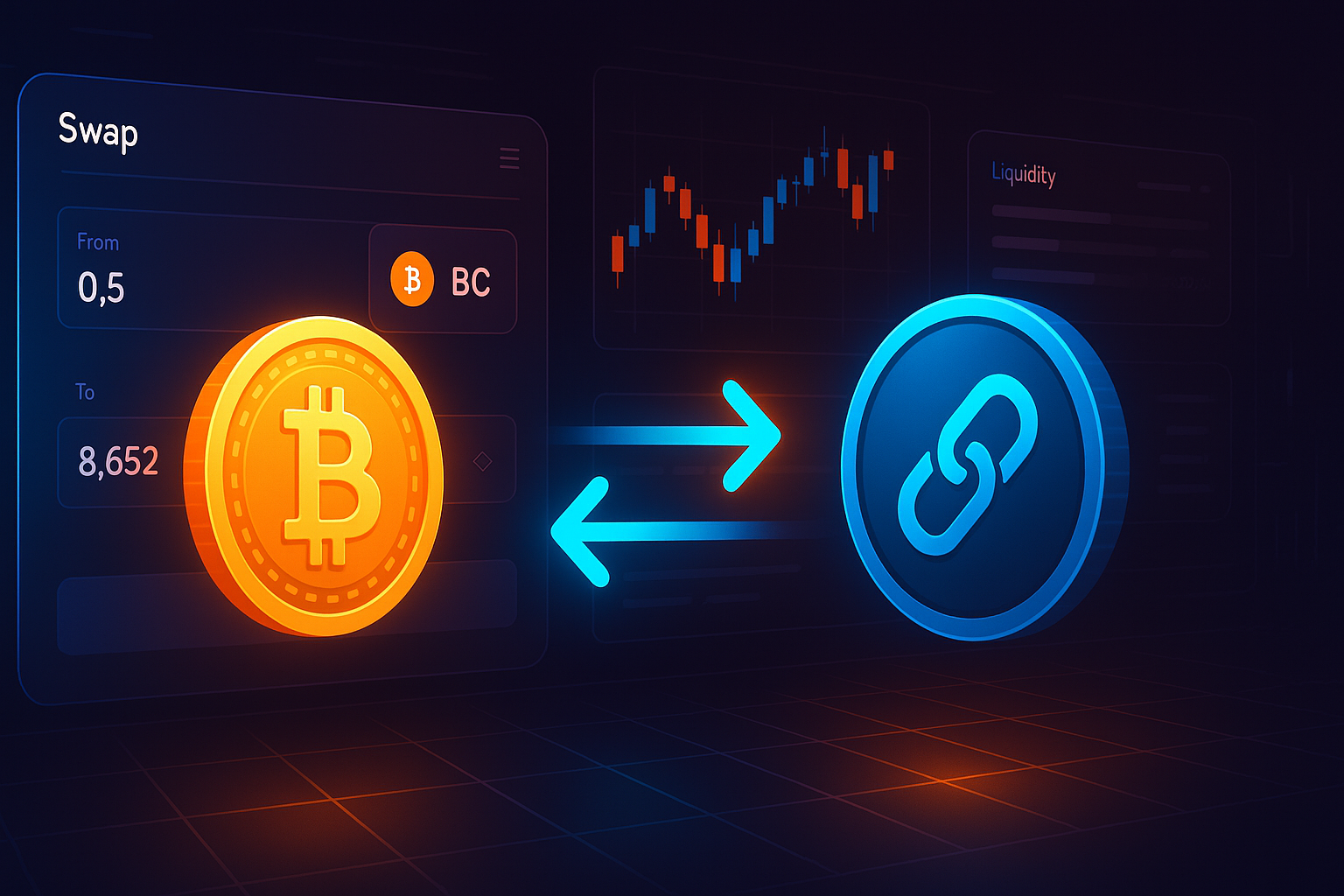
Look for a platform that supports a direct BTC to LINK route, clearly lists fees, and lets you keep control of your keys. A dedicated tool that lets you swap crypto instantly between BTC and LINK can simplify this entire process.
Before proceeding:
- Review any available documentation or FAQs
- Check whether you will receive a floating or fixed rate
- Verify minimum and maximum swap amounts
Step 3: Enter trade details
- Select BTC as the currency you are sending.
- Select LINK as the currency you wish to receive.
- Type in the amount of BTC you want to convert.
- Paste your LINK receiving address carefully.
Some platforms show an estimated amount of LINK you will receive and may also provide an estimated completion time based on network conditions.
Step 4: Confirm terms and generate a deposit address
Once your trade details look correct:
- Review the rate, any stated service fees, and the expected output amount.
- Confirm the swap to generate a unique BTC deposit address for this trade.
Most services generate a one-time address that you must send your BTC to within a specific time window so that the quoted rate or conditions remain valid.
Step 5: Send BTC from your wallet
- Open your BTC wallet and choose “Send”.
- Paste the BTC deposit address provided by the swap service.
- Enter the exact BTC amount you committed to on the swap interface.
- Set an appropriate network fee in your wallet. A higher fee usually means faster confirmation.
- Double-check all details, then broadcast the transaction.
Step 6: Wait for confirmations and receive LINK
The swap service will monitor the Bitcoin network for your deposit. After the required number of confirmations:
- Your BTC is credited on the service side for the swap
- The service executes the conversion into LINK
- LINK is sent to the address you provided
You can track progress using:
- A Bitcoin block explorer for your BTC transaction
- The swap platform’s status page for your order
- A block explorer for the network where your LINK is received
Step 7: Verify the LINK in your wallet
Once the swap is marked as completed:
- Open your LINK wallet to confirm the new balance.
- If you do not see LINK, ensure that:
- The correct token is added or visible in the wallet interface
- You are on the correct network (for example, Ethereum if you received ERC-20 LINK)
Store any transaction IDs and order IDs safely in case you need them for future reference or support.
Practical Tips for a Smooth BTC to LINK Swap
A few simple habits can significantly reduce risk and help you get better outcomes from every swap.
1. Start with a small test transaction
If you are using a new platform or a new wallet setup, send a small amount of BTC first. Confirm that:
- The swap completes as expected
- LINK arrives at the correct address
- Your wallet displays the token properly
Once you are confident in the process, you can proceed with larger swaps.
2. Double-check addresses and networks
Before confirming anything:
- Verify the first and last characters of both BTC and LINK addresses
- Confirm which blockchain your LINK will be on (for example, Ethereum, another EVM chain, or a different supported network)
- Ensure your wallet is compatible with that network and token type
3. Monitor network fees and timing
Transaction fees can vary greatly across days or even hours. To optimize costs:
- Check current Bitcoin network fees through a fee estimator or explorer
- Consider running your swap during lower congestion periods when possible
- Avoid last-minute swaps during extreme volatility unless necessary
4. Understand the pricing model
Different services use different pricing approaches:
- Floating rate: Your final LINK amount is based on the market rate when your BTC deposit is confirmed.
- Fixed rate (time-limited): The platform locks a rate for a short window, provided you send BTC quickly.
Know which model you are using and how it affects your expected outcome, especially in fast-moving markets.
5. Keep good records
Save:
- Transaction hashes (TXIDs) for both BTC and LINK
- Order IDs or reference numbers from the swap platform
- Timestamps and amounts
These records are useful for personal tracking, tax reporting, and any support inquiries you may need to make later.
Conclusion
A btc to link swap is more than just trading one token for another. It is about rebalancing your portfolio, accessing DeFi opportunities, and aligning your holdings with your market outlook. By understanding the benefits, the potential risks, and the exact process, you can move between BTC and LINK with confidence.
Using a trusted non-custodial platform for a btc to link swap on a private exchange can streamline the experience, help you maintain control of your keys, and reduce friction compared with traditional custodial exchanges. Combine that with careful attention to addresses, fees, and timing, and you will be well positioned to manage your BTC and LINK positions both safely and efficiently.
As with all crypto activity, always do your own research, verify the platforms you use, and never risk more than you can afford to lose.
Ready to Swap?
Convert your crypto instantly on GhostSwap — no KYC, no sign-up required.
Popular swaps: BTC to XMR | BTC to ETH | XMR to BTC | ETH to XMR | BTC to SOL