LTC to BTC Swap: How to Exchange Litecoin for Bitcoin Quickly and Safely
Introduction
Litecoin and Bitcoin are two of the most established cryptocurrencies in the market. Many traders, investors, and crypto users regularly move value between them, which makes knowing how to perform an efficient LTC to BTC swap an essential skill. Whether you are rebalancing your portfolio, taking profit, or preparing to pay in BTC, doing this swap correctly can save you time, fees, and frustration.
Today, you no longer need a complicated trading interface or a centralized exchange account to convert LTC to BTC. Modern non-custodial services let you perform an LTC to BTC swap directly from your wallet, often without registration and with strong privacy protections.
This guide explains what an LTC to BTC swap is, why it matters, key benefits and risks, how to do it step by step, and practical tips to avoid common mistakes. The goal is to help you swap Litecoin for Bitcoin confidently, using methods that match your risk tolerance and technical comfort level.
Why LTC to BTC Swaps Matter
On the surface, converting Litecoin to Bitcoin may sound like a simple trade. In practice, it has broader implications for how you manage your crypto assets, your exposure to market volatility, and your overall strategy.
Managing Market Volatility
Crypto markets move fast. Some traders hold Litecoin for short to medium-term moves, then convert to Bitcoin as a longer-term store of value. An efficient LTC to BTC swap allows you to:
- Lock in profits after a Litecoin price surge
- Reduce exposure to altcoin volatility
- Rotate into what many consider a “blue-chip” crypto asset
Portfolio Rebalancing and Strategy
If you follow any kind of portfolio allocation strategy, there will be times when your LTC position grows relative to BTC. Rebalancing often involves converting a part of your Litecoin into Bitcoin to restore your target ratio. A smooth swap process makes that rebalancing quick and consistent.
Access to Liquidity and Ecosystem
Bitcoin remains the most widely accepted cryptocurrency globally. You may need BTC, not LTC, to:
- Pay certain service providers
- Fund trading accounts or derivatives platforms
- Use BTC-based DeFi or custodial products
This is why an LTC to BTC swap is frequently a step in a broader transaction flow, not just a speculative move.
Key Benefits of Swapping LTC to BTC
Different methods of performing an LTC to BTC swap have different pros and cons. Using a modern non-custodial swap service can offer several advantages compared to traditional exchanges.
1. Speed and Convenience
Non-custodial swap platforms let you exchange LTC for BTC directly from your wallet. Advantages include:
- No full KYC account setup in many cases so you are not stuck waiting for ID checks to clear
- Faster execution because you avoid order books and complex trading screens
- Simplified UX ideal for users who just want to convert LTC to BTC once in a while
2. Security and Self-Custody
On a centralized exchange, you must deposit LTC, trust the platform’s security, and then withdraw BTC later. With a non-custodial swap, you retain control over your private keys for as much of the process as possible. This can reduce exposure to:
- Exchange hacks or insolvency
- Frozen accounts or withdrawal delays
- Unwanted security trade-offs in hot wallets
Maintaining self-custody aligns with a core crypto principle: “not your keys, not your coins.”
3. Privacy and Less Data Sharing
Many users care about their financial privacy. Some swap platforms act as a private exchange solution, asking for only the minimum data required to process a swap. While you still need to follow your local regulations, using services that do not require full account creation can reduce your overall data footprint.
4. Competitive Rates
Non-custodial LTC to BTC swaps can offer rates comparable to centralized exchanges, especially when you factor in:
- Network fees
- Maker/taker trading fees
- Withdrawal fees from exchanges
When you add up all these costs, an instant swap can sometimes be more cost-effective than a multi-step centralized exchange route.
Risks and Drawbacks to Consider
No LTC to BTC swap method is completely risk-free. To use these tools smartly, it is important to understand the main drawbacks and how to mitigate them.
1. Price Slippage
Slippage happens when the final rate you receive differs from the quoted rate. This can occur due to:
- Rapid market movements between the time of quote and execution
- Insufficient liquidity for large trades
Mitigation strategies include:
- Swapping during periods of lower volatility
- Breaking a very large swap into smaller parts
- Using platforms that provide clear rate and fee information up front
2. Network Fees and Confirmation Times
Both Litecoin and Bitcoin networks have their own transaction fees and confirmation times. When performing an LTC to BTC swap, you might face:
- Higher BTC network fees during congested periods
- Longer waiting times for required confirmations
To minimize this:
- Check current network conditions for both LTC and BTC
- Avoid peak congestion periods when possible
- Use reasonable, not minimum, network fee settings in your wallet
3. Platform Risk
Not all swap platforms are created equal. Some risks include:
- Poor security standards
- Lack of transparency around fees and rates
- No clear support or recourse if something goes wrong
Always research a platform, look for user reviews, and test it with a small amount before trusting it for significant swaps.
4. Regulatory and Tax Considerations
In many jurisdictions, an LTC to BTC swap is a taxable event, similar to selling LTC for fiat and then buying BTC. You are responsible for:
- Tracking the cost basis of your LTC
- Recording the value of BTC received
- Reporting gains or losses according to local law
Using tools that provide transaction histories can make tax reporting easier.
Step-by-Step Guide: How to Perform an LTC to BTC Swap
Below is a general process for doing a non-custodial LTC to BTC swap using an instant swap platform. Details may differ across services, but the main steps are similar.
Step 1: Choose a Reliable Swap Service
Select a platform that supports an LTC to BTC swap with a non-custodial flow. Look for:
- Clear interface and transparent fee structure
- Publicly documented process and support options
- Positive user feedback and reasonable track record
Step 2: Prepare Your Wallets
You will need:
- A wallet holding the LTC you want to swap
- A Bitcoin wallet address to receive the BTC
Verify that you control the BTC address and double-check its accuracy. Copy and paste, then visually confirm the first and last few characters before using it in any swap service.
Step 3: Enter Swap Details
On the swap platform:
- Select the trading pair: LTC → BTC.
- Enter the amount of LTC you want to convert, or the amount of BTC you want to receive if the platform supports “reverse” quoting.
- Review the quoted rate, estimated amount of BTC, and any displayed service fee.
Take a moment to compare this quote with market prices on major exchanges so you understand how competitive it is, factoring in saved withdrawal fees and time.
Step 4: Provide Your BTC Receiving Address
Paste your Bitcoin wallet address into the receiving field. Double-check it carefully. Errors here can be irreversible. Many users send a small test transaction first when dealing with new wallets or large amounts.
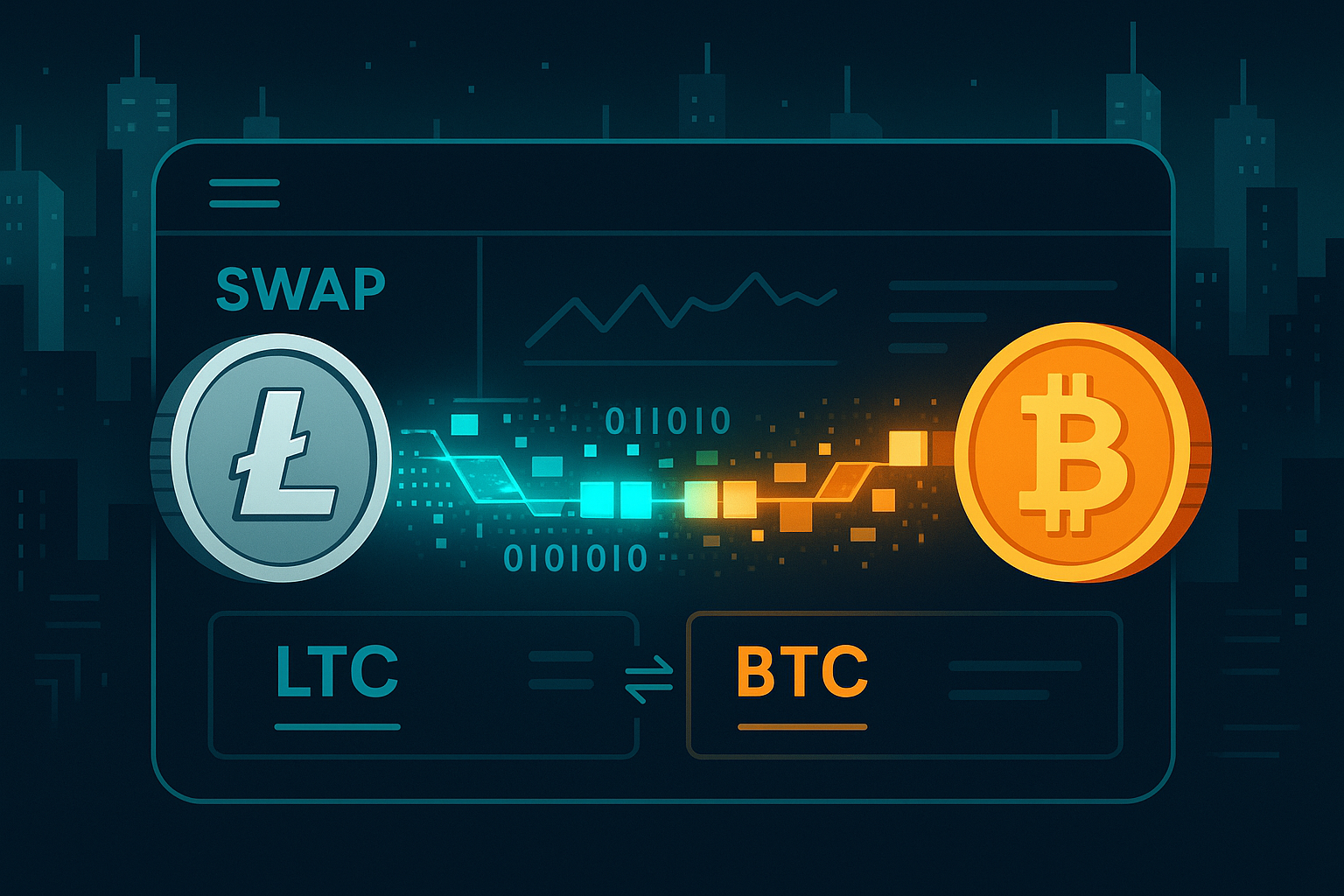
Step 5: Generate the Deposit Address and Send LTC
Once you confirm the details, the platform will generate a unique LTC deposit address for your swap. Then:
- Open your Litecoin wallet.
- Send the specified amount of LTC to the deposit address.
- Set an appropriate network fee in your LTC wallet so the transaction confirms in a reasonable time.
The platform will wait for the required number of Litecoin confirmations before executing the swap on its side.
Step 6: Wait for the Swap to Complete
After your LTC transaction is confirmed on-chain:
- The service executes the LTC to BTC swap internally.
- It sends the resulting BTC to your specified Bitcoin address.
- You can track the progress on the platform’s status page or via transaction IDs.
Final completion time depends on both Litecoin and Bitcoin network conditions, but non-custodial swaps are typically faster overall than moving funds via centralized exchanges.
Step 7: Verify Receipt of BTC
When the platform shows your swap as complete:
- Open your BTC wallet and confirm the incoming transaction.
- Optionally, look up the BTC transaction hash on a block explorer for extra verification.
Once the Bitcoin transaction has sufficient confirmations, your LTC to BTC swap is finalized.
Practical Tips for Safer and Smarter LTC to BTC Swaps
1. Start Small if You Are New
If it is your first time using a particular platform, start with a smaller amount of LTC. This lets you check the full process end to end without risking a large balance.
2. Double-Check Addresses and Networks
Crypto transactions are irreversible. Before confirming any swap:
- Verify you are sending LTC on the Litecoin network, not a wrapped token on another chain.
- Confirm your BTC receiving address is correct and belongs to a wallet you control.
3. Monitor Network Conditions
High congestion on the Bitcoin network can raise fees and slow confirmations. You can:
- Check LTC and BTC mempool status and suggested fee rates
- Avoid very busy periods if your swap is not time-sensitive
4. Compare Effective Total Cost
Instead of only focusing on the headline exchange rate:
- Add service fees, network fees, and potential exchange withdrawal fees if you compare with centralized platforms.
- Include your time cost and convenience in the calculation.
5. Keep Records for Tax and Tracking
Maintain a simple log of your swaps:
- Date and time
- Amount of LTC sent and BTC received
- Quoted rate and fees
- Transaction IDs for both chains
This helps with tax reporting and lets you analyze how efficient your swaps are over time.
6. Use Reputable, Non-Custodial Services
Whenever possible, choose platforms that let you swap crypto instantly with a non-custodial flow, keeping your coins in your own wallets rather than on centralized ledgers. Always verify URLs, avoid links from unsolicited messages, and bookmark the correct site to reduce phishing risks.
Conclusion
An LTC to BTC swap is more than a simple trade between two cryptocurrencies. It is a crucial tool for managing volatility, rebalancing portfolios, and accessing the broader Bitcoin ecosystem. By understanding the benefits, recognizing the risks, and following a clear step-by-step process, you can convert Litecoin to Bitcoin efficiently and with greater confidence.
Focus on security, privacy, and transparency when choosing how to execute your swap. Non-custodial services that respect your self-custody and data can provide a practical balance between ease of use and robust control over your funds. The next time you decide to move value from Litecoin into Bitcoin, using a well-designed LTC to BTC swap service can help you complete the process quickly, safely, and with competitive rates.
Ready to Swap?
Convert your crypto instantly on GhostSwap — no KYC, no sign-up required.
Popular swaps: BTC to XMR | BTC to ETH | XMR to BTC | ETH to XMR | BTC to SOL