What Is Slippage in Crypto? A Complete 2026 Guide for Traders
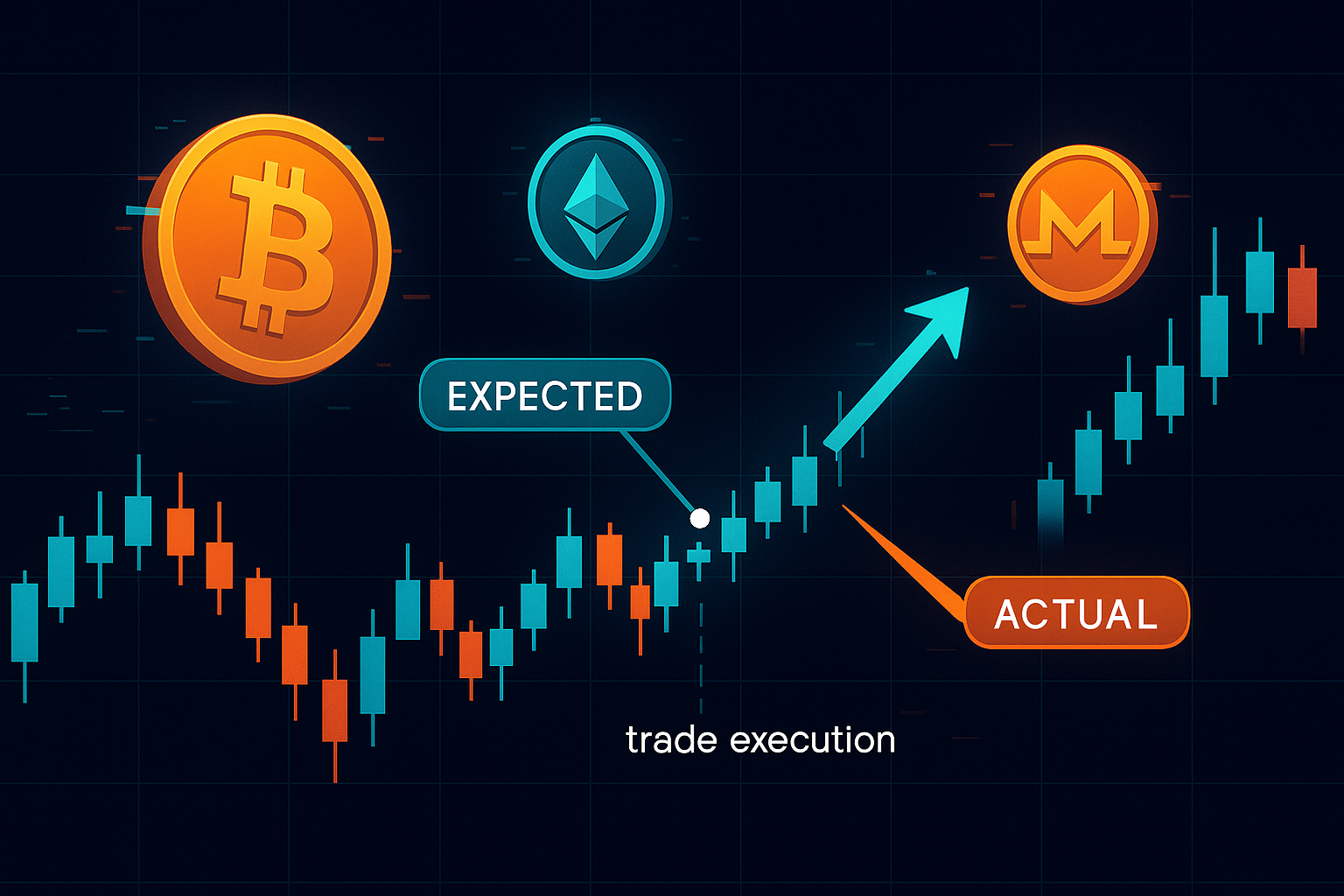
Deslizamento em criptomoedas is the difference between the price you expect when placing an order and the actual price you get when the trade executes. It happens because crypto prices move quickly and order books or liquidity pools cannot always fill your trade at the exact quoted rate.
If you trade on instant swap platforms like Troca de fantasmas, understanding how slippage works is essential for avoiding unpleasant surprises and managing your risk.
O que é Slippage em Criptomoedas? Explicado de forma simples.
At its core, slippage is a small price “surprise” that happens between the moment you click “swap” or “buy” and the moment your trade actually goes through.
You might see a quote like “1 ETH = 2,800 USDT” and expect to get that exact rate. By the time your transaction is confirmed, you might instead receive 2,790 USDT or 2,810 USDT. That difference is slippage.
Sometimes slippage works in your favor and you get a slightly better price. More often, traders worry about derrapagem negativa, where you receive less than expected. In fast-moving crypto markets, slippage is normal, but it should never be ignored.
Understanding what is slippage in crypto is about recognizing that the market is constantly moving, so the “snapshot” price you see is not guaranteed unless the platform or protocol specifically locks it in.
Como funciona o slippage em criptomoedas?
To understand how slippage happens, you need a basic picture of how trades are filled behind the scenes.
Livros de ordens versus pools de liquidez
Centralized exchanges and some DEX frontends use livros de encomendas. These are lists of buy and sell orders at different prices. When you place a market order, the system matches you with the best available price in the book.
If your order is small and the book is deep, you get filled close to the last traded price. But if liquidity is thin or your order is large, your trade “walks up” or “walks down” the book, filling at progressively worse prices. The blended rate you get is different from the price you first saw, which creates slippage.
On many DeFi platforms and non-custodial swap services, trades route through criadores de mercado automatizados (AMMs) like Uniswap or Curve. These use pools de liquidez and price assets based on a formula such as the constant-product curve (x * y = k).
When you trade against a pool, your swap changes the ratio of tokens in the pool. This immediately shifts the price. If your trade is a large percentage of the pool, the price change is larger, which again shows up to you as slippage.
Market volatility and confirmation delay
Crypto prices can move significantly even within a single block.
On blockchains like Ethereum, there is a delay between when you sign and broadcast your transaction and when miners or validators include it in a block. During that time, the market price can move up or down due to new information, large orders, or bot activity.
By the time your swap executes, the on-chain price may be different from when you submitted the transaction. This time gap is another key driver of slippage in crypto trading.
Configurações de tolerância de deslizamento
Most DEX interfaces and instant swap services allow you to set a tolerância ao deslizamento. This is the maximum price deviation you are willing to accept for your trade to go through.
- If actual slippage stays within your tolerance, the trade executes.
- If it exceeds your tolerance, the transaction reverts or fails.
For example, if you set a 1% slippage tolerance when buying a token and the market moves against you by 0.8%, the swap will still complete. If it moves by 1.5%, the transaction will usually fail, protecting you from an unexpectedly bad fill.
Positive vs negative slippage
Slippage can go both ways:
- Deslizamento negativo: You receive less of the token than originally quoted or pay more than expected. Traders usually try to minimize this.
- Deslizamento positivo: You receive more of the token than quoted or pay less. Some platforms pass this benefit to users; others keep the difference as part of their business model.
Whether you trade via a non-custodial swap like Troca instantânea de criptomoedas da GhostSwap engine or directly on-chain, the mechanics of slippage are driven by these same factors: liquidity depth, price impact, and market movement during confirmation.
Por que a derrapagem (slippage) é importante no mercado de criptomoedas?
Understanding what is slippage in crypto matters because it has a direct impact on how much you actually receive from each trade and how reliably your strategies perform.
Impact on trade execution and costs
Even small amounts of negative slippage effectively act as an extra hidden fee.
If you plan to pay a 0.3% trading fee but suffer 1% slippage, your real cost is closer to 1.3%. Over many trades, this can significantly reduce your net returns, especially for active traders and arbitrage strategies.
Risk management for volatile tokens
High-volatility coins and low-liquidity tokens are especially prone to slippage.
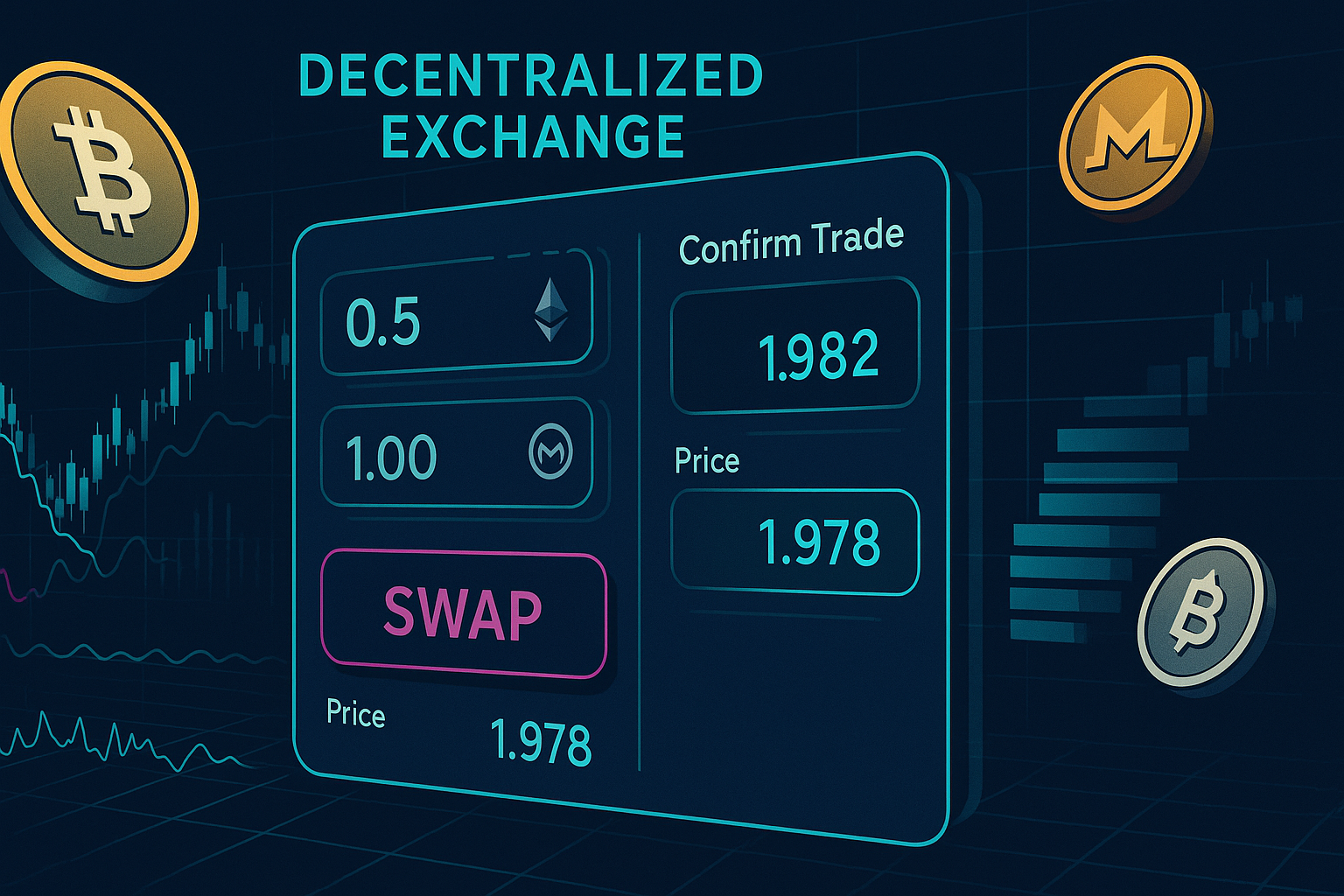
When you trade micro-cap or newly launched tokens, even a moderate trade size can move the price materially, leaving you with far fewer tokens than you expected. Setting conservative slippage tolerance and sizing trades appropriately can help you avoid disastrous fills.
Strategy performance and backtesting
Algorithmic traders and quant strategies must model slippage realistically. Backtests that ignore slippage and trading friction will almost always overstate performance.
Even retail traders using simple DCA or swing trading approaches should factor in some average slippage per trade when estimating long-term results.
Líderes e MEV
On public blockchains, bots and sophisticated traders can observe pending transactions in the mempool and attempt to profit through front‑running ou mais amplo MEV (Miner/Maximal Extractable Value) estratégias.
These activities can worsen your slippage, especially during periods of intense on-chain activity. While the technical details are complex, the takeaway is simple: busy chains and hot tokens often experience higher slippage because of bot competition.
You can swap BTC, ETH, USDT and 1,500+ other coins on GhostSwap without KYC, while keeping a close eye on the effective rate you receive after slippage.
Deslizamento em Criptografia: Exemplos e Casos de Uso
Seeing concrete examples makes it easier to internalize how slippage affects real trades.
Example 1: Small BTC trade with low slippage
Suppose 1 BTC is trading at 60,000 USDT on a large, liquid pool as tracked on CoinGecko.
You decide to swap 0.01 BTC for USDT using a market order. Because Bitcoin has deep liquidity, your trade is tiny compared to the pool. The executed price might be 59,985 or 59,980 USDT per BTC, giving you around 599.8 USDT instead of 600 USDT.
Here, slippage is small (0.02% to 0.03%) and practically negligible for most users.
Example 2: Mid-cap altcoin during volatility
Now consider a mid-cap altcoin with thinner liquidity. According to CoinMarketCap, its average daily volume is much lower than BTC’s.
You attempt to buy $5,000 worth with a market order right after a big news announcement. As other traders are also rushing in, the order book is moving quickly.
Your initial quote suggests a price of $2.50 per token, but the actual fill ends up closer to $2.60. That is a 4% negative slippage, which can materially alter your expected profit if you planned a short-term trade.
Example 3: Low-liquidity DeFi token on a DEX
You discover a new DeFi token trading in a Uniswap-like AMM pool. The total liquidity in the pool is only $100,000.
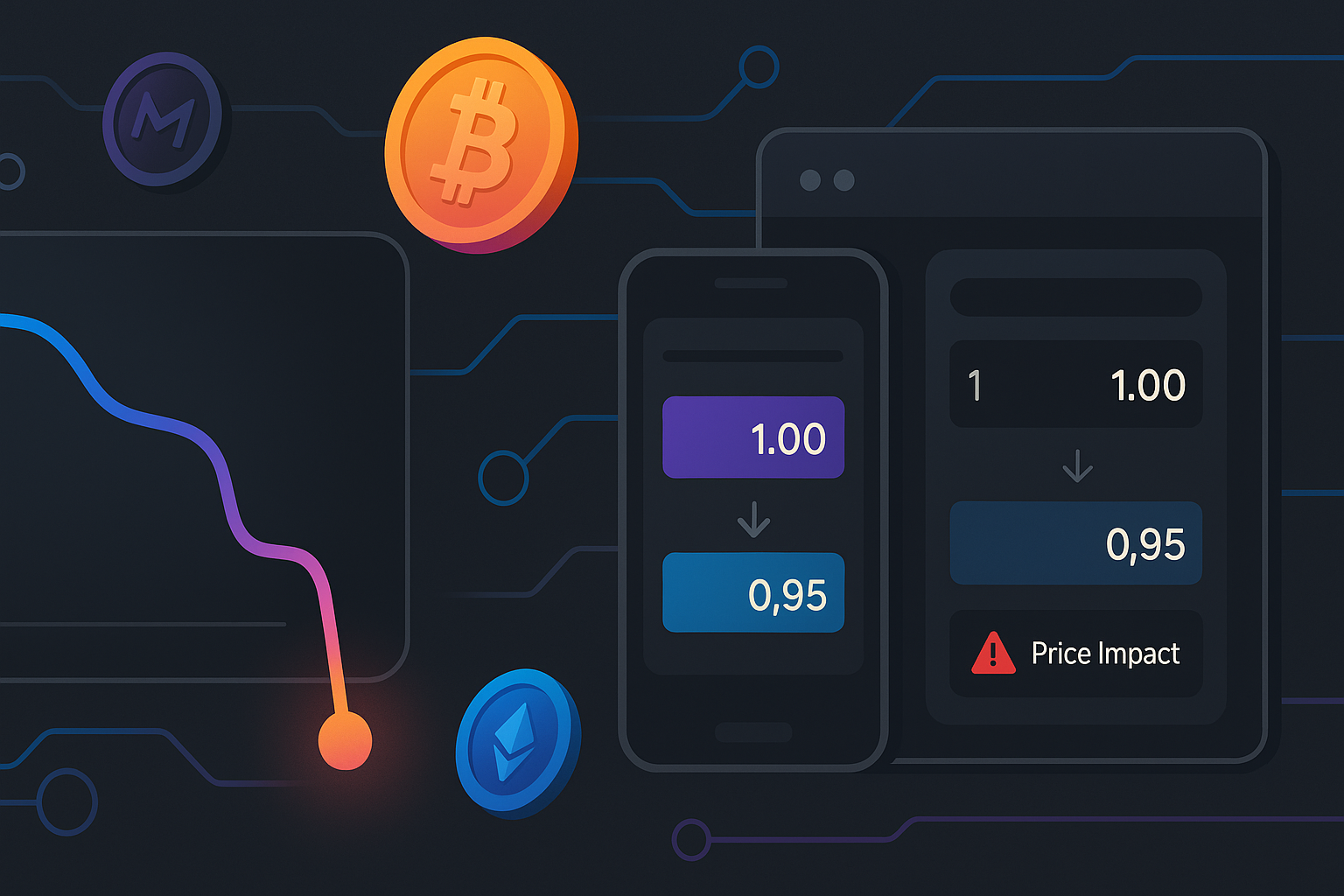
You try to buy $10,000 worth, which is 10% of the pool’s value. Because your trade meaningfully alters the token ratio in the pool, the price curve moves sharply. The “price impact” shown in the interface might be 5% or more.
Even if no one else trades at that moment, you experience large slippage simply from your own order size relative to the pool.
Example 4: Stablecoin swap with low slippage
Stablecoin pools such as USDC/USDT or DAI/USDT on specialized AMMs are designed to minimize slippage for coins that should trade near $1.00.
If you trade $50,000 between major stablecoins in a deep liquidity pool, slippage might be only a few basis points (0.02% to 0.05%), making them ideal for large transfers and arbitrage.
Example 5: NFT or on-chain token launch snipe
During token launches or new NFT mints, some traders set very high slippage tolerance (5% or more) to ensure their transaction is accepted, even if the price spikes.
While this can help get into hot launches, it also opens the door to extreme negative slippage. If bots move first and push the price up, late buyers can end up paying far more than intended before the transaction fails or settles.
Pros and Cons of Slippage in Crypto Trading
Slippage is not inherently good or bad. It is a side effect of how markets work, but it comes with trade‑offs.
Benefits and “pros” of slippage
- Descoberta eficiente de preços: Slippage reflects real supply and demand, helping markets find fair prices quickly.
- Execução mais rápida: Accepting some slippage via market orders can ensure your trade fills quickly, rather than waiting for a limit order that might never hit.
- Oportunidades positivas de deslize: In some cases, especially with falling prices or thin books, you may end up paying less or receiving more than you expected.
- Necessary for liquidity providers: Slippage and price impact are part of what rewards liquidity providers in AMMs, because they earn fees for taking the other side of your trade.
Drawbacks and “cons” of slippage
- Hidden trading costs: Negative slippage increases the real cost of trading beyond visible fees.
- Incerteza nos resultados: You can never know the exact fill price in advance for a market order, which complicates planning.
- Vulnerability to bots and MEV: High slippage tolerance can be exploited by front‑running, leading to worse execution.
- Strategy degradation: Trading strategies that look profitable on paper may fail in practice once slippage is taken into account.
Como o Slippage se relaciona com a negociação no GhostSwap
GhostSwap é um swap não custodial platform that aggregates liquidity across multiple sources to offer competitive crypto exchange rates without requiring sign‑ups or KYC.
When you execute an instant swap on GhostSwap, the platform’s routing logic selects the best available paths across integrated liquidity pools and DEXes. This routing helps minimize slippage by:
- Splitting large trades across multiple pools to reduce price impact
- Avoiding thin-liquidity routes when better alternatives exist
- Quoting you a clear expected rate before you confirm the swap
Even with smart routing, slippage cannot be eliminated entirely, especially for large orders or highly volatile tokens. What matters is that you stay aware of the effective rate you receive and the potential range of outcomes.
Porque o GhostSwap é um troca privada style, non-custodial swap service, you never deposit funds into a centralized account. You simply connect your wallet, choose your assets, and swap crypto instantly while retaining full control of your keys.
Pronto para começar a negociar?
If you understand what is slippage in crypto and how to manage it, you are better prepared to trade confidently on non-custodial platforms.
On GhostSwap.io, you can swap crypto instantly across 1,500+ pairs, monitor your effective rate in real time, and keep custody of your assets at all times.
Start by testing a small trade, observing any difference between the quoted and executed rate, and then scale up as you become comfortable with how slippage behaves for your preferred coins.
Perguntas frequentes
What is acceptable slippage in crypto trading?
Acceptable slippage depends on your strategy, time horizon, and the asset’s liquidity.
For major coins like BTC and ETH, many traders target slippage below 0.5%, and often much less on deep venues. For small-cap or newly launched tokens, 1% to 3% slippage might be common, though anything higher should be treated with caution.
As a rule of thumb, set the lowest slippage tolerance that still lets your transaction reliably go through, and increase it only when necessary.
How can I reduce slippage in crypto?
You can reduce slippage by trading during higher liquidity periods, avoiding thin markets, and splitting large orders into several smaller ones.
Using limit orders where available, choosing stablecoin or blue-chip pairs, and avoiding chasing pumps immediately after big news also helps. On non-custodial swap platforms, check the “price impact” or quoted rate carefully before confirming.
Why do DEXs ask me to set a slippage tolerance?
DEXs and swap interfaces ask for slippage tolerance because prices can move between the time you sign your transaction and the time it hits the blockchain.
The tolerance value tells the smart contract how much deviation from the quoted price you are willing to accept. If the actual execution would be worse than your tolerance, the transaction reverts, protecting you from extreme negative slippage at the cost of a failed transaction (and sometimes gas fees).
Is slippage the same as fees?
No. Slippage and fees are related but distinct.
Fees are explicit costs charged by exchanges, protocols, or validators, usually shown as a percentage or fixed amount. Slippage is the difference between the expected and actual execution price, caused by market movement and liquidity conditions.
When evaluating the real cost of a trade, you should account for both visible fees and any negative slippage.
What is price impact vs slippage?
Impacto no preço is the theoretical change in price caused by the size of your trade relative to available liquidity, often shown before you execute.
Derrapagem is the realized difference between the price you expected and the price you actually got after all factors, including price impact and market movement during confirmation.
High price impact almost always leads to higher negative slippage, which is why large trades in shallow pools can be so costly.